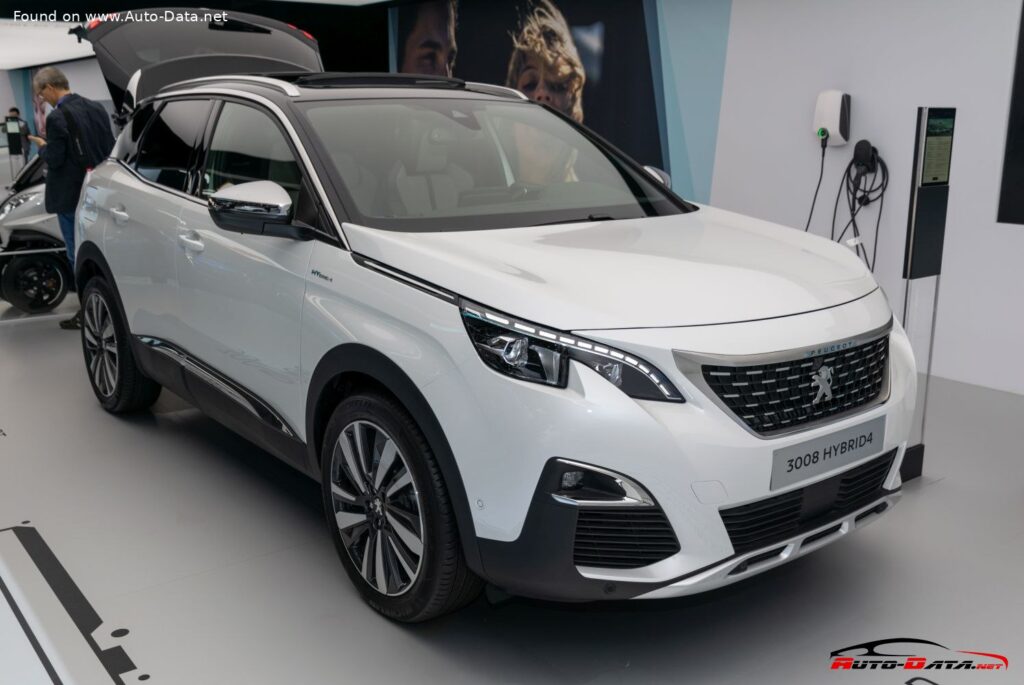
The Peugeot 3008 II (Phase I, 2016) 1.6 BlueHDi (100 Hp) S&S represents a pivotal moment for the French automaker, marking its ambitious transition from a compact multi-purpose vehicle (MPV) to a full-fledged compact crossover SUV. Launched in 2016 as the initial phase of its second generation, this model quickly garnered international acclaim, including the prestigious European Car of the Year award in 2017. Designed primarily for the competitive European market, the 3008 II stood out with its bold styling, upscale interior, and a strong emphasis on efficiency, particularly with its advanced BlueHDi diesel powertrains. This specific variant, featuring the 1.6-liter BlueHDi engine with 100 horsepower and a Start & Stop system, was positioned as an economical yet capable option within the lineup, catering to a broad segment of buyers seeking a stylish, practical, and fuel-efficient family vehicle.
Engine & Performance: The Efficient Heart of the Peugeot 3008 II (Phase I, 2016)
At the core of this Peugeot 3008 II (Phase I, 2016) variant is the 1.6-liter BlueHDi (BHY DV6FD) diesel engine, a testament to Peugeot’s commitment to modern, efficient powertrain technology. This inline four-cylinder engine, with a displacement of 1560 cubic centimeters (95.2 cubic inches), is equipped with a turbocharger and intercooler, ensuring a responsive power delivery despite its modest displacement. It generates a peak output of 100 horsepower at 3750 revolutions per minute, complemented by a robust 254 Newton meters (187.34 lb.-ft.) of torque available from a low 1750 rpm. This low-end torque is particularly beneficial for urban driving and provides ample pulling power for a vehicle of its size.
The engine’s advanced common rail diesel fuel injection system, combined with Peugeot’s BlueHDi technology, an integrated Start & Stop system, and a particulate filter, ensures compliance with the stringent Euro 6 emission standards. This focus on environmental performance is coupled with impressive fuel economy figures. The 3008 II 1.6 BlueHDi achieves an estimated combined fuel consumption of 4.0-4.2 liters per 100 kilometers, translating to an excellent 56-58.8 US miles per gallon. Urban consumption ranges from 52.3 to 56 US mpg, while extra-urban driving can see figures climb to an impressive 57.4 to 61.9 US mpg. These numbers underscore its appeal as a cost-effective daily driver in markets where diesel remains popular.
Power is delivered to the front wheels via a five-speed manual transmission, a common setup for efficiency-focused models in this segment. While not a performance-oriented SUV, the 3008 II 1.6 BlueHDi offers adequate acceleration for everyday driving, reaching 60 miles per hour from a standstill in a calculated 12.4 seconds. Its top speed is rated at 174 kilometers per hour, or approximately 108.12 mph. The vehicle’s weight-to-power ratio stands at 12.9 kilograms per horsepower (77.5 Hp/tonne), reflecting its emphasis on balanced performance and economy.
Design & Features of the Peugeot 3008 II (Phase I, 2016)
The second-generation Peugeot 3008 II (Phase I, 2016) made a significant splash with its radical departure from its predecessor’s design. It adopted a distinctly SUV-like silhouette, characterized by sharp lines, a prominent grille, and a high waistline, giving it a commanding road presence. As a five-door, five-seat compact SUV, it offers a practical and versatile package for families and individuals alike. Its dimensions—175.08 inches in length, 72.48 inches in width (82.6 inches including mirrors), and 63.58 inches in height—contribute to a compact footprint that remains maneuverable in urban environments while providing ample interior space. The generous 105.31-inch wheelbase further enhances ride comfort and stability.
One of the most lauded aspects of the 3008 II was its interior, specifically Peugeot’s innovative i-Cockpit. This feature defined the cabin experience, offering a small-diameter steering wheel, a configurable 12.3-inch digital instrument cluster (head-up display style), and a central touchscreen infotainment system. This ergonomic and futuristic layout aimed to provide an immersive and intuitive driving experience. The interior design emphasized quality materials and a premium feel, setting it apart from many competitors in its class.
Practicality was a key consideration, with a minimum trunk capacity of 520 liters (18.36 cubic feet), expanding to a substantial 1482 liters (52.34 cubic feet) with the rear seats folded. This cargo versatility makes it well-suited for various lifestyles, from daily commutes to weekend adventures. The vehicle’s ground clearance of 8.62 inches, coupled with approach and departure angles of 20° and 29° respectively, hints at its capability to handle light off-road excursions or challenging urban terrain.
In terms of chassis and safety, the 3008 II employs an independent McPherson strut front suspension with coil springs and an anti-roll bar, paired with a semi-independent rear suspension with coil springs. This setup provides a comfortable ride and predictable handling. Braking is handled by ventilated discs at the front and solid discs at the rear, supported by an Anti-lock Braking System (ABS) for enhanced safety. Electric power steering, a rack and pinion system, offers light and precise control, making parking and low-speed maneuvers effortless. The vehicle was available with various tire sizes, including 215/65 R17, 225/55 R18, and 205/55 R19, mounted on corresponding wheel rims.
Technical Specifications: Peugeot 3008 II (Phase I, 2016) 1.6 BlueHDi (100 Hp) S&S
| Category | Specification |
| General Information | |
| Brand | Peugeot |
| Model | 3008 |
| Generation | 3008 II (Phase I, 2016) |
| Type (Engine) | 1.6 BlueHDi (100 Hp) S&S |
| Start of production | 2016 year |
| End of production | 2018 year |
| Powertrain Architecture | Internal Combustion engine |
| Body type | SUV |
| Seats | 5 |
| Doors | 5 |
| Performance Specifications | |
| Fuel consumption (economy) – urban | 4.2-4.5 l/100 km |
| Fuel consumption (economy) – extra urban | 3.8-4.1 l/100 km |
| Fuel consumption (economy) – combined | 4.0-4.2 l/100 km |
| CO2 emissions | 103-109 g/km |
| Fuel Type | Diesel |
| Acceleration 0 – 100 km/h | 13.1 sec |
| Acceleration 0 – 62 mph | 13.1 sec |
| Acceleration 0 – 60 mph (Calculated) | 12.4 sec |
| Maximum speed | 174 km/h |
| Emission standard | Euro 6 |
| Weight-to-power ratio | 12.9 kg/Hp |
| Engine Specifications | |
| Power | 100 Hp @ 3750 rpm. |
| Torque | 254 Nm @ 1750 rpm. |
| Engine layout | Front, Transverse |
| Engine Model/Code | BHY DV6FD |
| Engine displacement | 1560 cm3 |
| Number of cylinders | 4 |
| Engine configuration | Inline |
| Space, Volume and Weights | |
| Kerb Weight | 1290 kg |
| Trunk (boot) space – minimum | 520 l |
| Trunk (boot) space – maximum | 1482 l |
| Fuel tank capacity | 53 l |
| Dimensions | |
| Length | 4447 mm |
| Width | 1841 mm |
| Height | 1615 mm |
| Wheelbase | 2675 mm |
Legacy and Market Impact of the Peugeot 3008 II (Phase I, 2016)
The Peugeot 3008 II (Phase I, 2016) fundamentally reshaped Peugeot’s presence in the highly competitive compact SUV segment, particularly across Europe and other international markets where it was sold. Its predecessor, the first-generation 3008, was often criticized for its somewhat awkward MPV-like styling. The second generation, however, was a complete aesthetic and philosophical overhaul, embracing the booming SUV trend with a confident and stylish design that resonated strongly with consumers. This bold move paid off handsomely, with the 3008 II quickly becoming a sales success and a critical darling.
Its crowning achievement, the European Car of the Year award in 2017, cemented its reputation as a segment leader. Judges praised its striking design, the revolutionary i-Cockpit interior, high perceived quality, and efficient powertrains. The 1.6 BlueHDi (100 Hp) S&S variant, in particular, played a crucial role in showcasing Peugeot’s ability to combine strong fuel economy and low emissions with a desirable package, making it an attractive proposition for a wide range of buyers prioritizing running costs without sacrificing style or practicality.