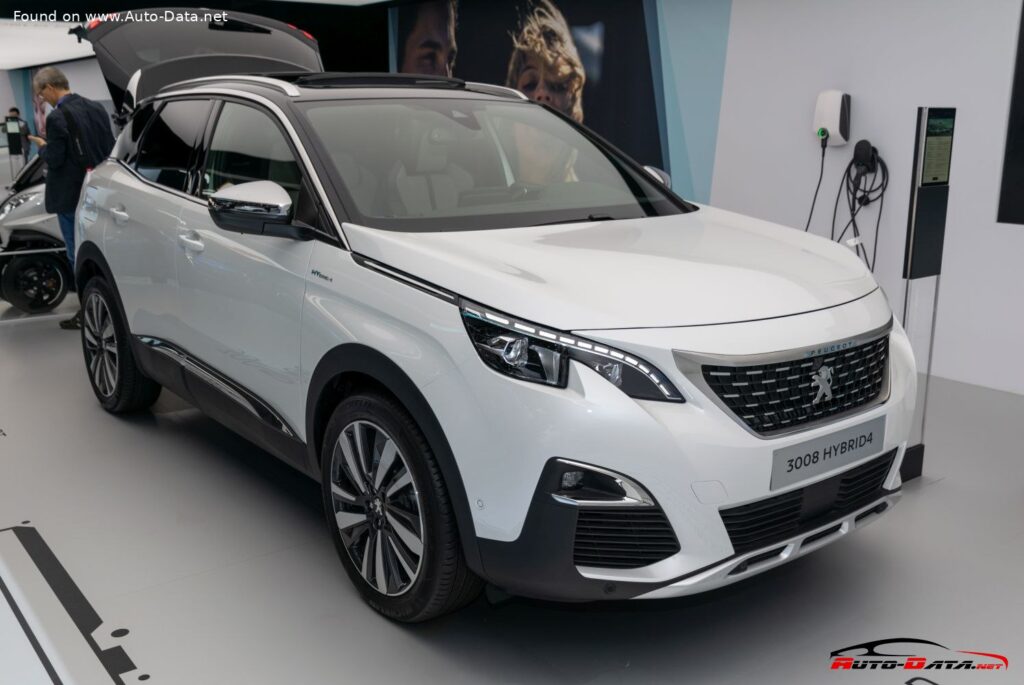
The Peugeot 3008 II (Phase I, 2016) 1.6 Hybrid4 (300 Hp) e-EAT8 represents a significant advancement for the French automaker in the competitive compact SUV segment. While not sold in the United States, the 3008 II quickly gained recognition in Europe and international markets for its striking design, premium interior, and advanced technology. The 1.6 Hybrid4, introduced in 2019, was a particularly compelling version, showcasing Peugeot’s commitment to electrification by blending robust performance with impressive fuel efficiency and reduced emissions.
The Peugeot 3008 II Hybrid4: A European Plug-in Hybrid Pioneer
Produced between 2019 and 2020, the 3008 II Hybrid4 combined a 1.6-liter gasoline engine with two electric motors and an 8-speed automatic transmission, offering all-wheel-drive capability. This variant catered to the growing demand for eco-conscious, powerful family vehicles, demonstrating how mainstream brands could integrate advanced hybrid powertrains into popular segments. The 3008 II Hybrid4 exemplified Peugeot’s “power of choice” strategy, providing consumers with a balanced option between dynamic driving and environmental responsibility.
Engine & Performance: The 1.6 Hybrid4 Powertrain
The Peugeot 3008 II (Phase I, 2016) 1.6 Hybrid4 (300 Hp) e-EAT8 features a sophisticated Plug-in Hybrid Electric Vehicle (PHEV) powertrain. This system combines a 1.6-liter (1598 cm³) inline four-cylinder turbocharged gasoline engine with two electric motors, delivering a total system output of 300 horsepower and 383.53 lb.-ft. of torque. The gasoline engine produces 200 horsepower at 6000 rpm and 221.27 lb.-ft. of torque at 3000 rpm, utilizing direct injection and a DOHC valvetrain for optimal efficiency and power delivery.
The hybrid system incorporates two electric motors. The first, positioned between the combustion engine and the transmission, contributes 110 horsepower at 2500 rpm and 236.02 lb.-ft. of torque. The second electric motor is located on the rear axle, providing 113 horsepower at 14000 rpm and 122.44 lb.-ft. of torque. This arrangement enables an intelligent all-wheel-drive (4×4) system without a mechanical connection between the axles. Power is managed by an 8-speed e-EAT (Efficient Automatic Transmission) automatic gearbox, ensuring smooth shifts and optimized power distribution.
Performance figures are impressive for its class. The 3008 Hybrid4 accelerates from 0 to 60 mph in 5.6 seconds, with a top speed of 149.13 mph (240 km/h). Its plug-in hybrid nature provides an all-electric range (WLTP) of 35.42 to 36.66 miles (57-59 km) from a 13.2 kWh Lithium-ion battery located under the rear seats. In electric-only mode, it can reach a maximum speed of 83.89 mph (135 km/h). This allows for significant daily commuting without gasoline consumption, resulting in a combined fuel economy of 180.9 US mpg (1.3 l/100 km) on the WLTP cycle and low CO2 emissions of 29-31 g/km, meeting Euro 6d emission standards. A Start & Stop System further enhances fuel efficiency.
Design & Features: A Distinctive European SUV
The Peugeot 3008 II (Phase I, 2016) marked a design revolution for Peugeot’s SUVs. It moved away from the MPV-like styling of its predecessor, adopting a more assertive and stylish SUV aesthetic. The exterior features sharp lines, a bold front grille, and distinctive “fang” LED daytime running lights. The body style is a 5-door SUV, comfortably seating five occupants and offering a blend of practicality and modern elegance.
Inside, the 3008 II introduced Peugeot’s innovative “i-Cockpit” layout, a hallmark of the brand’s contemporary vehicles. This includes a compact steering wheel, a configurable 12.3-inch digital instrument cluster positioned above the steering wheel, and a central touchscreen infotainment system. The cabin materials and finish were significantly upgraded, offering a near-premium experience.
Safety and technological features are paramount in a modern vehicle like the 3008 II Hybrid4. Standard safety equipment typically includes ABS (Anti-lock Braking System), multiple airbags, and stability control. The electric power steering, rack and pinion type, ensures responsive handling. The vehicle rides on an independent McPherson front suspension and a semi-independent, coil spring rear suspension, providing a balanced ride quality. Braking is handled by ventilated discs at the front and disc brakes at the rear. The vehicle’s dimensions are 175.08 inches in length, 72.48 inches in width, and 63.58 inches in height, providing a substantial road presence and ample interior space. Trunk space ranges from 13.95 cubic feet with all seats up to 47.92 cubic feet with the rear seats folded down.
Technical Specifications: Peugeot 3008 II (Phase I, 2016) 1.6 Hybrid4 (300 Hp) e-EAT8
| General Information | |
| Brand | Peugeot |
| Model | 3008 |
| Generation | 3008 II (Phase I, 2016) |
| Type (Engine) | 1.6 Hybrid4 (300 Hp) e-EAT8 |
| Start of production | 2019 |
| End of production | 2020 |
| Powertrain Architecture | PHEV (Plug-in Hybrid Electric Vehicle) |
| Body type | SUV |
| Seats | 5 |
| Doors | 5 |
| Performance Specifications | |
| Combined fuel consumption (WLTP) | 1.3 l/100 km (180.9 US mpg) |
| CO2 emissions (WLTP) | 29-31 g/km |
| Fuel consumption (economy) – combined (NEDC) | 1.5 l/100 km (156.8 US mpg) |
| CO2 emissions (NEDC) | 35 g/km |
| Fuel Type | Petrol / electricity |
| Acceleration 0 – 60 mph (Calculated) | 5.6 sec |
| Acceleration 0 – 100 km/h | 5.9 sec |
| Maximum speed | 240 km/h (149.13 mph) |
| Emission standard | Euro 6d |
| Weight-to-power ratio | 6.1 kg/Hp (163 Hp/tonne) |
| Weight-to-torque ratio | 3.5 kg/Nm (282.6 Nm/tonne) |
| Electric Cars and Hybrids Specifications | |
| Gross battery capacity | 13.2 kWh |
| Battery technology | Lithium-ion (Li-Ion) |
| Battery location | Below the floor, under the rear seats |
| All-electric range (WLTP) | 57-59 km (35.42 – 36.66 mi) |
| Average Energy consumption (WLTP) | 15.2-15.6 kWh/100 km (138 – 134 MPGe) |
| Max speed (electric) | 135 km/h (83.89 mph) |
| Electric motor 1 power | 110 Hp @ 2500 rpm |
| Electric motor 1 Torque | 320 Nm (236.02 lb.-ft.) @ 500-2500 rpm |
| Electric motor 1 location | Between the combustion engine and the transmission |
| Electric motor 2 power | 113 Hp @ 14000 rpm |
| Electric motor 2 Torque | 166 Nm (122.44 lb.-ft.) @ 0-4760 rpm |
| Electric motor 2 location | Rear axle, Transverse |
| System power | 300 Hp |
| System torque | 520 Nm (383.53 lb.-ft.) |
| Internal Combustion Engine Specifications | |
| Power | 200 Hp @ 6000 rpm |
| Power per liter | 125.2 Hp/l |
| Torque | 300 Nm (221.27 lb.-ft.) @ 3000 rpm |
| Engine layout | Front, Transverse |
| Engine Model/Code | 5GB EP6FADTXHPA |
| Engine displacement | 1598 cm³ (97.52 cu. in.) |
| Number of cylinders | 4 |
| Engine configuration | Inline |
| Cylinder Bore | 77 mm (3.03 in.) |
| Piston Stroke | 85.8 mm (3.38 in.) |
| Compression ratio | 10.2:1 |
| Number of valves per cylinder | 4 |
| Fuel injection system | Direct injection |
| Engine aspiration | Turbocharger, Intercooler |
| Valvetrain | DOHC |
| Engine oil capacity | 4.25 l (4.49 US qt) |
| Engine systems | Start & Stop System |
| Space, Volume and Weights | |
| Kerb Weight | 1840 kg (4056.51 lbs.) |
| Max. weight | 2330 kg (5136.77 lbs.) |
| Max load | 490 kg (1080.27 lbs.) |
| Trunk (boot) space – minimum | 395 l (13.95 cu. ft.) |
| Trunk (boot) space – maximum | 1357 l (47.92 cu. ft.) |
| Fuel tank capacity | 43 l (11.36 US gal) |
| Max. roof load | 80 kg (176.37 lbs.) |
| Permitted trailer load with brakes (12%) | 1250 kg (2755.78 lbs.) |
| Permitted trailer load without brakes | 750 kg (1653.47 lbs.) |
| Permitted towbar download | 64 kg (141.1 lbs.) |
| Dimensions | |
| Length | 4447 mm (175.08 in.) |
| Width | 1841 mm (72.48 in.) |
| Width with mirrors folded | 1906 mm (75.04 in.) |
| Width including mirrors | 2098 mm (82.6 in.) |
| Height | 1615 mm (63.58 in.) |
| Wheelbase | 2675 mm (105.31 in.) |
| Front track | 1579-1601 mm (62.17 – 63.03 in.) |
| Rear (Back) track | 1587-1610 mm (62.48 – 63.39 in.) |
| Front overhang | 923 mm (36.34 in.) |
| Rear overhang | 849 mm (33.43 in.) |
| Ride height (ground clearance) | 219 mm (8.62 in.) |
| Minimum turning circle (turning diameter) | 10.67 m (35.01 ft.) |
| Approach angle | 20° |
| Departure angle | 29° |
| Drivetrain, Brakes and Suspension Specifications | |
| Drivetrain Architecture | An Internal combustion engine (ICE) drives the front wheels, one electric motor drives the front wheels, one electric motor drives the rear wheels. There is an ability for running in full electric or mixed mode. |
| Drive wheel | All wheel drive (4×4) |
| Number of gears and type of gearbox | 8 gears, automatic transmission e-EAT |
| Front suspension | Independent type McPherson |
| Rear suspension | Semi-independent, coil spring |
| Front brakes | Ventilated discs |
| Rear brakes | Disc |
| Assisting systems | ABS (Anti-lock braking system) |
| Steering type | Steering rack and pinion |
| Power steering | Electric Steering |
| Tires size | 225/55 R18; 205/55 R19 |
| Wheel rims size | 18; 19 |
Legacy and Market Impact in Europe
The Peugeot 3008 II, and particularly its advanced plug-in hybrid variant, the Peugeot 3008 II (Phase I, 2016) 1.6 Hybrid4 (300 Hp) e-EAT8, established a significant legacy in the European automotive landscape. The second-generation 3008 was a game-changer for Peugeot, moving the brand into a more upscale and competitive position within the compact SUV segment. It won the European Car of the Year award in 2017, recognizing its design, innovative i-Cockpit interior, and overall package.
The introduction of the 1.6 Hybrid4 PHEV variant in 2019 further solidified the 3008’s reputation as a leader in technology and efficiency. In a market prioritizing fuel economy and environmental considerations, the Hybrid4 offered a compelling solution, combining powerful performance with the ability to cover significant distances on electric power. This made it attractive to company car drivers and private buyers seeking a versatile family SUV with reduced running costs.
In Europe, the 3008 Hybrid4 competed with rivals like the Volkswagen Tiguan eHybrid, Ford Kuga PHEV, Hyundai Tucson Plug-in Hybrid, Kia Sportage Plug-in Hybrid, and premium offerings from BMW and Mercedes-Benz. The Peugeot distinguished itself with its unique design, perceived higher-quality interior, and the robust performance of its 300-horsepower all-wheel-drive powertrain. Its ability to offer both spirited acceleration and impressive all-electric range provided a strong value proposition.
The 3008 II Hybrid4 demonstrated Peugeot’s capability to integrate complex hybrid technologies into a mass-market product successfully. It helped normalize PHEV technology in the compact SUV space and paved the way for future electrified models from the Stellantis group. While the Phase I Hybrid4 variant had a relatively short production run (2019-2020) before a facelift, its impact was profound, showcasing what a mainstream European brand could achieve in terms of performance, efficiency, and design innovation in the evolving automotive landscape. Its success underscored a shift in consumer preferences towards more sustainable yet capable vehicles, cementing its place as an important model in Peugeot’s modern history.