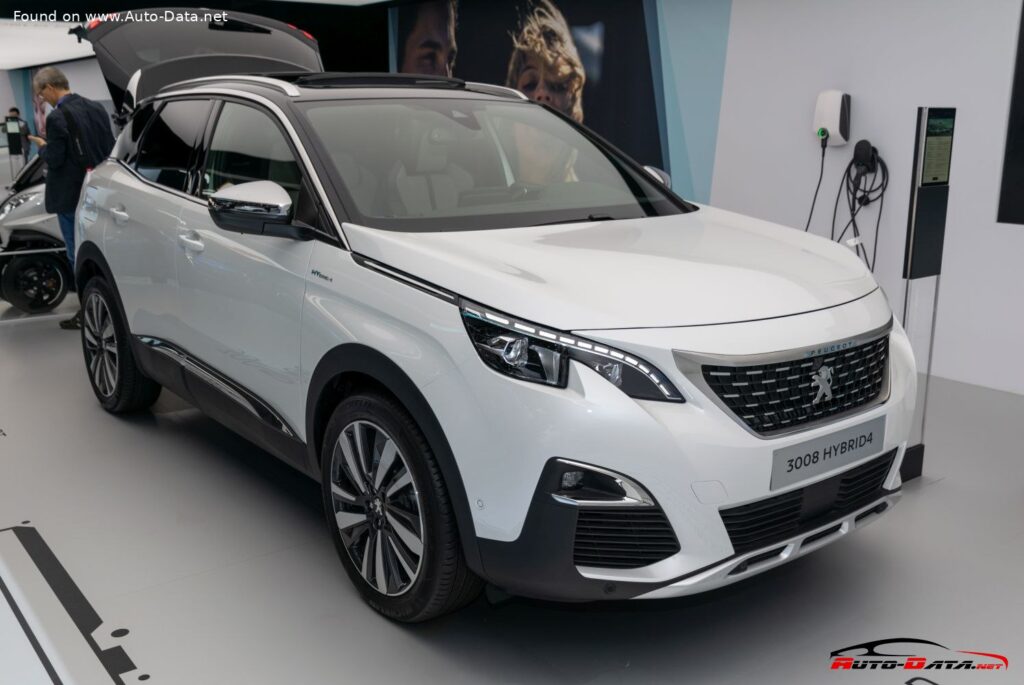
The Peugeot 3008 II (Phase I, 2016) 1.6 THP (165 Hp) Automatic S&S represents a pivotal moment for the French automaker, marking its definitive shift towards a more assertive and stylish presence in the highly competitive compact crossover SUV segment. Launched in 2016, this second-generation 3008, specifically the Phase I variant, dramatically departed from its predecessor’s more MPV-like styling, embracing a bold SUV aesthetic that resonated strongly with consumers across Europe and other international markets. While not officially sold in the United States, the 3008 garnered significant acclaim abroad, including the prestigious European Car of the Year award in 2017, underscoring its impact and innovative approach to design, technology, and driving dynamics.
The Peugeot 3008 II: A European Crossover Success
This particular iteration, powered by the efficient 1.6-liter THP (Turbo High Pressure) gasoline engine delivering 165 horsepower and paired with a smooth automatic transmission and Start & Stop system, exemplifies Peugeot’s commitment to combining performance with environmental responsibility. The 3008 II was designed to challenge established players in its class, offering a distinctively French blend of sophisticated design, a premium-feeling interior, and a comfortable yet engaging driving experience. Its introduction heralded a new era for Peugeot’s design language, characterized by sharp lines, a commanding stance, and an innovative cabin layout that set new benchmarks for the brand.
Engine & Performance
At the heart of the Peugeot 3008 II (Phase I, 2016) 1.6 THP (165 Hp) Automatic S&S lies a refined and potent powertrain. The 1.6-liter (1598 cm³ or 97.52 cubic inches) THP gasoline engine, identified by its 5GY EP6FDTM code, is an inline four-cylinder unit configured transversely at the front of the vehicle. This engine features direct fuel injection and is boosted by a turbocharger with an intercooler, a setup designed to deliver a robust combination of power and efficiency across the rev range.
The engine produces a healthy 165 horsepower at 6000 rpm, translating to an impressive 103.3 horsepower per liter, showcasing its advanced engineering. More notably, it generates a substantial 240 Nm (equivalent to 177.01 lb.-ft.) of torque available from a remarkably low 1400 rpm. This low-end torque is crucial for a crossover SUV, providing excellent responsiveness in city driving and ample power for highway cruising or overtaking maneuvers without constantly needing to downshift. The power-to-weight ratio for this model stands at 7.9 kg/Hp (126.9 Hp/tonne), while the torque-to-weight ratio is 5.4 kg/Nm (184.6 Nm/tonne), indicating a well-balanced performance package.
Power is channeled to the front wheels through a 6-speed automatic transmission, which contributes to both driving comfort and fuel economy. The vehicle also incorporates a Start & Stop system, a standard feature for modern European vehicles aimed at reducing fuel consumption and emissions in urban traffic. Performance figures are respectable for its class: the 3008 II (Phase I, 2016) 1.6 THP accelerates from 0 to 60 mph in a brisk 8.5 seconds (0-100 km/h in 8.9 seconds) and can reach a maximum speed of 128 mph (206 km/h). Fuel efficiency is a strong point, with combined consumption rated between 39.2 and 41.3 US mpg (5.7-6.0 l/100 km), and CO2 emissions ranging from 129-136 g/km, meeting the stringent Euro 6 emission standard. This makes it an environmentally conscious choice within its segment.
Design & Features
The design of the Peugeot 3008 II (Phase I, 2016) was a radical departure and a key factor in its widespread appeal. Moving away from the somewhat utilitarian look of its predecessor, the second-generation 3008 adopted a sleek, modern, and distinctly SUV-like silhouette. Classified as a 5-door, 5-seat SUV, its dimensions—175.08 inches (4447 mm) in length, 72.48 inches (1841 mm) in width (82.6 inches or 2098 mm including mirrors), and 63.58 inches (1615 mm) in height—place it firmly in the compact crossover category. The 105.31-inch (2675 mm) wheelbase provides a stable platform and contributes to a spacious cabin.
Visually, the 3008 boasts a striking front fascia dominated by a large grille and sharp, feline-inspired headlights, often featuring LED daytime running lights that give it a distinctive signature. The side profile is characterized by strong character lines, a rising waistline, and a “floating roof” effect achieved by a blacked-out C-pillar, adding to its dynamic appearance. With a ground clearance of 8.62 inches (219 mm), an approach angle of 20°, and a departure angle of 29°, the 3008 possesses more than just cosmetic SUV credentials, allowing it to handle light off-road excursions or challenging urban obstacles with ease.
Inside, the 3008 truly sets itself apart with Peugeot’s innovative i-Cockpit design. This interior concept features a compact steering wheel, a configurable 12.3-inch digital instrument cluster positioned above the steering wheel, and a central touchscreen infotainment system angled towards the driver. The cabin materials are generally high-quality, with thoughtful touches and a sense of sophistication that rivals more premium brands. Seating for five is comfortable, and practicality is well-addressed with a minimum trunk space of 18.36 cubic feet (520 liters), expanding to an impressive 52.34 cubic feet (1482 liters) with the rear seats folded down. This cargo capacity makes it a versatile vehicle for families and individuals alike.
In terms of chassis and safety, the 3008 employs an independent McPherson strut front suspension with a coil spring and anti-roll bar, while the rear features a semi-independent setup with coil springs. Braking is handled by ventilated discs at the front and solid discs at the rear, complemented by an Anti-lock Braking System (ABS) for enhanced stopping power and stability. The electric power steering system, with its rack and pinion setup, offers light and precise control, contributing to the car’s agile feel.
Technical Specifications
| Category | Specification |
| General Information | |
| Brand | Peugeot |
| Model | 3008 |
| Generation | 3008 II (Phase I, 2016) |
| Type (Engine) | 1.6 THP (165 Hp) Automatic S&S |
| Start of production | 2016 year |
| End of production | 2018 year |
| Powertrain Architecture | Internal Combustion engine |
| Body type | SUV |
| Seats | 5 |
| Doors | 5 |
| Performance Specs | |
| Fuel consumption (economy) – urban | 7.3-7.6 l/100 km (30.9 – 32.2 US mpg) |
| Fuel consumption (economy) – extra urban | 4.8-5.1 l/100 km (46.1 – 49 US mpg) |
| Fuel consumption (economy) – combined | 5.7-6.0 l/100 km (39.2 – 41.3 US mpg) |
| CO2 emissions | 129-136 g/km |
| Fuel Type | Petrol (Gasoline) |
| Acceleration 0 – 60 mph | 8.5 sec |
| Maximum speed | 206 km/h (128 mph) |
| Emission standard | Euro 6 |
| Weight-to-power ratio | 7.9 kg/Hp (126.9 Hp/tonne) |
| Weight-to-torque ratio | 5.4 kg/Nm (184.6 Nm/tonne) |
| Engine Specs | |
| Power | 165 Hp @ 6000 rpm |
| Power per liter | 103.3 Hp/l |
| Torque | 240 Nm @ 1400 rpm (177.01 lb.-ft. @ 1400 rpm) |
| Engine layout | Front, Transverse |
| Engine Model/Code | 5GY EP6FDTM |
| Engine displacement | 1598 cm³ (1.6 Liters (97.52 cu. in.)) |
| Number of cylinders | 4 |
| Engine configuration | Inline |
| Cylinder Bore | 77 mm (3.03 in.) |
| Piston Stroke | 85.5 mm (3.37 in.) |
| Number of valves per cylinder | 4 |
| Fuel injection system | Direct injection |
| Engine aspiration | Turbocharger, Intercooler |
| Engine oil capacity | 4.25 l (4.49 US qt) |
| Engine systems | Start & Stop System |
| Space, Volume and Weights | |
| Kerb Weight | 1300 kg (2866.01 lbs.) |
| Max. weight | 1950 kg (4299.01 lbs.) |
| Max load | 650 kg (1433 lbs.) |
| Trunk (boot) space – minimum | 520 l (18.36 cu. ft.) |
| Trunk (boot) space – maximum | 1482 l (52.34 cu. ft.) |
| Fuel tank capacity | 53 l (14 US gal) |
| Permitted trailer load with brakes (12%) | 1550 kg (3417.17 lbs.) |
| Dimensions | |
| Length | 4447 mm (175.08 in.) |
| Width | 1841 mm (72.48 in.) |
| Width with mirrors folded | 1906 mm (75.04 in.) |
| Width including mirrors | 2098 mm (82.6 in.) |
| Height | 1615 mm (63.58 in.) |
| Wheelbase | 2675 mm (105.31 in.) |
| Front track | 1579-1601 mm (62.17 – 63.03 in.) |
| Rear (Back) track | 1587-1610 mm (62.48 – 63.39 in.) |
| Front overhang | 923 mm (36.34 in.) |
| Rear overhang | 849 mm (33.43 in.) |
| Ride height (ground clearance) | 219 mm (8.62 in.) |
| Minimum turning circle (turning diameter) | 10.67 m (35.01 ft.) |
| Approach angle | 20° |
| Departure angle | 29° |
| Drivetrain, Brakes and Suspension Specs | |
| Drivetrain Architecture | The Internal combustion engine (ICE) drives the front wheels of the vehicle. |
| Drive wheel | Front wheel drive |
| Number of gears and type of gearbox | 6 gears, automatic transmission |
| Front suspension | Independent, type McPherson with coil spring and anti-roll bar |
| Rear suspension | Semi-independent, coil spring |
| Front brakes | Ventilated discs |
| Rear brakes | Disc |
| Assisting systems | ABS (Anti-lock braking system) |
| Steering type | Steering rack and pinion |
| Power steering | Electric Steering |
| Tires size | 215/65 R17; 225/55 R18; 205/55 R19 |
| Wheel rims size | 17; 18; 19 |
Legacy and Market Impact
The Peugeot 3008 II (Phase I, 2016) 1.6 THP (165 Hp) Automatic S&S, and indeed the entire second-generation 3008 lineup, left an indelible mark on the compact crossover segment, particularly in its primary markets of Europe and Asia. Its launch was not merely an update but a complete reinvention, successfully transforming the 3008 from a somewhat niche MPV-crossover into a mainstream SUV powerhouse. This strategic shift paid off handsomely, as evidenced by its critical acclaim and strong sales performance.
The car’s reputation quickly grew, primarily due to its bold and distinctive exterior design, which stood out from the often-conservative styling of its competitors. The “European Car of the Year 2017” award was a testament to its all-around excellence, recognizing its innovative design, advanced technology, efficient powertrains, and engaging driving dynamics. This award significantly boosted Peugeot’s brand.