
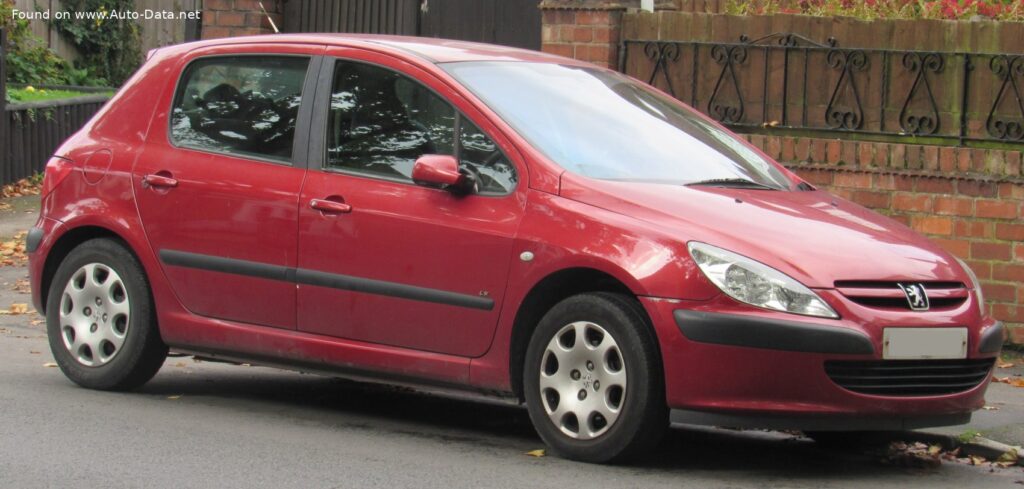
The Peugeot 307 1.4 (75 Hp) represents a significant chapter in the history of the French automaker Peugeot, debuting in 2001 as a successor to the popular 306. Positioned within the C-segment in Europe, this compact car quickly gained recognition for its distinctive, taller design intended to maximize interior space and visibility compared to its competitors. The 1.4-liter, 75 horsepower variant served as an entry-level option, prioritizing fuel efficiency and affordability for the European market. Though never officially sold in the United States, the 307 played a vital role in Peugeot’s global strategy, achieving success in Europe, Asia, and South America. Its innovative design and practicality were acknowledged with the prestigious European Car of the Year award in 2002, solidifying its position as a key model from 2001 to 2005 for this generation.
Engine & Performance: The Heart of the Peugeot 307
The Peugeot 307 1.4 (75 Hp) powertrain centers around a front-wheel-drive configuration powered by a conventional internal combustion engine. The vehicle utilizes the KFW TU3JP engine, a naturally aspirated, 1.4-liter (1361 cm3 or 83.05 cu. in.) inline-four gasoline unit. This engine employs a Single Overhead Camshaft (SOHC) design with two valves per cylinder, a cost-effective and reliable configuration emphasizing durability and ease of maintenance. Fuel delivery is managed by a multi-port manifold injection system, optimizing combustion efficiency.
Producing 75 horsepower at 5500 rpm and a peak torque of 88.51 lb.-ft. (120 Nm) at 3400 rpm, the 1.4-liter engine prioritizes economical daily driving over outright performance. The vehicle’s weight-to-power ratio is 15.2 kg/Hp (approximately 33.5 lbs/Hp), reflecting its modest performance goals. Acceleration from 0 to 60 mph takes 13.9 seconds, while 0 to 100 km/h is achieved in 14.6 seconds. The maximum speed is 103.77 mph (167 km/h). These figures position the Peugeot 307 1.4 (75 Hp) as a capable urban and suburban commuter, suitable for highway speeds but not designed for spirited driving.
Fuel efficiency is a key attribute of this entry-level model. Combined fuel consumption is rated at 35.1 US mpg (6.7 l/100 km), with urban driving yielding 27 US mpg (8.7 l/100 km) and extra-urban figures reaching 42.8 US mpg (5.5 l/100 km). A 15.85 US gallon (60 liter) fuel tank provides a respectable cruising range. Emissions compliance with the Euro 3 standard reflects the environmental regulations of its production period. The engine requires 3.49 US quarts (3.3 liters) of oil, and the cooling system holds 6.34 US quarts (6 liters) of coolant. Power is transferred to the front wheels via a precise 5-speed manual transmission, a standard choice for compact cars prioritizing driver engagement and fuel economy in the European market.
Design & Features of the Peugeot 307
The Peugeot 307 is a five-door hatchback (also available in a three-door configuration), characterized by its tall and spacious body style. Measuring 165.43 inches (4202 mm) in length, 68.11 inches (1730 mm) in width, and 59.45 inches (1510 mm) in height, the 307 presents a more upright stance than many of its contemporaries. This design, often described as a “semi-MPV” or “tall hatchback,” maximizes interior volume and passenger comfort. The 102.68-inch (2608 mm) wheelbase contributes to a stable ride and a generous cabin.
The interior offers seating for five occupants. The elevated seating position, a direct result of the tall design, enhances visibility for both the driver and passengers, providing a more commanding road presence. Trunk space is practical, ranging from 12.04 cu. ft. (341 liters) with all seats in use to 46.9 cu. ft. (1328 liters) with the rear seats folded, demonstrating its versatility for families and cargo transport.
The 307’s chassis features a front suspension utilizing a wishbone setup, while the rear employs a trailing arm design, a common and effective combination for front-wheel-drive compacts. Braking is handled by ventilated discs at the front and solid discs at the rear, supplemented by an Anti-lock Braking System (ABS) – a crucial safety feature for vehicles of this era. Steering is a rack and pinion system with hydraulic power assistance, providing a direct and communicative feel. The vehicle rides on 195/65 R15 tires mounted on 15-inch wheel rims. A relatively tight turning circle of 36.52 feet (11.13 meters) enhances maneuverability in urban environments. The drag coefficient (Cd) of 0.31 contributes to fuel efficiency at higher speeds.
Peugeot 307 1.4 (75 Hp) Technical Specifications
| Category | Specification |
|---|---|
| General Information | |
| Brand | Peugeot |
| Model | 307 |
| Generation | 307 |
| Engine Type | 1.4 (75 Hp) |
| Production Start | 2001 |
| Production End | 2005 |
| Powertrain Architecture | Internal Combustion engine |
| Body Type | Hatchback |
| Seats | 5 |
| Doors | 3-5 |
| Performance Specs | |
| Fuel Consumption (Urban) | 8.7 l/100 km (27 US mpg) |
| Fuel Consumption (Extra Urban) | 5.5 l/100 km (42.8 US mpg) |
| Fuel Consumption (Combined) | 6.7 l/100 km (35.1 US mpg) |
| CO2 Emissions | 159 g/km |
| Fuel Type | Petrol (Gasoline) |
| Acceleration 0-60 mph | 13.9 sec |
| Acceleration 0-62 mph (0-100 km/h) | 14.6 sec |
| Maximum Speed | 103.77 mph (167 km/h) |
| Emission Standard | Euro 3 |
| Weight-to-Power Ratio | 15.2 kg/Hp (33.5 lbs/Hp) |
| Weight-to-Torque Ratio | 9.5 kg/Nm (6.4 lbs/lb.-ft.) |
| Engine Specs | |
| Power | 75 Hp @ 5500 rpm |
| Power per Liter | 55.1 Hp/l |
| Torque | 88.51 lb.-ft. (120 Nm) @ 3400 rpm |
| Engine Layout | Front, Transverse |
| Engine Model/Code | KFW TU3JP |
| Engine Displacement | 1361 cm3 (1.4 l / 83.05 cu. in.) |
| Number of Cylinders | 4 |
| Engine Configuration | Inline |
| Cylinder Bore | 2.95 in. (75 mm) |
| Piston Stroke | 3.03 in. (77 mm) |
| Compression Ratio | 10.5:1 |
| Valves per Cylinder | 2 |
| Fuel Injection System | Multi-port manifold injection |
| Engine Aspiration | Naturally aspirated |
| Valvetrain | SOHC |
| Engine Oil Capacity | 3.3 l (3.49 US qt) |
| Coolant Capacity | 6 l (6.34 US qt) |
| Dimensions, Volume, and Weights | |
| Kerb Weight | 2517.68 lbs. (1142 kg) |
| Max. Weight (GVWR) | 3619.99 lbs. (1642 kg) |
| Max Load | 1102.31 lbs. (500 kg) |
| Trunk Space (Minimum) | 12.04 cu. ft. (341 l) |
| Trunk Space (Maximum) | 46.9 cu. ft. (1328 l) |
| Fuel Tank Capacity | 15.85 US gal (60 l) |
| Drivetrain, Brakes, and Suspension | |
| Drivetrain Architecture | Front-wheel drive, Internal Combustion engine |
| Number of Gears/Gearbox Type | 5 gears, manual transmission |
| Front Suspension | Wishbone |
| Rear Suspension | Trailing arm |
| Front Brakes | Ventilated discs |
| Rear Brakes | Disc |
| Assisting Systems | ABS (Anti-lock braking system) |
| Steering Type | Steering rack and pinion |
| Power Steering | Hydraulic Steering |
| Tire Size | 195/65 R15 |
The Peugeot 307, particularly the 1.4-liter (75 Hp) model, established itself as a significant competitor in the European compact car segment from 2001 to 2005. Facing rivals like the Volkswagen Golf, Ford Focus, Opel Astra, and Renault Mégane, the 307 differentiated itself with its unique tall design, offering increased interior space and visibility. Winning the European Car of the Year award in 2002 validated its innovative design, comfort, and safety features. The 1.4-liter variant attracted budget-conscious buyers and those prioritizing fuel economy, providing an accessible entry point into the 307 range. Its reliable TU3JP engine contributed to its reputation as a dependable daily driver. The 307 helped solidify Peugeot’s reputation for stylish, comfortable, and practical compact vehicles, influencing subsequent models like the 308. Today, the Peugeot 307 is remembered as a successful and influential model, perfectly tailored to the demands of its primary market, even though it never reached American shores.
