
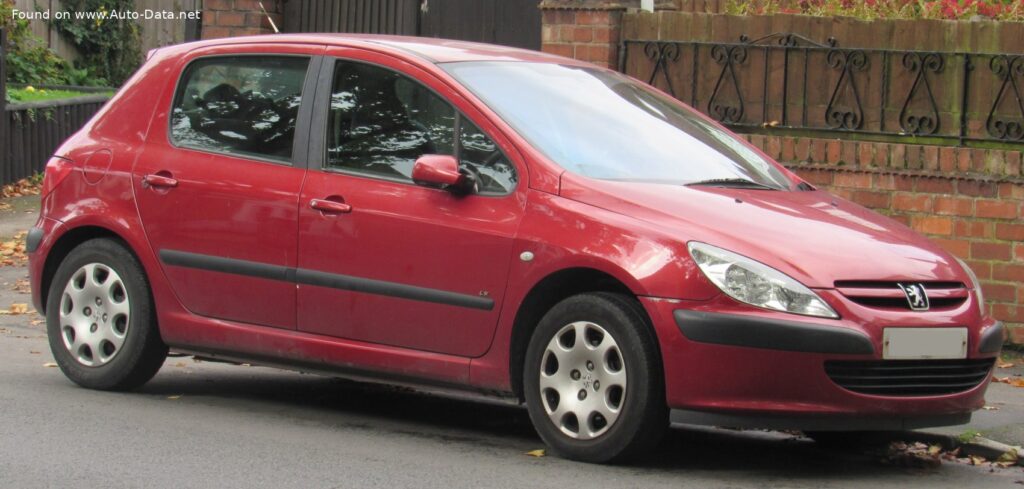
The Peugeot 307 1.6 (109 Hp) represents a significant compact family car from the early 2000s, primarily aimed at the competitive European automotive market. Introduced in 2001, the 307 succeeded the popular 306, striving to enhance Peugeot’s standing in the C-segment through increased interior space, improved safety features, and a more contemporary design. This specific version, powered by the 1.6-liter naturally aspirated gasoline engine, provided a practical combination of performance and fuel economy, making it a favored choice for daily commuting and family transport throughout Europe.
The Peugeot 307: A European Success Story
The Peugeot 307 was a pivotal model for the French manufacturer, signifying a move towards a taller, more spacious vehicle design that blurred the lines between a traditional hatchback and a compact multi-purpose vehicle (MPV). Production of this generation and powertrain configuration ran from 2001 to 2005, during which it received widespread critical acclaim, culminating in the prestigious European Car of the Year award in 2002. While not officially offered for sale in the United States, the 307 played a vital role in bolstering Peugeot’s presence in its core European markets and other international regions, offering a compelling package of practicality, comfort, and distinctive French automotive styling.
Engine & Performance
The Peugeot 307 1.6 (109 Hp) is powered by the NFU TU5JP4 engine, a 1.6-liter (1587 cm³ or 96.84 cubic inches) naturally aspirated inline-four gasoline engine. This engine was widely used across numerous PSA (Peugeot S.A.) vehicles of the period, recognized for its durability and adequate performance within its class. It features a Double Overhead Camshaft (DOHC) valvetrain with four valves per cylinder, totaling 16 valves, which optimizes airflow and power delivery. Fuel is delivered through a multi-port fuel injection system, ensuring precise control of the fuel-air mixture.
The engine produces a maximum power output of 109 horsepower (Hp) at 5750 revolutions per minute (rpm), resulting in a power-to-liter ratio of 68.7 Hp/l. Torque is rated at 147 Newton-meters (108.42 lb.-ft.) at 3900 rpm, providing sufficient mid-range pulling power for everyday driving situations. This powertrain is paired with a 5-speed manual transmission, which directs power to the front wheels. The transverse engine mounting, typical for compact cars, maximizes interior space and contributes to balanced driving dynamics.
Performance figures for the 307 1.6 (109 Hp) include an estimated 0 to 60 mph acceleration time of 10.5 seconds (0-100 km/h in 11 seconds), with a top speed of 118.06 mph (190 km/h). While not designed for high-performance driving, these figures were competitive within its segment, offering adequate capability for highway cruising and urban driving. Fuel efficiency was a key consideration for European consumers. The combined fuel consumption is rated at 7.2 liters per 100 kilometers, equivalent to approximately 32.7 US miles per gallon (mpg). Fuel consumption in urban environments is 9.5 l/100 km (24.8 US mpg), while extra-urban driving yields more economical figures of 5.8 l/100 km (40.6 US mpg). The vehicle complied with Euro 3 emission standards, with CO2 emissions of 169 g/km.
Design & Features
The design of the Peugeot 307 represented a departure from its predecessor, adopting a taller, more rounded profile that was both modern and functional. It was available as a versatile hatchback, offered in three-door and five-door configurations, comfortably accommodating five passengers. This “tall car” design aimed to maximize interior space and improve visibility, a popular trend among European compact cars at the time. The vehicle’s overall dimensions are 165.43 inches (4202 mm) in length, 68.11 inches (1730 mm) in width, and 59.45 inches (1510 mm) in height, with a wheelbase of 102.68 inches (2608 mm) contributing to a stable ride and generous cabin space.
The interior of the 307 offered a practical and ergonomically designed cabin. The elevated seating position provided a commanding view of the road, and the well-designed interior offered a minimum trunk (boot) capacity of 12.04 cubic feet (341 liters), expandable to a substantial 46.9 cubic feet (1328 liters) with the rear seats folded down. This versatility made the 307 a practical choice for families and individuals requiring flexible cargo space.
Key features for the era included essential safety and driving aids. The vehicle was equipped with an Anti-lock Braking System (ABS) to enhance stopping control. The braking system utilized ventilated discs at the front and solid discs at the rear. Steering was managed by a rack and pinion system, complemented by hydraulic power steering, providing a comfortable and responsive driving experience. The suspension consisted of a wishbone design at the front and a trailing arm system at the rear, tuned for a balance of comfort and handling characteristic of French automobiles. The 307 rode on 195/65 R15 tires mounted on 15-inch wheel rims. Its drag coefficient (Cd) of 0.31 was respectable for a vehicle in its class, contributing to fuel efficiency and reduced wind noise.
Technical Specifications
| Category | Specification |
| General Information | |
| Brand | Peugeot |
| Model | 307 |
| Generation | 307 |
| Type (Engine) | 1.6 (109 Hp) |
| Start of Production | 2001 |
| End of Production | 2005 |
| Powertrain Architecture | Internal Combustion engine |
| Body Type | Hatchback |
| Seats | 5 |
| Doors | 3-5 |
| Performance Specs | |
| Fuel Consumption (Urban) | 9.5 l/100 km (24.8 US mpg) |
| Fuel Consumption (Extra Urban) | 5.8 l/100 km (40.6 US mpg) |
| Fuel Consumption (Combined) | 7.2 l/100 km (32.7 US mpg) |
| CO2 Emissions | 169 g/km |
| Fuel Type | Petrol (Gasoline) |
| Acceleration 0 – 60 mph (Calculated) | 10.5 sec |
| Acceleration 0 – 100 km/h | 11 sec |
| Maximum Speed | 190 km/h (118.06 mph) |
| Emission Standard | Euro 3 |
| Weight-to-Power Ratio | 10.8 kg/Hp (92.7 Hp/tonne) |
| Weight-to-Torque Ratio | 8 kg/Nm (125 Nm/tonne) |
| Engine Specs | |
| Power | 109 Hp @ 5750 rpm |
| Power per Liter | 68.7 Hp/l |
| Torque | 147 Nm @ 3900 rpm (108.42 lb.-ft. @ 3900 rpm) |
| Engine Layout | Front, Transverse |
| Engine Model/Code | NFU TU5JP4 |
| Engine Displacement | 1587 cm³ (1.6 Liters / 96.84 cu. in.) |
| Number of Cylinders | 4 |
| Engine Configuration | Inline |
Legacy & Market Impact
The Peugeot 307 entered a highly competitive European market segment, challenging established models like the Volkswagen Golf, Ford Focus, Opel Astra, and Renault Mégane. Its unique appeal lay in its emphasis on interior volume and a more upright driving position, offering a perceived advantage in comfort and practicality. This design resonated with many European buyers, particularly families, who valued the added space and ease of access.
Winning the European Car of the Year award in 2002 solidified its reputation and contributed to its market success. The 307 was praised for its comfortable ride, decent handling, and relatively refined engines, especially the 1.6-liter variant, which balanced performance and running costs effectively. Its strong sales performance helped Peugeot maintain its position as a leading European automotive brand in the early 2000s. The Peugeot 307 1.6 (109 Hp) became a common sight on European roads, representing a reliable and family-friendly compact car. Its legacy is one of innovative packaging, strong market acceptance, and Peugeot’s commitment to offering compelling options in the mainstream automotive segment.
