
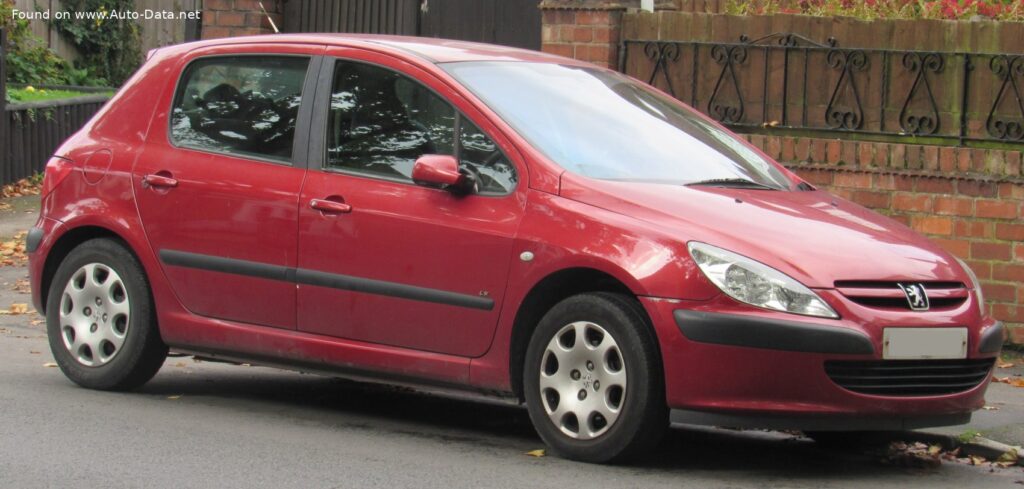
The Peugeot 307 2.0 (136 Hp) represents a significant chapter in the French automaker’s history within the highly competitive C-segment, or compact car market, primarily across Europe and other international territories. Launched in 2001 as a successor to the popular Peugeot 306, the 307 aimed to deliver increased interior space, enhanced safety features, and a more contemporary design. This article provides a detailed overview of the Peugeot 307 2.0 (136 Hp) variant, a key powertrain option produced from 2001 to 2005, offering a balance of performance and usability. Although never officially sold in the United States, the 307 was a common sight on European roads, embodying Peugeot’s design and engineering capabilities of the early 21st century. Its innovative packaging and overall appeal were recognized with the prestigious European Car of the Year award in 2002.
Engine & Performance of the Peugeot 307 2.0 (136 Hp)
The Peugeot 307 2.0 (136 Hp) is powered by a 2.0-liter (1997 cm³, or 121.86 cu. in.) naturally aspirated inline four-cylinder engine, designated the RFN EW10J4 by Peugeot. This engine was a well-established and respected unit within the PSA Group, known for its smooth operation and adequate power output for its class. The engine features a DOHC (Double Overhead Camshaft) valvetrain with four valves per cylinder, designed for efficient combustion. Fuel delivery is managed by a multi-port manifold injection system, a reliable technology for the period.
This powerplant generates 136 horsepower at 6000 rpm, resulting in a power-per-liter ratio of 68.1 Hp/l. Torque output is rated at 190 Nm (140.14 lb.-ft.), peaking at 4100 rpm, providing sufficient mid-range pull for everyday driving and highway cruising. Power is transmitted to the front wheels via a 5-speed manual transmission, a common configuration for compact cars of this era, balancing performance with fuel economy.
Performance figures for the Peugeot 307 2.0 (136 Hp) are competitive. Acceleration from 0 to 60 mph is estimated at 8.7 seconds, while the 0 to 100 km/h sprint takes 9.2 seconds. The vehicle achieves a maximum speed of 205 km/h (127.38 mph), making it suitable for European autobahns. Fuel efficiency is rated at a combined 7.9 l/100 km (29.8 US mpg). Urban fuel consumption is higher at 10.9 l/100 km (21.6 US mpg), while extra-urban driving yields a more economical 6.2 l/100 km (37.9 US mpg). The engine complies with the Euro 3 emission standard, reflecting the environmental regulations of the early 2000s. The engine is mounted front, transverse, contributing to the car’s front-wheel-drive architecture and maximizing cabin space.
Design & Features
The Peugeot 307 introduced a new design language for the brand, characterized by its “tall” body architecture. Unlike the more conventional hatchback silhouette of its predecessor, the 306, the 307 adopted a taller stance, resembling a compact MPV (Multi-Purpose Vehicle) in some respects. This design choice significantly increased interior volume and headroom for all five occupants, a key selling point in its segment. The car was available in both 3-door and 5-door hatchback configurations, offering versatility to suit different buyer preferences.
The 307 measures 165.43 inches in length, 68.11 inches in width, and 59.45 inches in height, with a wheelbase of 102.68 inches. This provides a balance between compact dimensions for urban maneuverability and sufficient interior space. The design incorporates large headlights, a prominent grille, and a generally rounded, aerodynamic shape, resulting in a drag coefficient (Cd) of 0.31.
The interior of the 307 offers a practical and comfortable cabin. The elevated seating position provides good visibility, a benefit of its tall design. Standard features included power steering (typically hydraulic for a more direct feel) and essential safety systems like ABS (Anti-lock Braking System). Depending on the trim level, additional amenities could include air conditioning, automatic climate control, power windows, and a decent audio system. Storage is ample, with a minimum trunk space of 12.04 cu. ft. (341 liters) expanding to 46.9 cu. ft. (1328 liters) with the rear seats folded, highlighting its hatchback practicality. The car rides on 205/55 R16 tires fitted to 16-inch wheel rims, providing a balance of grip and ride comfort.
Technical Specifications
| General Information | |
| Brand | Peugeot |
| Model | 307 |
| Generation | 307 |
| Type (Engine) | 2.0 (136 Hp) |
| Start of production | 2001 year |
| End of production | 2005 year |
| Powertrain Architecture | Internal Combustion engine |
| Body type | Hatchback |
| Seats | 5 |
| Doors | 3-5 |
| Performance Specs | |
| Fuel consumption (economy) – urban | 10.9 l/100 km (21.6 US mpg) |
| Fuel consumption (economy) – extra urban | 6.2 l/100 km (37.9 US mpg) |
| Fuel consumption (economy) – combined | 7.9 l/100 km (29.8 US mpg) |
| CO2 emissions | 183 g/km |
| Fuel Type | Petrol (Gasoline) |
| Acceleration 0 – 100 km/h | 9.2 sec |
| Acceleration 0 – 62 mph | 9.2 sec |
| Acceleration 0 – 60 mph (Calculated) | 8.7 sec |
| Maximum speed | 205 km/h (127.38 mph) |
| Emission standard | Euro 3 |
| Weight-to-power ratio | 8.8 kg/Hp (113.1 Hp/tonne) |
| Weight-to-torque ratio | 6.3 kg/Nm (158.1 Nm/tonne) |
| Engine Specs | |
| Power | 136 Hp @ 6000 rpm |
| Power per liter | 68.1 Hp/l |
| Torque | 190 Nm @ 4100 rpm (140.14 lb.-ft. @ 4100 rpm) |
| Engine layout | Front, Transverse |
| Engine Model/Code | RFN EW10J4 |
| Engine displacement | 1997 cm³ (121.86 cu. in.) |
| Number of cylinders | 4 |
| Engine configuration | Inline |
| Cylinder Bore | 85 mm (3.35 in.) |
| Piston Stroke | 88 mm (3.46 in.) |
| Compression ratio | 10.8:1 |
| Number of valves per cylinder | 4 |
| Fuel injection system | Multi-port manifold injection |
| Engine aspiration | Naturally aspirated engine |
| Valvetrain | DOHC |
| Engine oil capacity | 4.25 l (4.49 US qt) |
| Coolant | 6.2 l (6.55 US qt) |
| Space, Volume and Weights | |
| Kerb Weight | 1202 kg (2649.96 lbs) |
| Max. weight | 1702 kg (3752.27 lbs) |
| Max load | 500 kg (1102.31 lbs) |
| Trunk (boot) space – minimum | 341 l (12.04 cu. ft.) |
| Trunk (boot) space – maximum | 1328 l (46.9 cu. ft.) |
| Fuel tank capacity | 60 l (15.85 US gal) |
| Permitted trailer load with brakes (12%) | 1300 kg (2866.01 lbs) |
| Permitted trailer load without brakes | 638 kg (1406.55 lbs) |
| Dimensions | |
| Length | 4202 mm (165.43 in.) |
| Width | 1730 mm (68.11 in.) |
| Height | 1510 mm (59.45 in.) |
| Wheelbase | 2608 mm (102.68 in.) |
| Front track | 1505 mm (59.25 in.) |
| Rear (Back) track | 1500 mm (59.06 in.) |
| Ride height (ground clearance) | 120 mm (4.72 in.) |
| Drag coefficient (Cd) | 0.31 |
| Minimum turning circle (turning diameter) | 11.13 m (36.52 ft) |
| Drivetrain, Brakes and Suspension Specs | |
| Drivetrain Architecture | The Internal combustion engine (ICE) drives the front wheels of the vehicle. |
| Drive wheel | Front wheel drive |
| Number of gears and type of gearbox | 5 gears, manual transmission |
| Front suspension | Trailing arm |
| Rear suspension | Wishbone |
| Front brakes | Ventilated discs |
| Rear brakes | Disc |
| Assisting systems | ABS (Anti-lock braking system) |
| Steering type | Steering rack and pinion |
| Power steering | Hydraulic Steering |
| Tires size | 205/55 R16 |
| Wheel rims size | 16 |
Legacy and Market Impact of the Peugeot 307
The Peugeot 307 had a significant impact on the European compact car market during its production run. Its innovative “tall” design, prioritizing interior space and practicality, distinguished it from many competitors. This contributed to its recognition as the European Car of the Year in 2002, boosting its market appeal.
In its primary markets, the 307 competed with rivals like the Volkswagen Golf, Ford Focus, Opel Astra (Vauxhall Astra in the UK), and Renault Mégane. Peugeot positioned the 307 as a more stylish, comfortable, and practical alternative, emphasizing its French flair and softer ride quality. The 2.0 (136 Hp) variant was particularly significant, offering a compelling blend of performance for those seeking more dynamism than smaller engine options, without venturing into hot-hatch territory. It was a popular choice for families and individuals who frequently traveled longer distances, appreciating the engine’s highway capability.
The 307’s legacy lies in its contribution to evolving compact car design, pushing boundaries for interior volume and visibility within a small footprint. Its success paved the way for future Peugeot models to adopt similar design philosophies focused on practicality and occupant comfort. While its long-term reliability and electrical systems sometimes faced criticism, it remained a strong seller throughout its lifecycle. Its influence can be seen in the subsequent Peugeot 308, which continued the brand’s commitment to offering well-rounded, attractive, and practical vehicles in the compact segment. For enthusiasts and drivers in Europe, the Peugeot 307 2.0 (136 Hp) remains a memorable example of early 2000s European automotive engineering, balancing performance, efficiency, and innovative design.
