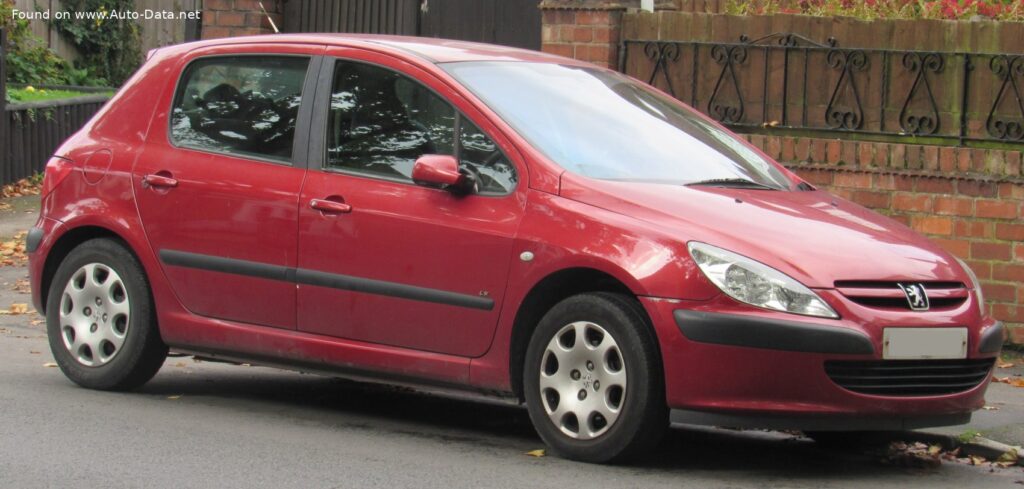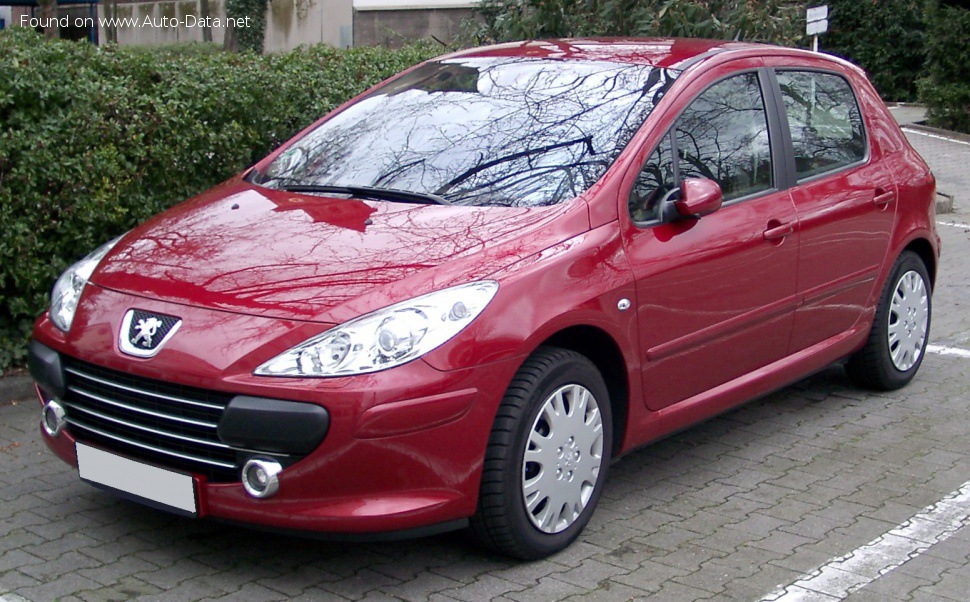
The Peugeot 307 (facelift 2005) 2.0i (140 Hp) Automatic represents a significant offering from the French automaker Peugeot within the competitive European C-segment, or small family car class. Introduced in 2001, the 307 succeeded the popular 306, quickly gaining recognition for its distinctive design that prioritized interior space and visibility. The 2005 facelift refined the aesthetics, interior, and mechanical components, ensuring its continued competitiveness against rivals like the Volkswagen Golf, Ford Focus, and Renault Mégane. While never officially sold in the United States, the 307 was a crucial model in Peugeot’s global strategy, particularly in Europe, where it was valued for its practicality, safety, and a driving experience that blended comfort with French design sensibilities.
Engine & Performance of the Peugeot 307 (facelift 2005)
The Peugeot 307 (facelift 2005) 2.0i Automatic is powered by a 2.0-liter (1997 cm³, or 121.86 cubic inches) inline-four cylinder gasoline engine. This naturally aspirated powerplant, often identified by engine codes RFJ EW10A or RFN EW10J4, features a Double Overhead Camshaft (DOHC) valvetrain with four valves per cylinder – a common and reliable configuration for its time. Fuel delivery is managed by a multi-port manifold injection system.
The engine produces 140 horsepower (Hp) at 6000 rpm, resulting in a power-per-liter output of approximately 70.1 Hp/l. Torque figures stand at 200 Nm (147.51 lb.-ft.) delivered at 4000 rpm, providing sufficient power for everyday driving. A compression ratio of 10.8:1 contributes to both efficiency and responsiveness.
Power is transferred to the front wheels via a 4-speed automatic transmission. While modern vehicles typically employ more gears, this 4-speed unit was standard for the segment at the time, offering a smooth, though not particularly sporty, driving experience. This combination allows the 307 to accelerate from 0 to 60 mph in approximately 9.3 seconds (or 0-100 km/h in 9.8 seconds), with a top speed of 124.27 mph (200 km/h). These figures place it in the mid-range of its competitors, providing adequate performance for typical European driving conditions. The vehicle’s weight-to-power ratio is 9.1 kg/Hp, or 110.1 Hp per ton, highlighting its balanced performance characteristics.
Fuel efficiency is rated at a combined 8.2 liters per 100 kilometers, equivalent to approximately 28.7 US mpg. Urban consumption is higher at 11.8 l/100 km (19.9 US mpg), while extra-urban driving achieves improved figures of 6.2 l/100 km (37.9 US mpg). The vehicle meets Euro 4 emission standards, with CO2 emissions of 195 g/km, reflecting the environmental considerations of vehicles from that era.
Design & Features of the Peugeot 307 (facelift 2005)
The 2005 facelift brought a refreshed aesthetic to the Peugeot 307, aligning it with Peugeot’s evolving design language, as seen on models like the 407. The updated design features a larger, more aggressive grille, revised headlights that extend further into the fenders, and a more prominent lion badge, giving the car a more modern and assertive appearance. The body style remains a versatile hatchback, available in both 3-door and 5-door configurations, catering to diverse customer needs, from sporty appeal to family practicality.
Measuring 165.83 inches (4212 mm) in length, 68.74 inches (1746 mm) in width, and 59.45 inches (1510 mm) in height, the 307 maintains its distinctive “tall” architecture. This design, combined with a generous 102.68-inch (2608 mm) wheelbase, contributes to its spacious interior. The car comfortably seats five occupants, offering ample headroom and legroom, a significant selling point in its segment.
Practicality is a key aspect of the 307’s design. Trunk space ranges from 12.04 cubic feet (341 liters) with the rear seats up, expanding to a substantial 46.9 cubic feet (1328 liters) when the rear seats are folded down. This flexibility makes it suitable for various uses, from daily commuting to family vacations. The vehicle has a kerb weight of 2802.08 lbs (1271 kg) and a maximum permissible weight of 3814 lbs (1730 kg), allowing for a maximum load of 1011.92 lbs (459 kg). It also boasts a towing capacity of 3240.8 lbs (1470 kg) with brakes and 1477.1 lbs (670 kg) without.
The 307 features a front-wheel-drive architecture with a well-tuned suspension system designed for comfort on European roads. It utilizes ventilated disc brakes at the front and disc brakes at the rear, complemented by an Anti-lock Braking System (ABS) for enhanced safety. The steering system is a rack and pinion type, offering precise control. The car rides on 205/55 R16 V tires fitted on 16-inch wheel rims, providing a balance of grip and ride comfort. With a minimum turning circle of 36.52 feet (11.13 meters), it is reasonably maneuverable in urban environments.
Technical Specifications: Peugeot 307 (facelift 2005) 2.0i (140 Hp) Automatic
| Category | Specification |
| General Information | |
| Brand | Peugeot |
| Model | 307 |
| Generation | 307 (facelift 2005) |
| Type (Engine) | 2.0i (140 Hp) Automatic |
| Start of Production | 2005 year |
| End of Production | 2008 year |
| Powertrain Architecture | Internal Combustion engine |
| Body type | Hatchback |
| Seats | 5 |
| Doors | 3-5 |
| Performance Specs | |
| Fuel consumption (economy) – urban | 11.8 l/100 km |
| Fuel consumption (economy) – extra urban | 6.2 l/100 km |
| Fuel consumption (economy) – combined | 8.2 l/100 km |
| CO2 emissions | 195 g/km |
| Fuel Type | Petrol (Gasoline) |
| Acceleration 0 – 100 km/h | 9.8 sec |
| Acceleration 0 – 62 mph | 9.8 sec |
| Acceleration 0 – 60 mph (Calculated) | 9.3 sec |
| Maximum speed | 200 km/h |
| Emission standard | Euro 4 |
| Weight-to-power ratio | 9.1 kg/Hp |
| Engine Specs | |
| Power | 140 Hp @ 6000 rpm |
| Power per liter | 70.1 Hp/l |
| Torque | 200 Nm @ 4000 rpm |
| Engine layout | Front, Transverse |
| Engine Model/Code | RFJ EW10A, RFN EW10J4 |
| Engine displacement | 1997 cm3 |
| Number of cylinders | 4 |
| Engine configuration | Inline |
The Peugeot 307 (facelift 2005) established itself as a practical, stylish, and safe family car in the European market. Its distinctive design, spacious interior, and balanced performance contributed to its success. The 307 paved the way for its successor, the Peugeot 308, demonstrating that a unique design combined with robust engineering could create a highly competitive product. While not a performance icon, its impact as a comfortable, spacious, and well-equipped compact hatchback was significant, solidifying Peugeot’s position in mainstream automotive design and engineering.