The Peugeot 307 Station Wagon (facelift 2005), specifically the 1.6 HDi (109 Hp) variant, represents a significant chapter in the history of compact family vehicles in Europe during the mid-2000s. As a key player in the highly competitive C-segment, this generation of the 307, produced from 2005 to 2008, solidified Peugeot’s reputation for offering practical, comfortable, and remarkably fuel-efficient transportation. Although never officially sold in the United States, the 307 Station Wagon, or “estate” as it’s known across the Atlantic, epitomized the European preference for versatile body styles and advanced diesel powertrains, balancing family utility with economic operation.
Introduced as a refreshed version of the original 307, the 2005 facelift brought subtle but impactful updates, primarily focusing on exterior styling and interior refinement, while retaining its core strengths of spaciousness and driving comfort. The 1.6 HDi engine, a hallmark of PSA Group’s diesel prowess, provided a compelling blend of adequate power and exceptional fuel economy, making it a popular choice for families and businesses alike who prioritized low running costs without sacrificing usability. This article delves into the technical specifications, design philosophies, and market impact of this enduring French vehicle.
Engine & Performance: The Efficient Heart of the Peugeot 307 Station Wagon (facelift 2005)
At the core of the Peugeot 307 Station Wagon (facelift 2005)’s appeal was its advanced 1.6 HDi diesel engine. Codenamed 9HZ DV6TED4, this inline four-cylinder unit boasted a displacement of 1560 cubic centimeters (95.2 cubic inches). Equipped with a common-rail direct fuel injection system, a turbocharger, and an intercooler, it delivered a respectable 109 horsepower at 4000 rpm. More impressively, it produced a robust 240 Nm (177.01 lb.-ft.) of torque at a low 1750 rpm, providing excellent pulling power and making it well-suited for hauling cargo or navigating varied European road conditions.
This powertrain architecture, with its front, transverse engine layout driving the front wheels through a 5-speed manual transmission, was optimized for efficiency. The engine’s design, featuring four valves per cylinder, ensured optimal combustion and performance. Its efficiency figures were particularly noteworthy: a combined fuel consumption of 5.0-5.1 liters per 100 kilometers, translating to an impressive 47-46.1 US miles per gallon. Urban consumption ranged from 6.2-6.3 l/100 km (37.9-37.3 US mpg), while extra-urban driving could achieve 4.4-4.5 l/100 km (53.5-52.3 US mpg). These figures, coupled with CO2 emissions of 131-134 g/km, ensured the vehicle met the Euro 4 emission standard, making it an environmentally conscious choice for its time.
The weight-to-power ratio for this model stood at 13.6 kg/Hp (73.5 Hp/tonne), and its weight-to-torque ratio was 6.2 kg/Nm (161.8 Nm/tonne). These metrics highlight the engine’s capability to move the vehicle’s kerb weight, which ranged from 1483-1492 kg (3269.46-3289.3 lbs.), with relative ease and strong economy. The 60-liter (15.85 US gallon) fuel tank provided a significant cruising range, further enhancing its suitability for long-distance family travel.
Design & Features: Practicality Meets Refinement
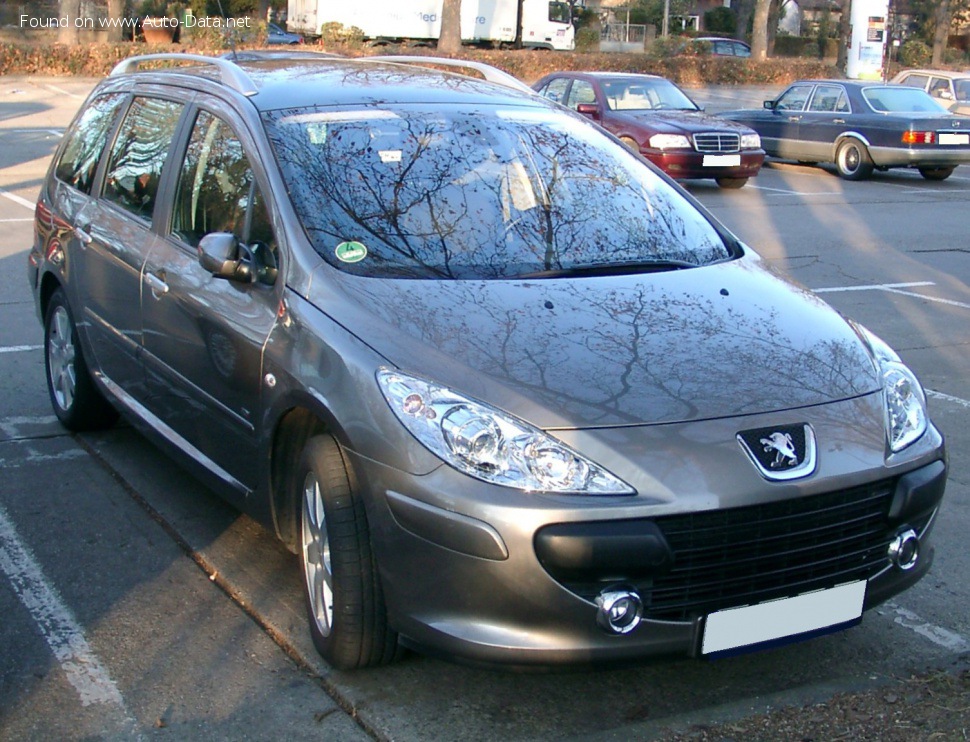
The Peugeot 307 Station Wagon (facelift 2005) was designed with versatility and family needs at its forefront. Its station wagon (estate) body type, featuring five doors and comfortable seating for five occupants, offered a compelling alternative to larger, less fuel-efficient SUVs. The 2005 facelift introduced a more assertive front fascia, characterized by a larger grille and restyled headlights, aligning it with Peugeot’s contemporary design language and giving it a more modern, sophisticated appearance.
Interior space was a key selling point. With a generous wheelbase of 2708 mm (106.61 inches), the 307 Station Wagon provided ample legroom for both front and rear passengers. The vehicle’s dimensions—4428 mm (174.33 inches) in length, 1762 mm (69.37 inches) in width, and 1560-1580 mm (61.42-62.2 inches) in height—contributed to a commanding road presence without being overly cumbersome for city driving. However, it was the cargo capacity that truly set it apart: a minimum trunk space of 520 liters (18.36 cubic feet), which could expand to a cavernous 2211 liters (78.08 cubic feet) with the rear seats folded down, rivaling some larger vehicles. This made it ideal for everything from weekly grocery runs to vacation luggage or even light commercial duties.
In terms of safety and driving dynamics, the 307 Station Wagon was equipped with essential features for its era. It utilized ventilated disc brakes at the front and disc brakes at the rear, complemented by an Anti-lock Braking System (ABS) for enhanced stopping power and control. The steering system employed a responsive rack and pinion setup, providing predictable handling. The permissible trailer load with brakes was 1300 kg (2866.01 lbs.), further underscoring its utility as a versatile family hauler.
Technical Specifications
| Category | Specification |
| General Information | |
| Brand | Peugeot |
| Model | 307 |
| Generation | 307 Station Wagon (facelift 2005) |
| Type (Engine) | 1.6 HDi (109 Hp) |
| Production Start | 2005 year |
| Production End | 2008 year |
| Powertrain Architecture | Internal Combustion engine |
| Body type | Station wagon (estate) |
| Seats | 5 |
| Doors | 5 |
| Performance Specifications | |
| Fuel consumption (urban) | 6.2-6.3 l/100 km (37.9 – 37.3 US mpg) |
| Fuel consumption (extra urban) | 4.4-4.5 l/100 km (53.5 – 52.3 US mpg) |
| Fuel consumption (combined) | 5.0-5.1 l/100 km (47 – 46.1 US mpg) |
| CO2 emissions | 131-134 g/km |
| Fuel Type | Diesel |
| Emission standard | Euro 4 |
| Weight-to-power ratio | 13.6 kg/Hp (73.5 Hp/tonne) |
| Weight-to-torque ratio | 6.2 kg/Nm (161.8 Nm/tonne) |
| Engine Specifications | |
| Power | 109 Hp @ 4000 rpm |
| Power per liter | 69.9 Hp/l |
| Torque | 240 Nm @ 1750 rpm (177.01 lb.-ft. @ 1750 rpm) |
| Engine layout | Front, Transverse |
| Engine Model/Code | 9HZ DV6TED4 |
| Engine displacement | 1560 cm3 (95.2 cu. in.) |
| Number of cylinders | 4 |
| Engine configuration | Inline |
| Cylinder Bore | 75 mm (2.95 in.) |
| Piston Stroke | 88.3 mm (3.48 in.) |
| Number of valves per cylinder | 4 |
| Fuel injection system | Diesel Commonrail |
| Engine aspiration | Turbocharger, Intercooler |
| Engine oil capacity | 3.8 l (4.02 US qt) |
| Engine oil specification | Not specified in data |
| Coolant capacity | 6.5 l (6.87 US qt) |
| Space, Volume and Weights | |
| Kerb Weight | 1483-1492 kg (3269.46 – 3289.3 lbs.) |
| Max. weight (GVWR) | 2000 kg (4409.25 lbs.) |
| Max load | 508-517 kg (1119.95 – 1139.79 lbs.) |
| Trunk (boot) space – minimum | 520 l (18.36 cu. ft.) |
| Trunk (boot) space – maximum | 2211 l (78.08 cu. ft.) |
| Fuel tank capacity | 60 l (15.85 US gal) |
| Permitted trailer load with brakes (12%) | 1300 kg (2866.01 lbs.) |
| Permitted trailer load without brakes | 740-745 kg (1631.42 – 1642.44 lbs.) |
| Dimensions | |
| Length | 4428 mm (174.33 in.) |
| Width | 1762 mm (69.37 in.) |
| Height | 1560-1580 mm (61.42 – 62.2 in.) |
| Wheelbase | 2708 mm (106.61 in.) |
| Front track | 1505 mm (59.25 in.) |
| Rear (Back) track | 1510 mm (59.45 in.) |
| Front overhang | 888 mm (34.96 in.) |
| Rear overhang | 832 mm (32.76 in.) |
| Drivetrain, Brakes and Suspension | |
| Drivetrain Architecture | The Internal combustion engine (ICE) drives the front wheels of the vehicle. |
| Drive wheel | Front wheel drive |
| Number of gears and type of gearbox | 5 gears, manual transmission |
| Front brakes | Ventilated discs |
| Rear brakes | Disc |
| Assisting systems | ABS (Anti-lock braking system) |
| Steering type | Steering rack and pinion |
Legacy and Market Impact in the European Segment
The Peugeot 307 Station Wagon (facelift 2005), especially with the 1.6 HDi engine, carved out a significant niche in the highly competitive European C-segment. In a market where fuel efficiency, versatility, and comfortable ride quality are paramount, the 307 SW stood as a compelling option for families and those requiring ample cargo space. Its primary competitors included other popular European station wagons such as the Ford Focus Wagon, Opel Astra Caravan, Renault Mégane Estate, and the Volkswagen Golf Variant. The Peugeot differentiated itself with its distinctive French styling, comfortable suspension tuning, and a strong emphasis on practical interior design.
Peugeot’s reputation for producing robust and economical diesel engines was further cemented by the 1.6 HDi. This powertrain contributed significantly to the 307’s market appeal, offering a blend of performance and low running costs that was highly valued by European consumers. The car’s ability to achieve over 46 US miles per gallon in combined driving conditions was a major selling point, especially as fuel prices continued to be a concern across the continent. Its Euro 4 emission standard compliance also ensured its relevance in a tightening regulatory environment.
The 307 Station Wagon’s legacy is one of a reliable, spacious, and sensible family car that capably fulfilled its role for countless owners. It demonstrated Peugeot’s commitment to offering practical solutions that didn’t compromise on style or driving pleasure, within the constraints of a high-volume, mass-market segment. While never crossing the Atlantic to US dealerships, its impact on European automotive culture was substantial, solidifying the station wagon’s position as a viable and preferred family vehicle over the burgeoning SUV trend in its home market. The 307 SW was a testament to efficient packaging, advanced diesel technology, and a keen understanding of the needs of the European family motorist, making it a memorable and impactful model in Peugeot’s modern history.