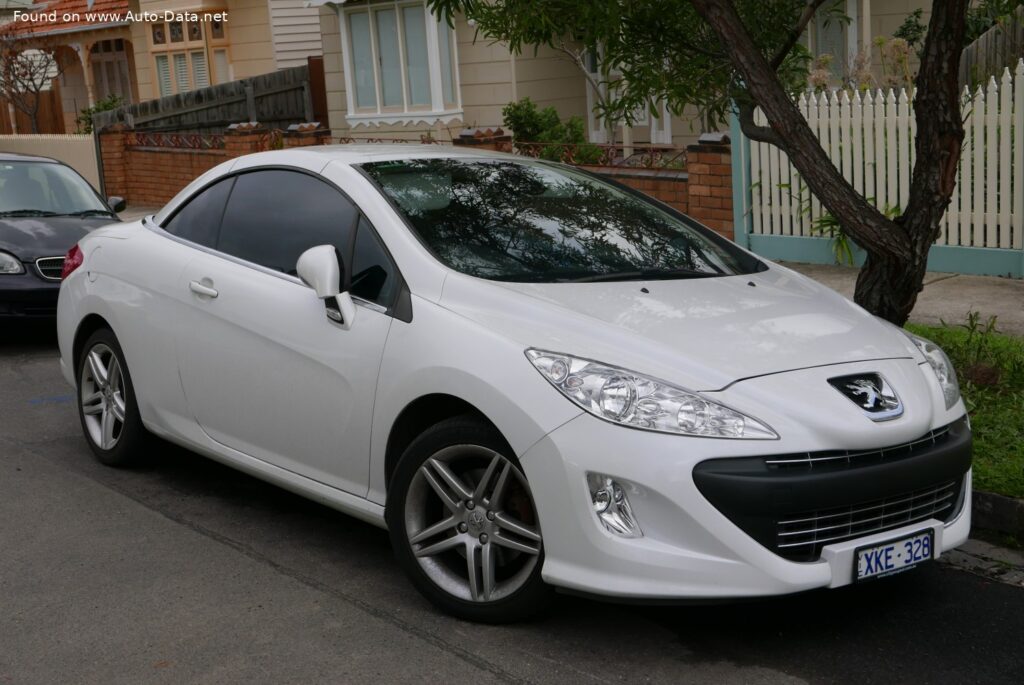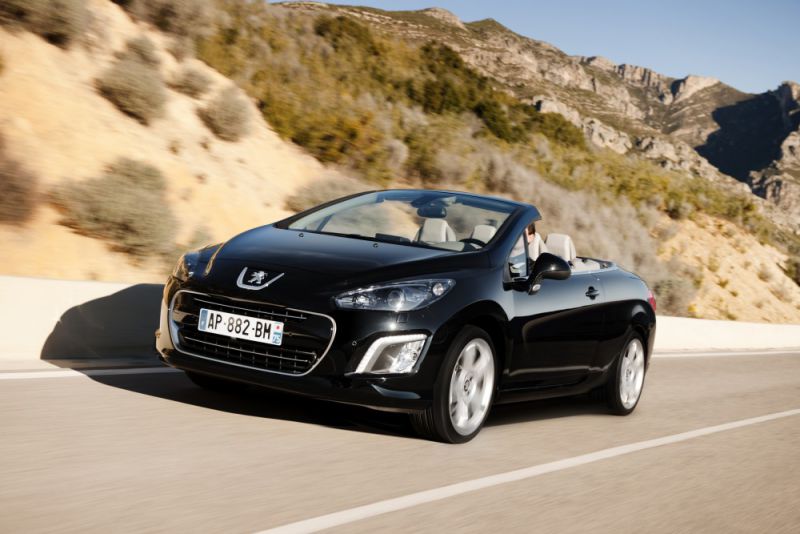
The Peugeot 308 CC I (Phase II, 2011) 1.6 e-HDI represents a refinement of Peugeot’s foray into the compact coupe-cabriolet market. Introduced as a facelift to the original 308 CC, this version, produced from 2013 to 2015, aimed to enhance the vehicle’s appeal with updated styling, improved efficiency, and a focus on modern diesel technology. While not officially sold in the United States, the 308 CC was a popular choice in Europe for buyers seeking a stylish and versatile open-top driving experience. It competed with models like the Renault Mégane Coupé-Cabriolet and Ford Focus CC.
Peugeot 308 CC I (Phase II): A Detailed Overview
The 308 CC, meaning “Coupé Cabriolet,” offered a retractable hardtop, providing the security and refinement of a coupe with the open-air enjoyment of a convertible. The Phase II update brought subtle but noticeable changes to the exterior design, including revised headlights and grille, along with interior enhancements focused on improving the overall driving experience. The 1.6 e-HDI variant, powered by a modern diesel engine, was particularly notable for its fuel efficiency and low emissions, aligning with increasingly stringent European environmental regulations.
Engine & Performance
The heart of the 308 CC I (Phase II) 1.6 e-HDI is a 1.6-liter inline-four cylinder diesel engine, designated 9HC DV6C. This engine produces 115 horsepower at 3600 rpm and a substantial 285 Nm (210.21 lb.-ft.) of torque at 1750 rpm. The engine utilizes a turbocharger with an intercooler and a diesel commonrail fuel injection system to optimize performance and efficiency. The e-HDI designation signifies the inclusion of particulate filter technology, reducing harmful emissions. Power is delivered to the front wheels via a six-speed manual transmission.
Performance figures reflect the car’s focus on economy rather than outright speed. Acceleration from 0 to 100 km/h (0-62 mph) takes 12.2 seconds, while 0 to 60 mph is achieved in approximately 11.6 seconds. The vehicle has a maximum speed of 191 km/h (118.68 mph). The weight-to-power ratio of 13.3 kg/Hp and weight-to-torque ratio of 5.4 kg/Nm demonstrate a reasonable balance between power and vehicle mass. Fuel economy is a key strength, with combined cycle consumption rated at 4.6 l/100 km (51.1 US mpg or 61.4 UK mpg), and CO2 emissions of 119 g/km, meeting Euro 5 emission standards.
Design & Features
The Peugeot 308 CC I (Phase II) is a two-door, four-seat coupe-cabriolet. Its defining feature is the retractable hardtop, which allows the car to transform from a closed coupe to an open-air convertible in approximately 13 seconds. The exterior styling is characterized by a sleek and modern design, with flowing lines and a sporty stance. The Phase II facelift brought subtle revisions to the front fascia, including a redesigned grille and headlights, enhancing the car’s visual appeal.
Inside, the 308 CC offers a comfortable and well-equipped cabin. Standard features typically included air conditioning, power windows, and a basic audio system. Safety features, crucial for a convertible, included ABS (Anti-lock Braking System). The interior design prioritized a driver-focused layout with ergonomic controls. Trunk space is compromised when the roof is retracted, offering 226 liters (7.98 cu. ft.) with the top up and 403 liters (14.23 cu. ft.) with the top down. The vehicle’s kerb weight is 1535 kg (3384.1 lbs), with a maximum permissible weight of 1950 kg (4299.01 lbs).
Technical Specifications
| Brand | Peugeot |
| Model | 308 |
| Generation | 308 CC I (Phase II, 2011) |
| Type (Engine) | 1.6 e-HDI (115 Hp) |
| Start of production | 2013 |
| End of production | 2015 |
| Powertrain Architecture | Internal Combustion engine |
| Body type | Coupe – Cabriolet |
| Seats | 4 |
| Doors | 2 |
| Fuel consumption (urban) | 5.3 l/100 km (44.4 US mpg, 53.3 UK mpg, 18.9 km/l) |
| Fuel consumption (extra urban) | 4.2 l/100 km (56 US mpg, 67.3 UK mpg, 23.8 km/l) |
| Fuel consumption (combined) | 4.6 l/100 km (51.1 US mpg, 61.4 UK mpg, 21.7 km/l) |
| CO2 emissions | 119 g/km |
| Fuel Type | Diesel |
| Acceleration 0 – 100 km/h | 12.2 sec |
| Acceleration 0 – 62 mph | 12.2 sec |
| Acceleration 0 – 60 mph | 11.6 sec |
| Maximum speed | 191 km/h (118.68 mph) |
| Emission standard | Euro 5 |
| Weight-to-power ratio | 13.3 kg/Hp |
| Weight-to-torque ratio | 5.4 kg/Nm |
| Power | 115 Hp @ 3600 rpm |
| Torque | 285 Nm @ 1750 rpm (210.21 lb.-ft. @ 1750 rpm) |
| Engine layout | Front, Transverse |
| Engine Model/Code | 9HC DV6C |
| Engine displacement | 1560 cm3 (95.2 cu. in.) |
| Number of cylinders | 4 |
| Engine configuration | Inline |
| Number of valves per cylinder | 2 |
| Fuel injection system | Diesel Commonrail |
| Engine oil capacity | 3.75 l (3.96 US qt | 3.3 UK qt) |
| Coolant capacity | 6 l (6.34 US qt | 5.28 UK qt) |
| Kerb Weight | 1535 kg (3384.1 lbs) |
| Max. weight | 1950 kg (4299.01 lbs) |
| Max load | 415 kg (914.92 lbs) |
| Trunk (boot) space – minimum | 226 l (7.98 cu. ft.) |
| Trunk (boot) space – maximum | 403 l (14.23 cu. ft.) |
| Fuel tank capacity | 60 l (15.85 US gal | 13.2 UK gal) |
| Length | 4400 mm (173.23 in) |
| Width | 1872 mm (73.7 in) |
| Height | 1426 mm (56.14 in) |
| Wheelbase | 2605 mm (102.56 in) |
| Front track | 1526 mm (60.08 in) |
| Rear track | 1521 mm (59.88 in) |
| Minimum turning circle | 10.74 m (35.24 ft) |
| Drivetrain | Front wheel drive |
| Number of gears | 6 |
| Gearbox type | Manual transmission |
| Front suspension | Independent, McPherson with coil spring and anti-roll bar |
| Rear suspension | Semi-independent, coil spring |
| Front brakes | Ventilated discs |
| Rear brakes | Disc |
| Tires size | 205/55 R16 V |
| Wheel rims size | 16 |