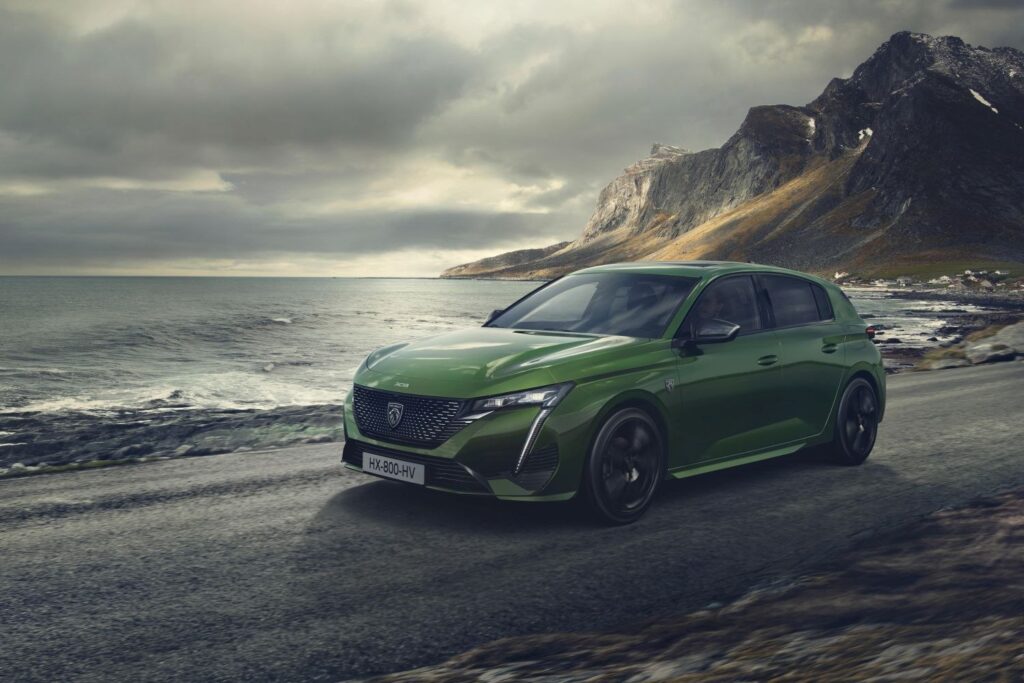
The Peugeot 308 III, launched in 2021 (Phase I), represents the third generation of Peugeot’s popular compact hatchback. Positioned as a direct competitor to vehicles like the Volkswagen Golf, Ford Focus, and Opel Astra, the 308 aims to blend stylish design with efficient technology and a comfortable driving experience. This iteration marked a significant departure from its predecessors, featuring a completely redesigned interior and exterior, and a focus on incorporating modern driver-assistance systems. The 1.2 PureTech 130 Hp EAT8 variant, detailed here, was a key offering in many European markets, providing a balance between performance and fuel economy.
Peugeot 308 III (Phase I): A Detailed Overview
The third-generation 308 builds upon the success of previous models, offering a more refined and technologically advanced package. While not officially sold in the United States, the 308 is a significant player in the European C-segment, known for its distinctive styling and focus on driving dynamics. The Phase I models, produced from September 2021 to January 2024, established the foundation for the 308 III range, with subsequent updates and powertrain options introduced later in its lifecycle.
Engine & Performance
The 1.2 PureTech engine is a three-cylinder, turbocharged gasoline engine that forms the heart of this 308 variant. Producing 130 horsepower at 5500 rpm and 230 Nm (169.64 lb.-ft.) of torque at 1750 rpm, it delivers a respectable level of performance for everyday driving. The engine’s direct injection system and turbocharger work in concert to provide a responsive and efficient power delivery. The power-to-weight ratio of 9.9 kg/Hp and a power-to-torque ratio of 5.6 kg/Nm contribute to a lively driving experience. Paired with the EAT8 (Efficient Automatic Transmission 8-speed) automatic gearbox, the powertrain offers smooth and quick gear changes, enhancing both acceleration and fuel efficiency. The engine layout is front, transverse, and utilizes a timing system with a DOHC valvetrain and 4 valves per cylinder. The 1.2L displacement (1199 cm3 or 73.17 cu. in.) is typical for European compact cars, prioritizing fuel economy and emissions compliance.
Design & Features
The Peugeot 308 III adopts a sleek and modern hatchback body style, characterized by sharp lines, a distinctive front grille, and Peugeot’s signature claw-like LED daytime running lights. The interior represents a significant upgrade over previous generations, featuring a minimalist design with a focus on quality materials and technology. A key highlight is the i-Cockpit interior layout, which includes a compact steering wheel and a raised instrument cluster. This design aims to provide a more engaging and intuitive driving experience. The 308 III offers seating for five passengers and provides 412 liters (14.55 cu. ft.) of trunk space, expandable to 1323 liters (46.72 cu. ft.) with the rear seats folded down. Safety features are comprehensive, including ABS (Anti-lock Braking System) and a suite of advanced driver-assistance systems (ADAS) available as options. The vehicle’s dimensions – 4367 mm (171.93 in.) in length, 1852 mm (72.91 in.) in width, and 1444 mm (56.85 in.) in height – position it squarely within the compact hatchback segment. The drag coefficient of 0.28 contributes to improved aerodynamic efficiency.
Technical Specifications
| Brand | Peugeot |
| Model | 308 |
| Generation | 308 III (Phase I, 2021) |
| Type (Engine) | 1.2 PureTech (130 Hp) EAT8 |
| Start of production | September, 2021 |
| End of production | January, 2024 |
| Powertrain Architecture | Internal Combustion engine |
| Body type | Hatchback |
| Seats | 5 |
| Doors | 5 |
| Fuel Type | Petrol (Gasoline) |
| Emission standard | Euro 6.3 |
| Weight-to-power ratio | 9.9 kg/Hp |
| Weight-to-torque ratio | 5.6 kg/Nm |
| Power | 130 Hp @ 5500 rpm |
| Power per litre | 108.4 Hp/l |
| Torque | 230 Nm @ 1750 rpm (169.64 lb.-ft. @ 1750 rpm) |
| Engine layout | Front, Transverse |
| Engine Model/Code | HNS EB2DTS |
| Engine displacement | 1199 cm3 (73.17 cu. in.) |
| Number of cylinders | 3 |
| Engine configuration | Inline |
| Cylinder Bore | 75 mm (2.95 in.) |
| Piston Stroke | 90.5 mm (3.56 in.) |
| Compression ratio | 10.5:1 |
| Number of valves per cylinder | 4 |
| Fuel injection system | Direct injection |
| Engine aspiration | Turbocharger, Intercooler |
| Valvetrain | DOHC |
| Engine oil capacity | 3.5 l (3.7 US qt | 3.08 UK qt) |
| Kerb Weight | 1289 kg (2841.76 lbs.) |
| Trunk (boot) space – minimum | 412 l (14.55 cu. ft.) |
| Trunk (boot) space – maximum | 1323 l (46.72 cu. ft.) |
| Fuel tank capacity | 52 l (13.74 US gal | 11.44 UK gal) |
| Length | 4367 mm (171.93 in.) |
| Width | 1852 mm (72.91 in.) |
| Width with mirrors folded | 1859 mm (73.19 in.) |
| Width including mirrors | 2062 mm (81.18 in.) |
| Height | 1444 mm (56.85 in.) |
| Wheelbase | 2675 mm (105.31 in.) |
| Front track | 1559 mm (61.38 in.) |
| Rear (Back) track | 1553 mm (61.14 in.) |
| Front overhang | 904 mm (35.59 in.) |
| Rear overhang | 788 mm (31.02 in.) |
| Ride height (ground clearance) | 140 mm (5.51 in.) |
| Drag coefficient (Cd) | 0.28 |
| Minimum turning circle (turning diameter) | 10.51 m (34.48 ft.) |
| Drivetrain Architecture | Front wheel drive. Internal Combustion engine. |
| Drive wheel | Front wheel drive |
| Number of gears and type of gearbox | 8 gears, automatic transmission EAT |
| Assisting systems | ABS (Anti-lock braking system) |
| Steering type | Steering rack and pinion |
| Power steering | Electric Steering |
| Tires size | 205/55 R16; 225/45 R17; 225/40 R18 |