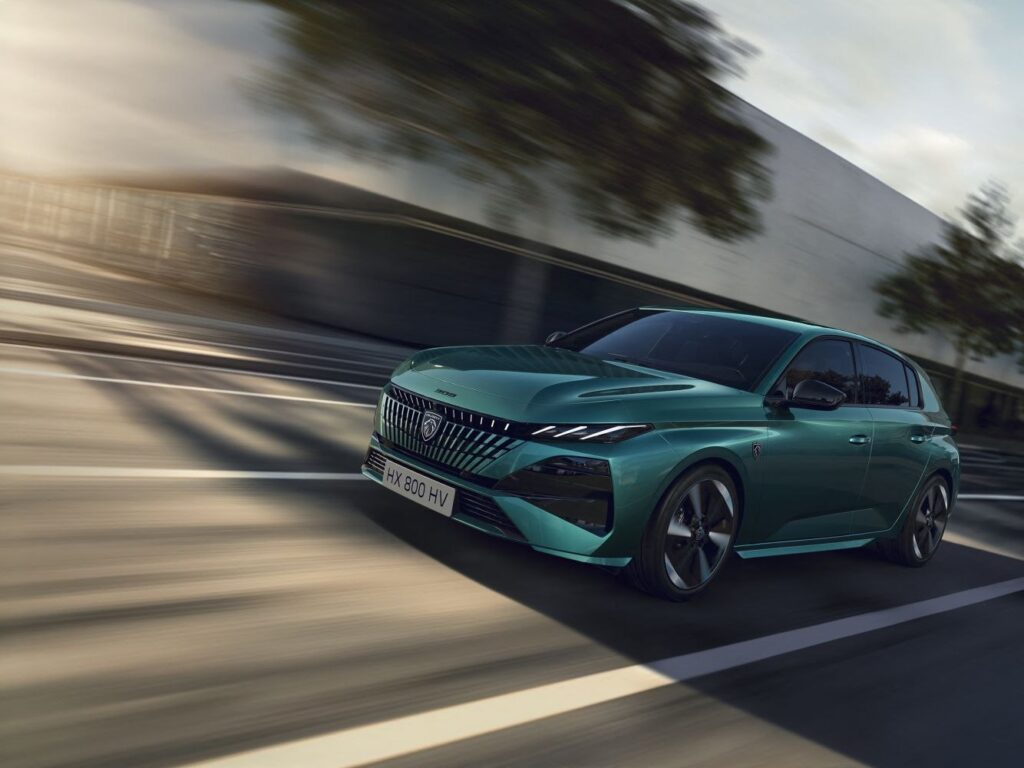
The Peugeot 308 III, specifically the Phase II update arriving in August 2025, represents the latest iteration of Peugeot’s popular compact hatchback. Positioned within the highly competitive C-segment, the 308 competes with vehicles like the Volkswagen Golf, Ford Focus, and Opel Astra. This version introduces significant updates, particularly in its electric variant, the E-308, focusing on enhanced efficiency and technology. While the Peugeot brand has a limited direct presence in the United States, the 308 is a cornerstone model in European markets, known for its stylish design, comfortable ride, and increasingly, its electrified powertrain options.
Peugeot 308 III (Phase II) E-308: An Overview
The Phase II update for the 308 builds upon the foundation laid by the third-generation model, launched in 2021. The E-308 variant, powered by a 58.3 kWh battery, is a key component of Peugeot’s commitment to electrification. This model aims to provide a compelling all-electric driving experience, balancing range, performance, and practicality for everyday use. The 2025 update brings refinements to the vehicle’s design, interior technology, and overall efficiency, solidifying its position as a strong contender in the electric vehicle market.
Engine & Performance
The E-308 58.3 kWh utilizes a fully electric powertrain, designated as a Battery Electric Vehicle (BEV). It features a single electric motor, model ZK02, mounted transversely at the front axle. This motor delivers 156 horsepower at 4070 rpm and 270 Nm (199.14 lb.-ft.) of torque available from 500 to 4060 rpm. The powertrain provides brisk acceleration, achieving 0-100 km/h (0-62 mph) in 9.3 seconds and 0-60 mph in a calculated 8.8 seconds. The E-308 has a maximum speed of 170 km/h (105.63 mph). The weight-to-power ratio is 10.7 kg/Hp, and the weight-to-torque ratio is 6.2 kg/Nm, indicating a reasonably efficient power delivery. The single-speed automatic transmission ensures smooth and seamless acceleration.
Design & Features
The Peugeot 308 III maintains the sleek and modern design language established by its predecessors. As a five-door hatchback, it offers a practical and versatile body style suitable for both urban commuting and longer journeys. The Phase II update includes subtle styling revisions, potentially focusing on the front fascia and lighting elements. Inside, the 308 boasts a minimalist and technology-focused cabin, centered around Peugeot’s i-Cockpit design, featuring a compact steering wheel and a raised instrument cluster. Key features of the E-308 include a 58.3 kWh lithium-nickel-manganese-cobalt oxide (Li-NMC) battery pack located under the floor, providing a usable capacity of 54 kWh. This battery delivers an all-electric range of 443-450 km (275.27 – 279.62 mi) on the WLTP cycle. Safety features are comprehensive, including ABS (Anti-lock Braking System) and a suite of driver-assistance systems. The trunk offers a minimum capacity of 361 liters (12.75 cu. ft.).
Technical Specifications
| Brand | Peugeot |
| Model | 308 |
| Generation | 308 III (Phase II, 2025) |
| Type (Engine) | E-308 58.3 kWh (156 Hp) Electric |
| Start of production | August, 2025 |
| Powertrain Architecture | BEV (Electric Vehicle) |
| Body type | Hatchback |
| Seats | 5 |
| Doors | 5 |
| Fuel Type | Electricity |
| Acceleration 0 – 100 km/h | 9.3 sec |
| Acceleration 0 – 62 mph | 9.3 sec |
| Acceleration 0 – 60 mph | 8.8 sec |
| Maximum speed | 170 km/h (105.63 mph) |
| Weight-to-power ratio | 10.7 kg/Hp |
| Weight-to-torque ratio | 6.2 kg/Nm |
| Gross battery capacity | 58.3 kWh |
| Net (usable) battery capacity | 54 kWh |
| Battery voltage | 400 V |
| Battery technology | Lithium nickel manganese cobalt oxides (Li-NMC) |
| Battery weight | 373 kg (822.32 lbs.) |
| Battery location | Below the floor |
| All-electric range (WLTP) | 443-450 km (275.27 – 279.62 mi) |
| Average Energy consumption (WLTP) | 14.9-15.0 kWh/100 km |
| MPGe | 141 – 140 |
| km/kWh | 6.7 – 6.7 |
| mi/kWh | 4.2 – 4.1 |
| Electric motor power | 156 Hp @ 4070 rpm |
| Electric motor Torque | 270 Nm @ 500-4060 rpm (199.14 lb.-ft. @ 500-4060 rpm) |
| Electric motor model/code | ZK02 |
| Electric motor location | Front axle, Transverse |
| Electric motor type | Synchronous |
| System power | 156 Hp @ 4070 rpm |
| System torque | 270 Nm @ 500-4060 rpm (199.14 lb.-ft. @ 500-4060 rpm) |
| Kerb Weight | 1674 kg (3690.54 lbs.) |
| Max. weight | 2115 kg (4662.78 lbs.) |
| Max load | 441 kg (972.24 lbs.) |
| Trunk (boot) space – minimum | 361 l (12.75 cu. ft.) |
| Length | 4360 mm (171.65 in.) |
| Width | 1850 mm (72.83 in.) |
| Height | 1460 mm (57.48 in.) |
| Wheelbase | 2670 mm (105.12 in.) |
| Drag coefficient (Cd) | 0.27 |
| Minimum turning circle | 10.95 m (35.93 ft.) |
| Drivetrain Architecture | One electric motor drives the front wheels. |
| Drive wheel | Front wheel drive |
| Number of gears | 1 |
| Type of gearbox | automatic transmission |
| Front suspension | Independent type McPherson |
| Rear suspension | Torsion |
| Front brakes | Ventilated discs, 304 mm |
| Rear brakes | Disc, 290 mm |
| Steering type | Steering rack and pinion |
| Power steering | Electric Steering |
| Tires size | 215/45 R18 |
| Wheel rims size | 18 |
The Peugeot 308 III Phase II E-308 represents a significant step forward in Peugeot’s electric vehicle strategy, offering a compelling blend of style, efficiency, and technology within the competitive compact hatchback segment.