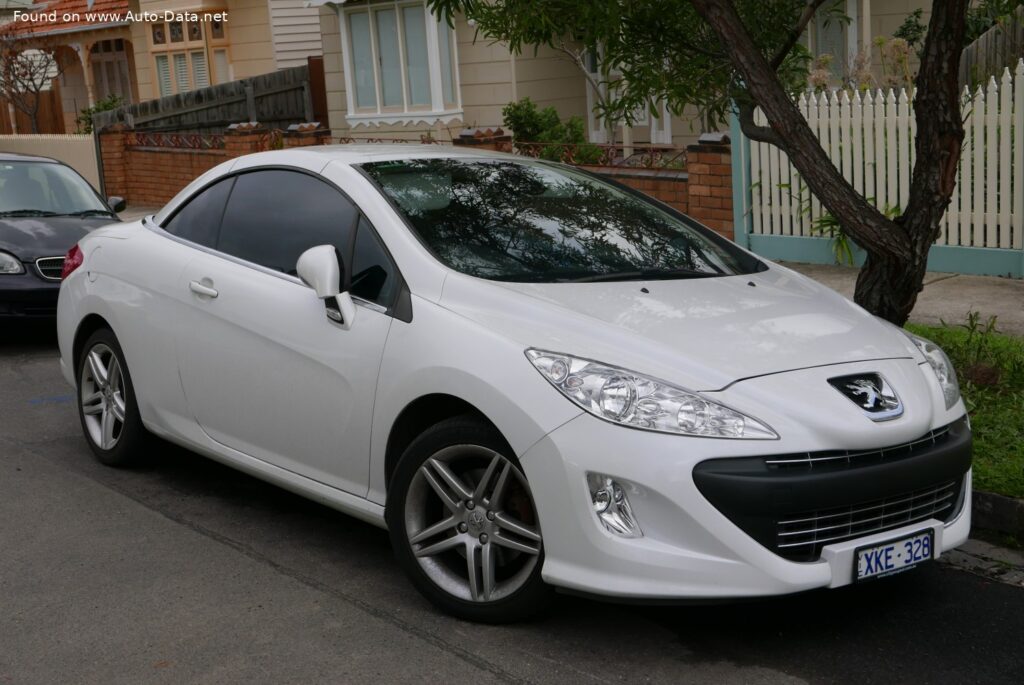
The Peugeot 308 SW I (Phase I) is a compact station wagon that was produced between 2008 and 2010. Part of the first generation of the 308 series, it represented Peugeot’s entry into the competitive European small family car segment, offering a practical and stylish alternative to traditional hatchbacks. The “SW” designation signifies “Station Wagon,” highlighting its focus on increased cargo capacity and versatility. This particular variant, equipped with the 1.6 16V THP engine producing 175 horsepower, aimed to balance performance with reasonable fuel economy, appealing to families and individuals needing a flexible vehicle for both daily commutes and longer journeys.
Peugeot 308 SW I (Phase I): Overview
The 308 SW I (Phase I) was designed as a successor to the Peugeot 307, addressing criticisms leveled at its predecessor regarding build quality and refinement. The SW body style, in particular, was a key offering for European consumers who favored the practicality of a wagon. Unlike the North American market where station wagons saw declining popularity, the SW remained a significant part of Peugeot’s sales volume in Europe. The Phase I models, produced from 2008 to 2010, established the design language and mechanical underpinnings for the 308 SW range.
Engine & Performance
The heart of this 308 SW variant is the 1.6-liter 16V THP (Turbo High Pressure) inline-four cylinder engine. This engine, designated 5FY EP6DTS, utilizes direct fuel injection and a turbocharger with an intercooler to deliver a respectable 175 horsepower at 6000 rpm and 240 Nm (177 lb-ft) of torque at 1600 rpm. This configuration provides a good balance between responsiveness and fuel efficiency. The engine’s power-to-liter ratio is 109.5 hp/l. Power is delivered to the front wheels via a six-speed manual transmission. Performance figures include a 0-100 km/h (0-62 mph) acceleration time of 9 seconds, and a 0-60 mph time of 8.6 seconds, with a maximum speed of 215 km/h (133.59 mph). The weight-to-power ratio is 8.7 kg/Hp, and the weight-to-torque ratio is 6.4 kg/Nm.
Design & Features
The Peugeot 308 SW I (Phase I) features a classic station wagon profile, characterized by its extended roofline and large rear cargo area. The vehicle offers seating for five, with some configurations accommodating up to seven passengers. The interior design prioritizes functionality and ergonomics, with a focus on providing a comfortable and practical space for both driver and passengers. Key features included standard ABS (Anti-lock braking system), electric power steering, and a McPherson strut front suspension paired with a coil spring torsion beam rear suspension. The SW’s defining characteristic is its spacious trunk, offering a minimum capacity of 573 liters (20.24 cu ft) which expands to a substantial 1736 liters (61.31 cu ft) with the rear seats folded down. The exterior dimensions are 4500 mm (177.17 in) in length, 1815 mm (71.46 in) in width, and 1564 mm (61.57 in) in height.
Technical Specifications
| Brand | Peugeot |
| Model | 308 |
| Generation | 308 SW I (Phase I, 2008) |
| Type (Engine) | 1.6 16V THP (175 Hp) |
| Start of production | 2008 |
| End of production | 2010 |
| Powertrain Architecture | Internal Combustion engine |
| Body type | Station wagon (estate) |
| Seats | 5-7 |
| Doors | 5 |
| Fuel consumption (urban) | 10.9 l/100 km (21.6 US mpg, 25.9 UK mpg, 9.2 km/l) |
| Fuel consumption (extra urban) | 6 l/100 km (39.2 US mpg, 47.1 UK mpg, 16.7 km/l) |
| Fuel consumption (combined) | 7.8 l/100 km (30.2 US mpg, 36.2 UK mpg, 12.8 km/l) |
| CO2 emissions | 185 g/km |
| Fuel Type | Petrol (Gasoline) |
| Acceleration 0 – 100 km/h | 9 sec |
| Acceleration 0 – 62 mph | 9 sec |
| Acceleration 0 – 60 mph | 8.6 sec |
| Maximum speed | 215 km/h (133.59 mph) |
| Emission standard | Euro 4 |
| Weight-to-power ratio | 8.7 kg/Hp |
| Weight-to-torque ratio | 6.4 kg/Nm |
| Power | 175 Hp @ 6000 rpm |
| Torque | 240 Nm @ 1600 rpm (177.01 lb.-ft. @ 1600 rpm) |
| Engine layout | Front, Transverse |
| Engine Model/Code | 5FY EP6DTS |
| Engine displacement | 1598 cm3 (97.52 cu. in.) |
| Number of cylinders | 4 |
| Engine configuration | Inline |
| Cylinder Bore | 77 mm (3.03 in.) |
| Piston Stroke | 85.8 mm (3.38 in.) |
| Number of valves per cylinder | 4 |
| Fuel injection system | Direct injection |
| Engine aspiration | Turbocharger, Intercooler |
| Valvetrain | DOHC |
| Engine oil capacity | 4.25 l (4.49 US qt | 3.74 UK qt) |
| Coolant | 6 l (6.34 US qt | 5.28 UK qt) |
| Kerb Weight | 1524 kg (3359.84 lbs.) |
| Max. weight | 2130 kg (4695.85 lbs.) |
| Max load | 606 kg (1336 lbs.) |
| Trunk (boot) space – minimum | 573 l (20.24 cu. ft.) |
| Trunk (boot) space – maximum | 1736 l (61.31 cu. ft.) |
| Fuel tank capacity | 60 l (15.85 US gal | 13.2 UK gal) |
| Max. roof load | 75 kg (165.35 lbs.) |
| Permitted trailer load with brakes (12%) | 1650 kg (3637.63 lbs.) |
| Permitted trailer load without brakes | 750 kg (1653.47 lbs.) |
| Permitted towbar download | 70 kg (154.32 lbs.) |
| Length | 4500 mm (177.17 in.) |
| Width | 1815 mm (71.46 in.) |
| Width including mirrors | 2038 mm (80.24 in.) |
| Height | 1564 mm (61.57 in.) |
| Wheelbase | 2708 mm (106.61 in.) |
| Front track | 1526-1536 mm (60.08 – 60.47 in.) |
| Rear track | 1521-1531 mm (59.88 – 60.28 in.) |
| Front overhang | 926 mm (36.46 in.) |
| Rear overhang | 866 mm (34.09 in.) |
| Minimum turning circle | 10.7 m (35.1 ft.) |
| Drivetrain | Front wheel drive |
| Number of gears | 6 gears, manual transmission |
| Front suspension | Independent, type McPherson with coil spring and anti-roll bar |
| Rear suspension | Coil spring, Torsion |
| Front brakes | Ventilated discs |
| Rear brakes | Disc |
| Tires size | 225/45 R17; 225/40 R18 |
| Wheel rims size | 7.5J x 17; 8J x 18 |