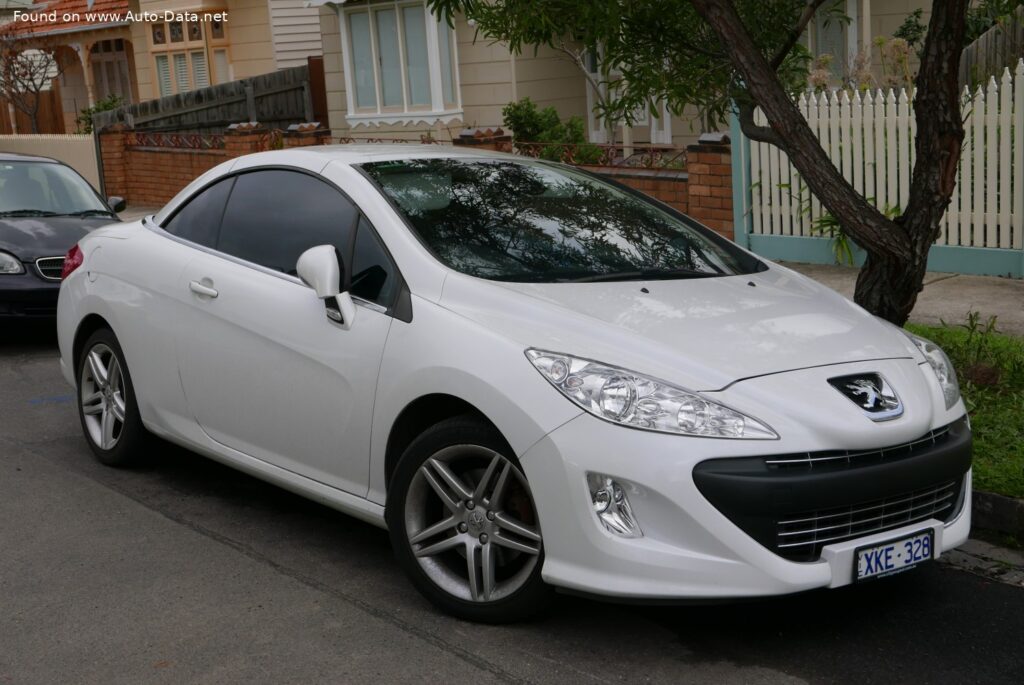
The Peugeot 308 SW I (Phase I), produced from 2010 to 2011, represents Peugeot’s entry into the competitive compact station wagon (estate) segment. As a practical and stylish vehicle, the 308 SW aimed to provide a versatile option for families and individuals needing increased cargo capacity without sacrificing driving pleasure. This particular variant, the Premium 1.6 16V VTi, featured a 1.6-liter naturally aspirated gasoline engine producing 120 horsepower. While not initially a high-volume seller in the United States due to Peugeot’s limited presence in the North American market, the 308 SW was a significant model in Europe, offering a compelling alternative to rivals like the Ford Focus Estate and Volkswagen Golf Variant.
Peugeot 308 SW I (Phase I): Overview
The 308 SW is the station wagon version of the Peugeot 308, which itself was a successor to the popular 307. The “SW” designation stands for “Station Wagon,” signifying its focus on practicality and cargo space. The Phase I models, produced between 2010 and 2011, represent the initial iteration of the first-generation 308 SW. The Premium trim level offered a higher level of standard equipment and refinement compared to base models, appealing to buyers seeking a more comfortable and well-equipped vehicle. The 1.6 VTi engine was a common choice in European markets, balancing fuel efficiency with adequate performance for everyday driving.
Engine & Performance
The Peugeot 308 SW Premium 1.6 16V VTi is powered by a 1.6-liter inline-four cylinder gasoline engine. This engine, designated 5FW EP6, produces 120 horsepower at 6000 rpm and 160 Nm (118.01 lb.-ft.) of torque at 4250 rpm. The engine utilizes multi-port fuel injection and a double overhead camshaft (DOHC) valvetrain, contributing to its relatively efficient operation. Power is delivered to the front wheels via a five-speed manual transmission. Acceleration from 0 to 100 km/h (0-62 mph) takes approximately 12 seconds, while 0 to 60 mph is achieved in around 11.4 seconds. The vehicle has a maximum speed of 189 km/h (117.44 mph). The engine’s power-to-weight ratio is 12.7 kg/Hp, and the torque-to-weight ratio is 9.5 kg/Nm. The engine’s displacement of 1598 cm3 (97.52 cu. in.) and a compression ratio optimized for both performance and fuel economy.
Design & Features
The 308 SW boasts a classic station wagon profile, characterized by its extended roofline and generous cargo area. The Phase I models feature Peugeot’s distinctive styling cues of the era, including a prominent front grille and sculpted body lines. The interior is designed with practicality in mind, offering comfortable seating for up to five passengers, with some configurations offering optional seven-seat layouts. The Premium trim level includes features such as air conditioning, power windows, and a quality audio system. Safety features, while standard for the time, included ABS (Anti-lock Braking System) and driver/passenger airbags. The SW’s key advantage lies in its spacious cargo area, offering 573 liters (20.24 cu. ft.) of space with the rear seats up and expanding to 1736 liters (61.31 cu. ft.) with the seats folded down. The vehicle’s dimensions are 4500 mm (177.17 in.) in length, 1815 mm (71.46 in.) in width, and 1564 mm (61.57 in.) in height.
Technical Specifications
| Brand | Peugeot |
| Model | 308 |
| Generation | 308 SW I (Phase I, 2008) |
| Type (Engine) | Premium 1.6 16V VTi (120 Hp) |
| Start of production | 2010 |
| End of production | 2011 |
| Powertrain Architecture | Internal Combustion engine |
| Body type | Station wagon (estate) |
| Seats | 5-7 |
| Doors | 5 |
| Fuel consumption (urban) | 9.1-9.3 l/100 km (25.8 – 25.3 US mpg) |
| Fuel consumption (extra urban) | 5.3-5.5 l/100 km (44.4 – 42.8 US mpg) |
| Fuel consumption (combined) | 6.7-6.9 l/100 km (35.1 – 34.1 US mpg) |
| CO2 emissions | 155-159 g/km |
| Fuel Type | Petrol (Gasoline) |
| Acceleration 0 – 100 km/h | 12 sec |
| Acceleration 0 – 62 mph | 12 sec |
| Acceleration 0 – 60 mph | 11.4 sec |
| Maximum speed | 189 km/h (117.44 mph) |
| Emission standard | Euro 5 |
| Weight-to-power ratio | 12.7 kg/Hp |
| Weight-to-torque ratio | 9.5 kg/Nm |
| Power | 120 Hp @ 6000 rpm |
| Torque | 160 Nm @ 4250 rpm (118.01 lb.-ft. @ 4250 rpm) |
| Engine layout | Front, Transverse |
| Engine Model/Code | 5FW EP6 |
| Engine displacement | 1598 cm3 (97.52 cu. in.) |
| Number of cylinders | 4 |
| Engine configuration | Inline |
| Cylinder Bore | 77 mm (3.03 in.) |
| Piston Stroke | 85.8 mm (3.38 in.) |
| Number of valves per cylinder | 4 |
| Fuel injection system | Multi-port manifold injection |
| Engine aspiration | Naturally aspirated engine |
| Valvetrain | DOHC |
| Engine oil capacity | 4.25 l (4.49 US qt | 3.74 UK qt) |
| Coolant | 6 l (6.34 US qt | 5.28 UK qt) |
| Kerb Weight | 1518 kg (3346.62 lbs.) |
| Max. weight | 2100 kg (4629.71 lbs.) |
| Max load | 582 kg (1283.09 lbs.) |
| Trunk (boot) space – minimum | 573 l (20.24 cu. ft.) |
| Trunk (boot) space – maximum | 1736 l (61.31 cu. ft.) |
| Fuel tank capacity | 60 l (15.85 US gal | 13.2 UK gal) |
| Max. roof load | 75 kg (165.35 lbs.) |
| Permitted trailer load with brakes (12%) | 1400 kg (3086.47 lbs.) |
| Permitted trailer load without brakes | 740 kg (1631.42 lbs.) |
| Permitted towbar download | 60 kg (132.28 lbs.) |
| Length | 4500 mm (177.17 in.) |
| Width | 1815 mm (71.46 in.) |
| Width including mirrors | 2038 mm (80.24 in.) |
| Height | 1564 mm (61.57 in.) |
| Wheelbase | 2708 mm (106.61 in.) |
| Front track | 1526-1536 mm (60.08 – 60.47 in.) |
| Rear (Back) track | 1521-1531 mm (59.88 – 60.28 in.) |
| Front overhang | 926 mm (36.46 in.) |
| Rear overhang | 866 mm (34.09 in.) |
| Minimum turning circle | 10.7 m (35.1 ft.) |
| Drive wheel | Front wheel drive |
| Number of gears | 5 gears, manual transmission |
| Front suspension | Independent, type McPherson with coil spring and anti-roll bar |
| Rear suspension | Coil spring, Torsion |
| Front brakes | Ventilated discs |
| Rear brakes | Disc |
| Steering type | Steering rack and pinion |
| Power steering | Electric Steering |
| Tires size | 205/55 R16; 225/45 R17; 225/40 R18 |
| Wheel rims size | 7J x 16; 7.5J x 17; 8J x 18 |