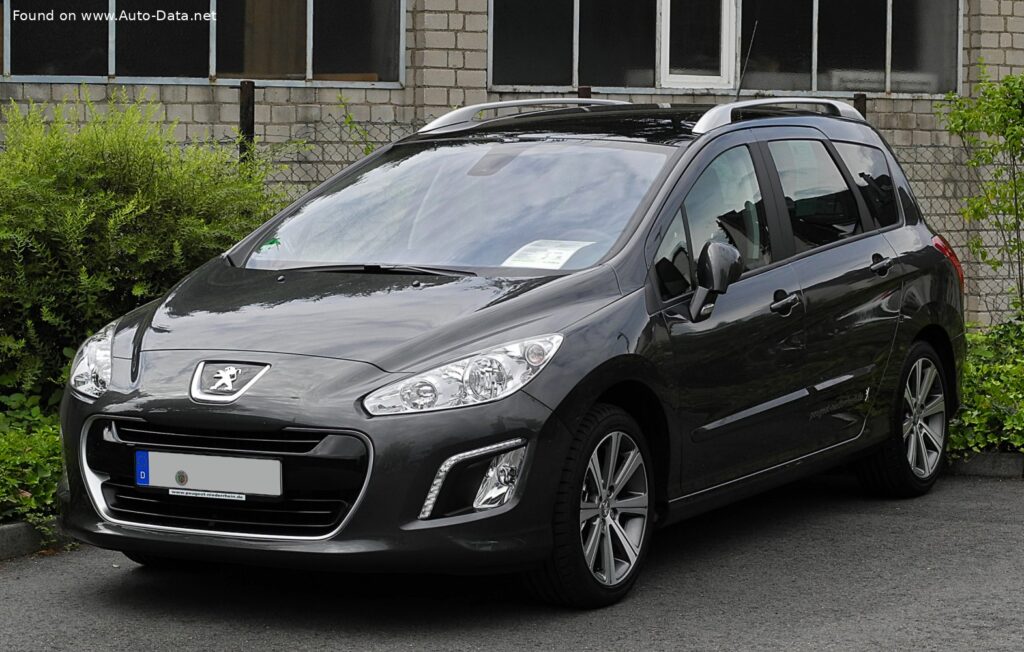
The Peugeot 308 SW I (Phase II, 2011) 1.6 16V THP (156 Hp) Automatic is a station wagon that represents a significant update to the first generation of the 308 SW. Introduced in 2011 and continuing through 2014, this variant aimed to blend practicality with a more refined driving experience. The 308 SW, in general, served as Peugeot’s competitor in the compact family estate segment, primarily targeting the European market where wagons maintain substantial popularity. While not officially sold in the United States, understanding its specifications provides insight into the engineering and design philosophies prevalent in European automotive manufacturing during this period.
Peugeot 308 SW I (Phase II): Overview
The 308 SW, meaning “Station Wagon,” offered a more versatile alternative to the standard 308 hatchback. The Phase II update brought styling revisions, improved interior materials, and enhanced equipment levels. The 1.6 16V THP engine, coupled with a six-speed automatic transmission, was a key powertrain option, balancing performance with fuel efficiency. This model catered to families and individuals needing ample cargo space without sacrificing driving comfort or modern features.
Engine & Performance
At the heart of the 308 SW I (Phase II) 1.6 16V THP Automatic lies a 1.6-liter inline-four cylinder engine. This engine, designated 5FV EP6CDT, utilizes direct fuel injection and a turbocharger with an intercooler to produce 156 horsepower at 6000 rpm and 240 Nm (177.01 lb.-ft.) of torque at 1400 rpm. This configuration delivers a good balance of power and responsiveness for everyday driving. The engine’s power-to-liter ratio is a respectable 97.6 hp/l. The six-speed automatic transmission provides smooth gear changes and contributes to a comfortable driving experience. Performance figures include a 0-100 km/h (0-62 mph) acceleration time of 9.7 seconds and a 0-60 mph time of 9.2 seconds, with a maximum speed of 210 km/h (130.49 mph). The weight-to-power ratio of 9.9 kg/Hp and weight-to-torque ratio of 6.4 kg/Nm indicate a reasonably efficient powertrain.
Design & Features
The Peugeot 308 SW I (Phase II) is a five-door station wagon with seating for five, and optionally seven, passengers. Its exterior design features a sloping roofline and a long, practical cargo area. The Phase II updates included revised front and rear styling, giving the car a more modern and refined appearance. Inside, the cabin was designed with practicality and comfort in mind. Key features included a spacious interior, comfortable seating, and a user-friendly infotainment system for the time. Safety features, crucial for family vehicles, included ABS (Anti-lock Braking System) and a robust body structure. The vehicle’s dimensions – 4500 mm (177.17 in) in length, 1815 mm (71.46 in) in width, and 1555 mm (61.22 in) in height – provide ample interior space without being overly cumbersome. The trunk offers a minimum capacity of 573 liters (20.24 cu. ft.), expanding to a substantial 1736 liters (61.31 cu. ft.) with the rear seats folded down.
Technical Specifications
| Brand | Peugeot |
| Model | 308 |
| Generation | 308 SW I (Phase II, 2011) |
| Type (Engine) | 1.6 16V THP (156 Hp) Automatic |
| Start of production | 2011 |
| End of production | 2014 |
| Powertrain Architecture | Internal Combustion engine |
| Body type | Station wagon (estate) |
| Seats | 5-7 |
| Doors | 5 |
| Fuel consumption (urban) | 11 l/100 km (21.4 US mpg, 25.7 UK mpg, 9.1 km/l) |
| Fuel consumption (extra urban) | 5.8 l/100 km (40.6 US mpg, 48.7 UK mpg, 17.2 km/l) |
| Fuel consumption (combined) | 7.8 l/100 km (30.2 US mpg, 36.2 UK mpg, 12.8 km/l) |
| CO2 emissions | 180 g/km |
| Fuel Type | Petrol (Gasoline) |
| Acceleration 0 – 100 km/h | 9.7 sec |
| Acceleration 0 – 62 mph | 9.7 sec |
| Acceleration 0 – 60 mph | 9.2 sec |
| Maximum speed | 210 km/h (130.49 mph) |
| Emission standard | Euro 5 |
| Weight-to-power ratio | 9.9 kg/Hp |
| Weight-to-torque ratio | 6.4 kg/Nm |
| Power | 156 Hp @ 6000 rpm |
| Torque | 240 Nm @ 1400 rpm (177.01 lb.-ft. @ 1400 rpm) |
| Engine layout | Front, Transverse |
| Engine Model/Code | 5FV EP6CDT |
| Engine displacement | 1598 cm3 (97.52 cu. in.) |
| Number of cylinders | 4 |
| Engine configuration | Inline |
| Cylinder Bore | 77 mm (3.03 in.) |
| Piston Stroke | 85.8 mm (3.38 in.) |
| Number of valves per cylinder | 4 |
| Fuel injection system | Direct injection |
| Engine aspiration | Turbocharger, Intercooler |
| Valvetrain | DOHC |
| Engine oil capacity | 4.25 l (4.49 US qt | 3.74 UK qt) |
| Coolant | 6.2 l (6.55 US qt | 5.46 UK qt) |
| Kerb Weight | 1541 kg (3397.32 lbs.) |
| Max. weight | 2160 kg (4761.98 lbs.) |
| Max load | 619 kg (1364.66 lbs.) |
| Trunk (boot) space – minimum | 573 l (20.24 cu. ft.) |
| Trunk (boot) space – maximum | 1736 l (61.31 cu. ft.) |
| Fuel tank capacity | 60 l (15.85 US gal | 13.2 UK gal) |
| Max. roof load | 75 kg (165.35 lbs.) |
| Permitted trailer load with brakes (12%) | 1350 kg (2976.24 lbs.) |
| Permitted trailer load without brakes | 750 kg (1653.47 lbs.) |
| Permitted towbar download | 60 kg (132.28 lbs.) |
| Length | 4500 mm (177.17 in.) |
| Width | 1815 mm (71.46 in.) |
| Width including mirrors | 2038 mm (80.24 in.) |
| Height | 1555 mm (61.22 in.) |
| Wheelbase | 2708 mm (106.61 in.) |
| Front track | 1526 mm (60.08 in.) |
| Rear track | 1521 mm (59.88 in.) |
| Front overhang | 926 mm (36.46 in.) |
| Rear overhang | 866 mm (34.09 in.) |
| Minimum turning circle | 10.7 m (35.1 ft.) |
| Drivetrain | Front wheel drive |
| Number of gears | 6 |
| Gearbox type | Automatic transmission |
| Front suspension | Independent, type McPherson with coil spring and anti-roll bar |
| Rear suspension | Coil spring, Torsion |
| Front brakes | Ventilated discs |
| Rear brakes | Disc |
| Steering type | Steering rack and pinion |
| Power steering | Electric Steering |
| Tires size | 225/45 R17 |
| Wheel rims size | 7.5J x 17 |
The Peugeot 308 SW I (Phase II) 1.6 16V THP Automatic represents a well-rounded package for those seeking a practical and comfortable family vehicle. Its blend of fuel efficiency, performance, and spaciousness made it a popular choice in the European market.