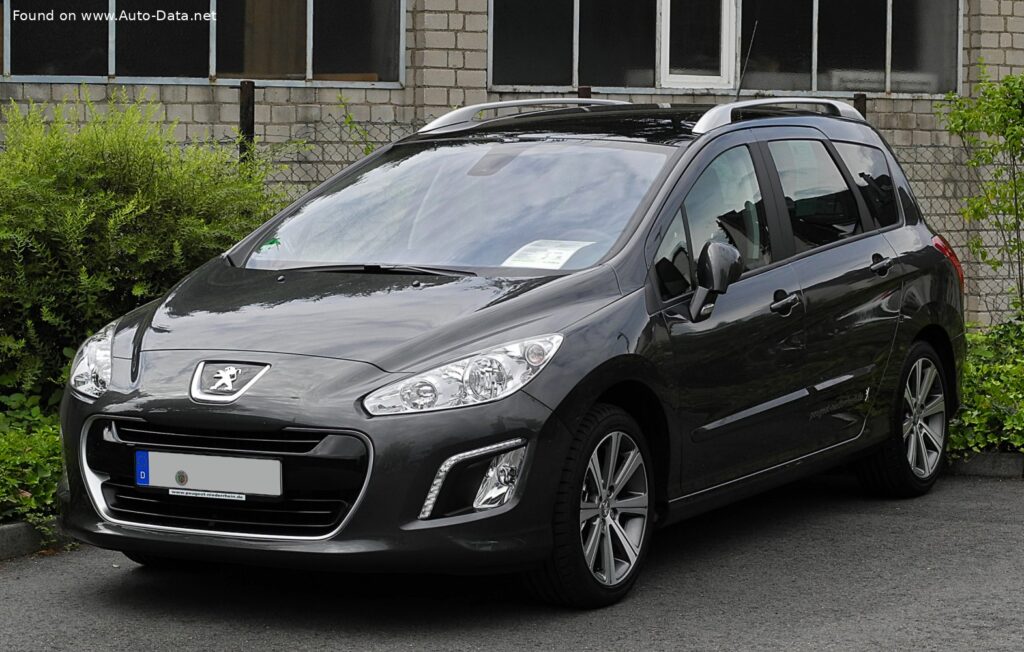
The Peugeot 308 SW I (Phase II, 2011) 1.6 16V VTi Automatic is a station wagon that represents a significant iteration of Peugeot’s compact family vehicle. Introduced as part of the first generation 308 SW series, the Phase II update, launched in 2011, brought refinements to styling, technology, and efficiency. Positioned within the European C-segment, the 308 SW competed with vehicles like the Volkswagen Golf Estate, Ford Focus Estate, and Renault Mégane Sport Tourer. While not officially sold in the United States, the 308 SW was a popular choice for families in Europe seeking a practical and stylish vehicle offering a blend of comfort, space, and fuel economy.
Peugeot 308 SW I (Phase II): Overview and Market Position
The 308 SW, meaning “Station Wagon,” was Peugeot’s offering in the increasingly popular estate car segment. The Phase II update for the 2011 model year focused on enhancing the vehicle’s appeal through subtle cosmetic changes, improved interior materials, and the introduction of updated engine options. The 1.6 16V VTi engine, paired with an automatic transmission, was a common configuration, aimed at buyers prioritizing ease of use and reasonable running costs. The 308 SW distinguished itself with a spacious interior, a large cargo area, and Peugeot’s characteristic focus on driving dynamics. It served as a versatile vehicle for both daily commuting and longer journeys, catering to families and individuals needing ample cargo capacity.
Engine & Performance
The 2011 Peugeot 308 SW 1.6 16V VTi Automatic is powered by a 1.6-liter inline-four cylinder naturally aspirated gasoline engine. This engine, designated EP6, produces 120 horsepower at 6000 rpm and 160 Nm (118.01 lb.-ft.) of torque at 4250 rpm. The engine utilizes multi-port fuel injection and features 16 valves (four per cylinder). Power is delivered to the front wheels via a four-speed automatic transmission. Performance figures include a 0-100 km/h (0-62 mph) acceleration time of 14 seconds and a maximum speed of 182 km/h (113.09 mph). The 0-60 mph acceleration is calculated at 13.3 seconds. The engine’s power-to-weight ratio is 11.9 kg/Hp, and the torque-to-weight ratio is 8.9 kg/Nm. Fuel economy is rated at 7.2 liters per 100 kilometers (32.7 US mpg, 39.2 UK mpg) on a combined cycle, with 10 l/100 km (23.5 US mpg) in urban conditions and 5.5 l/100 km (42.8 US mpg) on the extra-urban cycle.
Design & Features
The Peugeot 308 SW I (Phase II) is a five-door, five-seat station wagon. Its exterior design features a sloping roofline and a relatively long wheelbase, maximizing interior space. The Phase II update included minor styling tweaks to the front and rear fascias, including revised headlights and taillights. Inside, the 308 SW offers a practical and comfortable cabin. The rear seats can be folded down to create a significantly larger cargo area. Trunk space ranges from a minimum of 520 liters (18.36 cu. ft.) to a maximum of 2149 liters (75.89 cu. ft.) with the rear seats folded. Standard features typically included air conditioning, power windows, central locking, and an audio system. Safety features, in line with European standards of the time, included ABS (Anti-lock Braking System) and front airbags. The vehicle’s dimensions are: length 4500 mm (177.17 in.), width 1815 mm (71.46 in.), and height 1564 mm (61.57 in.). The wheelbase measures 2708 mm (106.61 in.).
Technical Specifications
| Brand | Peugeot |
| Model | 308 |
| Generation | 308 SW I (Phase II, 2011) |
| Type (Engine) | 1.6 16V VTi (120 Hp) Automatic |
| Start of production | 2011 |
| End of production | 2013 |
| Powertrain Architecture | Internal Combustion engine |
| Body type | Station wagon (estate) |
| Seats | 5 |
| Doors | 5 |
| Fuel consumption (urban) | 10 l/100 km (23.5 US mpg) |
| Fuel consumption (extra urban) | 5.5 l/100 km (42.8 US mpg) |
| Fuel consumption (combined) | 7.2 l/100 km (32.7 US mpg) |
| Fuel Type | Petrol (Gasoline) |
| Acceleration 0 – 100 km/h | 14 sec |
| Acceleration 0 – 62 mph | 14 sec |
| Acceleration 0 – 60 mph | 13.3 sec |
| Maximum speed | 182 km/h (113.09 mph) |
| Emission standard | Euro 5 |
| Weight-to-power ratio | 11.9 kg/Hp |
| Weight-to-torque ratio | 8.9 kg/Nm |
| Power | 120 Hp @ 6000 rpm |
| Torque | 160 Nm @ 4250 rpm (118.01 lb.-ft. @ 4250 rpm) |
| Engine layout | Front, Transverse |
| Engine Model/Code | EP6 |
| Engine displacement | 1598 cm3 (97.52 cu. in.) |
| Number of cylinders | 4 |
| Engine configuration | Inline |
| Number of valves per cylinder | 4 |
| Fuel injection system | Multi-port manifold injection |
| Engine aspiration | Naturally aspirated engine |
| Engine oil capacity | 4.25 l (4.49 US qt | 3.74 UK qt) |
| Coolant capacity | 6 l (6.34 US qt | 5.28 UK qt) |
| Kerb Weight | 1430 kg (3152.61 lbs.) |
| Max. weight | 2130 kg (4695.85 lbs.) |
| Max load | 700 kg (1543.24 lbs.) |
| Trunk (boot) space – minimum | 520 l (18.36 cu. ft.) |
| Trunk (boot) space – maximum | 2149 l (75.89 cu. ft.) |
| Fuel tank capacity | 60 l (15.85 US gal | 13.2 UK gal) |
| Length | 4500 mm (177.17 in.) |
| Width | 1815 mm (71.46 in.) |
| Height | 1564 mm (61.57 in.) |
| Wheelbase | 2708 mm (106.61 in.) |
| Minimum turning circle | 11.08 m (36.35 ft.) |
| Drivetrain Architecture | Front wheel drive |
| Number of gears | 4 |
| Gearbox type | Automatic transmission |
| Front suspension | Independent, McPherson with coil spring and anti-roll bar |
| Rear suspension | Semi-independent, coil spring |
| Front brakes | Ventilated discs |
| Rear brakes | Disc |
| Assisting systems | ABS (Anti-lock braking system) |
| Steering type | Steering rack and pinion |
| Power steering | Electric |
| Tires size | 205/55 R16 V; 225/45 R17 V |
| Wheel rims size | 16; 17 |
The Peugeot 308 SW I (Phase II, 2011) 1.6 16V VTi Automatic offered a practical and efficient solution for families in Europe. Its combination of spaciousness, reasonable performance, and fuel economy made it a competitive choice in the C-segment station wagon market.