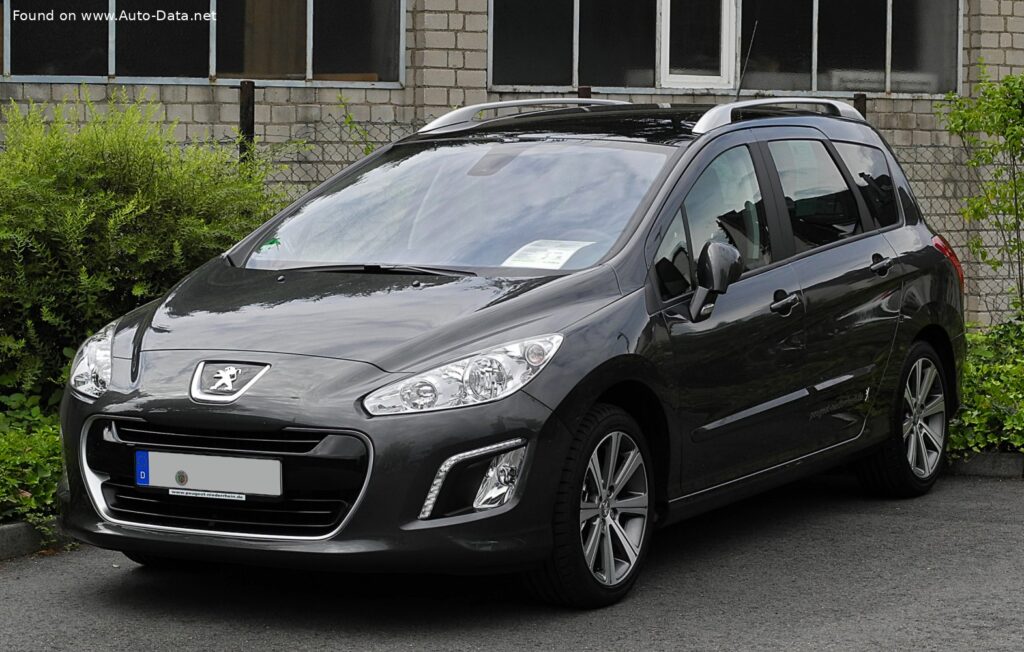
The Peugeot 308 SW I (Phase II, 2011) 1.6 e-HDi (115 Hp) represents a significant iteration of Peugeot’s compact station wagon, designed primarily for the European market. Introduced as a practical and fuel-efficient option, the 308 SW aimed to blend family-friendly space with Peugeot’s reputation for stylish design and comfortable driving dynamics. This version, specifically the Phase II update from 2011, incorporated refinements to both the exterior and interior, along with advancements in engine technology focused on reducing emissions and improving fuel economy. The “SW” designation signifies “Station Wagon,” indicating its role as the estate version of the 308, offering increased cargo capacity compared to the hatchback model.
Peugeot 308 SW I (Phase II): A Focus on Efficiency
The 308 SW, in its first generation, was a key model for Peugeot, competing in the crowded compact family car segment. The Phase II update, launched in 2011, brought a refreshed front fascia, revised interior trim, and crucially, the introduction of the e-HDi engine option. This powertrain combined a 1.6-liter diesel engine with Stop & Start technology and a particulate filter, aligning with increasingly stringent European emission standards. The SW body style was particularly popular in Europe, where practicality and cargo space are highly valued, making it a common sight on the continent’s roads. While not officially sold in the United States, understanding its specifications provides insight into the engineering priorities of European automakers during this period.
Engine & Performance
The heart of the 308 SW I (Phase II) 1.6 e-HDi is a 1.6-liter inline-four cylinder diesel engine, designated 9HD DV6C. This engine produces 115 horsepower at 3600 rpm and 270 Nm (199.14 lb.-ft.) of torque at 1750 rpm. The engine’s turbocharger and intercooler contribute to its relatively strong torque output, providing good responsiveness for everyday driving. The e-HDi designation signifies the inclusion of Stop & Start technology, which automatically shuts off the engine when the vehicle is stationary, further enhancing fuel efficiency. Paired with a 6-speed manual transmission, the 308 SW achieves a 0-100 km/h (0-62 mph) acceleration time of 11.9 seconds and a maximum speed of 185 km/h (114.95 mph). Fuel economy is a standout feature, with combined cycle consumption rated at 4.2 l/100 km (56 US mpg, 67.3 UK mpg), and CO2 emissions of 110 g/km, meeting Euro 5 emission standards.
Design & Features
The Peugeot 308 SW I (Phase II) is a five-door station wagon, typically seating five passengers, with some configurations offering optional seven-seat layouts. Its exterior design is characterized by Peugeot’s flowing lines and a relatively understated elegance. The Phase II update brought a revised front grille, headlights, and bumper, giving the car a more modern appearance. Inside, the 308 SW prioritizes practicality and comfort. The spacious interior offers ample headroom and legroom for passengers. The key feature, however, is the generous cargo area. With the rear seats up, the trunk offers 573 liters (20.24 cu. ft.) of space, expanding to a substantial 1736 liters (61.31 cu. ft.) with the rear seats folded down. Standard features typically included ABS, electric power steering, and a range of comfort amenities. Safety features were continually improved throughout the 308’s lifecycle, with the Phase II models benefiting from enhanced structural rigidity and improved braking performance.
Technical Specifications
| Brand | Peugeot |
| Model | 308 |
| Generation | 308 SW I (Phase II, 2011) |
| Type (Engine) | 1.6 e-HDi (115 Hp) |
| Start of production | 2013 |
| End of production | 2014 |
| Powertrain Architecture | Internal Combustion engine |
| Body type | Station wagon (estate) |
| Seats | 5-7 |
| Doors | 5 |
| Fuel consumption (urban) | 4.9 l/100 km (48 US mpg, 57.6 UK mpg, 20.4 km/l) |
| Fuel consumption (extra urban) | 3.8 l/100 km (61.9 US mpg, 74.3 UK mpg, 26.3 km/l) |
| Fuel consumption (combined) | 4.2 l/100 km (56 US mpg, 67.3 UK mpg, 23.8 km/l) |
| CO2 emissions | 110 g/km |
| Fuel Type | Diesel |
| Acceleration 0 – 100 km/h | 11.9 sec |
| Acceleration 0 – 62 mph | 11.9 sec |
| Acceleration 0 – 60 mph | 11.3 sec |
| Maximum speed | 185 km/h (114.95 mph) |
| Emission standard | Euro 5 |
| Weight-to-power ratio | 12.5 kg/Hp, 80.1 Hp/tonne |
| Weight-to-torque ratio | 5.3 kg/Nm, 188.2 Nm/tonne |
| Power | 115 Hp @ 3600 rpm |
| Power per litre | 73.7 Hp/l |
| Torque | 270 Nm @ 1750 rpm (199.14 lb.-ft. @ 1750 rpm) |
| Engine layout | Front, Transverse |
| Engine Model/Code | 9HD DV6C |
| Engine displacement | 1560 cm3 (95.2 cu. in.) |
| Number of cylinders | 4 |
| Engine configuration | Inline |
| Cylinder Bore | 75 mm (2.95 in.) |
| Piston Stroke | 88.3 mm (3.48 in.) |
| Number of valves per cylinder | 4 |
| Fuel injection system | Diesel Commonrail |
| Engine aspiration | Turbocharger, Intercooler |
| Valvetrain | DOHC |
| Engine oil capacity | 3.75 l (3.96 US qt | 3.3 UK qt) |
| Coolant | 6 l (6.34 US qt | 5.28 UK qt) |
| Kerb Weight | 1435 kg (3163.63 lbs.) |
| Max. weight | 1970 kg (4343.11 lbs.) |
| Max load | 535 kg (1179.47 lbs.) |
| Trunk (boot) space – minimum | 573 l (20.24 cu. ft.) |
| Trunk (boot) space – maximum | 1736 l (61.31 cu. ft.) |
| Fuel tank capacity | 60 l (15.85 US gal | 13.2 UK gal) |
| Max. roof load | 75 kg (165.35 lbs.) |
| Permitted trailer load with brakes (12%) | 1400 kg (3086.47 lbs.) |
| Permitted trailer load without brakes | 730 kg (1609.37 lbs.) |
| Permitted towbar download | 60 kg (132.28 lbs.) |
| Length | 4500 mm (177.17 in.) |
| Width | 1815 mm (71.46 in.) |
| Width including mirrors | 2038 mm (80.24 in.) |
| Height | 1555 mm (61.22 in.) |
| Wheelbase | 2708 mm (106.61 in.) |
| Front track | 1526 mm (60.08 in.) |
| Rear track | 1521 mm (59.88 in.) |
| Front overhang | 926 mm (36.46 in.) |
| Rear overhang | 866 mm (34.09 in.) |
| Minimum turning circle | 10.7 m (35.1 ft.) |
| Drivetrain Architecture | Front wheel drive |
| Number of gears | 6 gears, manual transmission |
| Front suspension | Independent, type McPherson with coil spring and anti-roll bar |
| Rear suspension | Coil spring, Torsion |
| Front brakes | Ventilated discs |
| Rear brakes | Disc |
| Assisting systems | ABS (Anti-lock braking system) |
| Steering type | Steering rack and pinion |
| Power steering | Electric Steering |
| Tires size | 205/55 R16 |
| Wheel rims size | 7J x 16 |