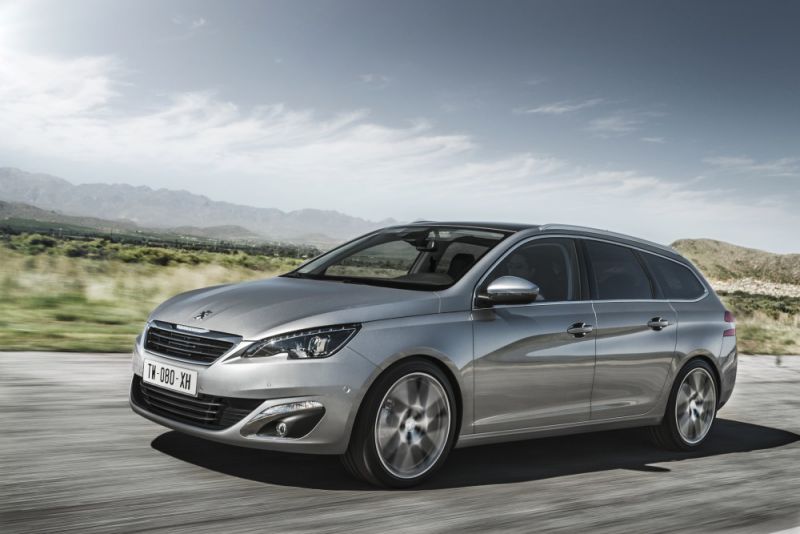
The Peugeot 308 SW II (Phase I), produced from 2013 to 2015, represents the second generation of Peugeot’s compact station wagon. Positioned within the competitive European C-segment, the 308 SW aimed to provide a practical and efficient vehicle for families and individuals requiring ample cargo space. This particular variant, equipped with a 1.6 HDi diesel engine producing 92 horsepower, was a popular choice in European markets due to its fuel economy and suitability for long-distance travel. While not officially sold in the United States, the 308 SW exemplifies the European preference for versatile, fuel-efficient station wagons, offering a compelling alternative to the growing SUV market.
Peugeot 308 SW II (Phase I): Overview
The 308 SW II built upon the success of its predecessor, introducing a more refined design, improved interior quality, and enhanced technology. The “SW” designation signifies “Station Wagon,” highlighting the vehicle’s primary focus on practicality and cargo capacity. The Phase I models, produced between 2013 and 2015, established the foundation for subsequent updates and revisions within the 308 SW II range. The 1.6 HDi engine was a cornerstone of Peugeot’s diesel lineup, known for its balance of performance and fuel efficiency. This model catered to buyers seeking a cost-effective and versatile vehicle for everyday use.
Engine & Performance
The heart of the 308 SW II 1.6 HDi is a 1.6-liter inline-four cylinder diesel engine, designated 9HP DV6DTED. This engine produces 92 horsepower at 4000 rpm and 230 Nm (169.64 lb.-ft.) of torque at 1750 rpm. The engine utilizes a turbocharger with an intercooler to enhance power output and efficiency. Power is delivered to the front wheels via a five-speed manual transmission. Acceleration from 0 to 100 km/h (0-62 mph) takes 11.9 seconds, while 0 to 60 mph is achieved in 11.3 seconds. The vehicle boasts a maximum speed of 181 km/h (112.47 mph). A key feature of this engine is its fuel efficiency, achieving a combined fuel consumption of 3.8 l/100 km (61.9 US mpg or 74.3 UK mpg). The engine also incorporates a diesel particulate filter to reduce emissions, meeting Euro 5 standards with CO2 emissions of 99 g/km.
Design & Features
The Peugeot 308 SW II Phase I is a five-door, five-seat station wagon (estate). Its exterior design features a sleek and modern aesthetic, typical of Peugeot’s styling language during that period. The SW body style provides a significantly larger cargo area compared to the hatchback version. With the rear seats up, the trunk offers a minimum of 610 liters (21.54 cu. ft.) of space, expanding to a substantial 1660 liters (58.62 cu. ft.) with the rear seats folded down. The vehicle’s dimensions are 4585 mm (180.51 in.) in length, 1863 mm (73.35 in.) in width, and 1461/1472 mm (57.52 in.) in height. The wheelbase measures 2730 mm (107.48 in.).
Inside, the 308 SW II Phase I offers a functional and comfortable cabin. Standard features typically included air conditioning, power windows, and a basic audio system. Safety features, while not as extensive as in modern vehicles, included ABS (Anti-lock Braking System) and driver/passenger airbags. The focus was on providing a practical and reliable vehicle for everyday use, with an emphasis on maximizing interior space and fuel efficiency. The vehicle’s kerb weight is 1180 kg (2601.45 lbs), with a maximum permissible weight of 1850 kg (4078.55 lbs).
Technical Specifications
| Brand | Peugeot |
| Model | 308 |
| Generation | 308 SW II (Phase I, 2013) |
| Type (Engine) | 1.6 HDi (92 Hp) |
| Start of production | 2013 |
| End of production | 2015 |
| Powertrain Architecture | Internal Combustion engine |
| Body type | Station wagon (estate) |
| Seats | 5 |
| Doors | 5 |
| Fuel consumption (urban) | 4.5 l/100 km (52.3 US mpg, 62.8 UK mpg, 22.2 km/l) |
| Fuel consumption (extra urban) | 3.5 l/100 km (67.2 US mpg, 80.7 UK mpg, 28.6 km/l) |
| Fuel consumption (combined) | 3.8 l/100 km (61.9 US mpg, 74.3 UK mpg, 26.3 km/l) |
| CO2 emissions | 99 g/km |
| Fuel Type | Diesel |
| Acceleration 0 – 100 km/h | 11.9 sec |
| Acceleration 0 – 62 mph | 11.9 sec |
| Acceleration 0 – 60 mph | 11.3 sec |
| Maximum speed | 181 km/h (112.47 mph) |
| Emission standard | Euro 5 |
| Weight-to-power ratio | 12.8 kg/Hp, 78 Hp/tonne |
| Weight-to-torque ratio | 5.1 kg/Nm, 194.9 Nm/tonne |
| Power | 92 Hp @ 4000 rpm |
| Power per litre | 59 Hp/l |
| Torque | 230 Nm @ 1750 rpm (169.64 lb.-ft. @ 1750 rpm) |
| Engine layout | Front, Transverse |
| Engine Model/Code | 9HP DV6DTED |
| Engine displacement | 1560 cm3 (95.2 cu. in.) |
| Number of cylinders | 4 |
| Engine configuration | Inline |
| Number of valves per cylinder | 2 |
| Fuel injection system | Diesel Commonrail |
| Engine aspiration | Turbocharger, Intercooler |
| Engine oil capacity | 3.75 l (3.96 US qt | 3.3 UK qt) |
| Coolant | 6 l (6.34 US qt | 5.28 UK qt) |
| Kerb Weight | 1180 kg (2601.45 lbs) |
| Max. weight | 1850 kg (4078.55 lbs) |
| Max load | 670 kg (1477.1 lbs) |
| Trunk (boot) space – minimum | 610 l (21.54 cu. ft.) |
| Trunk (boot) space – maximum | 1660 l (58.62 cu. ft.) |
| Fuel tank capacity | 53 l (14 US gal | 11.66 UK gal) |
| Length | 4585 mm (180.51 in.) |
| Width | 1863 mm (73.35 in.) |
| Height | 1461/1472 mm (57.52 in.) |
| Wheelbase | 2730 mm (107.48 in.) |
| Front track | 1551/1563 mm (61.06 in.) |
| Rear (Back) track | 1546/1557 mm (60.87 in.) |
| Ride height (ground clearance) | 109 mm (4.29 in.) |
| Minimum turning circle (turning diameter) | 11.2 m (36.75 ft.) |
| Drivetrain Architecture | Front wheel drive |
| Number of gears and type of gearbox | 5 gears, manual transmission |
| Front suspension | Independent, type McPherson with coil spring and anti-roll bar |
| Rear suspension | Semi-independent, coil spring |
| Front brakes | Ventilated discs |
| Rear brakes | Disc |