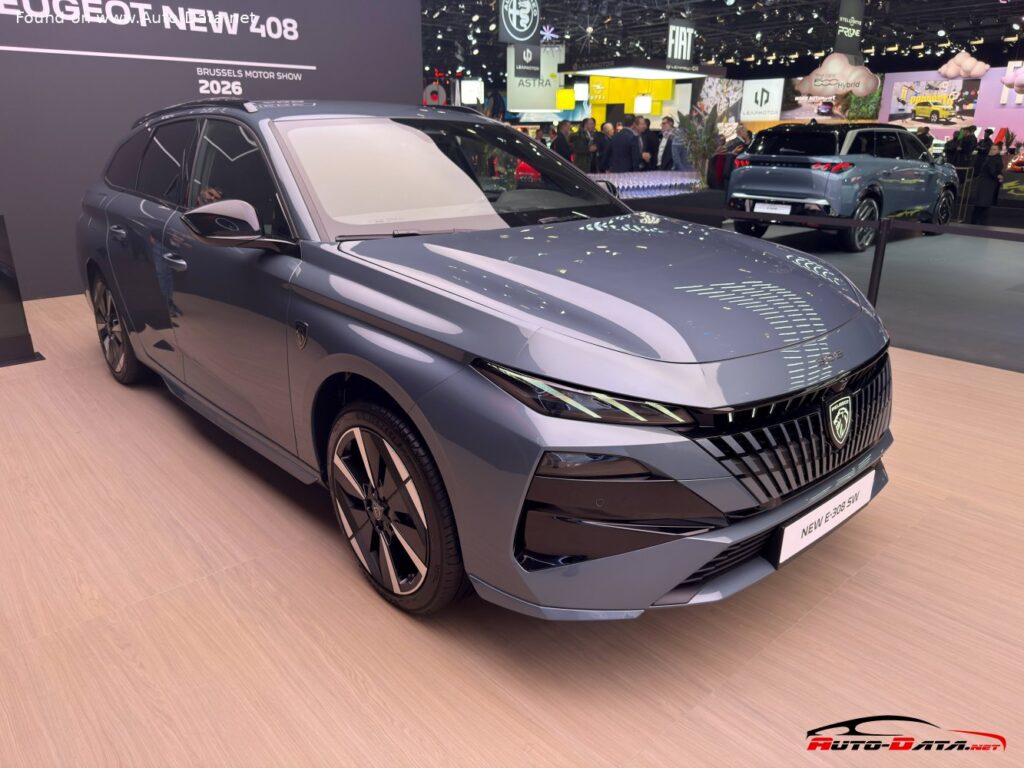
The automotive landscape for 2025 is poised to welcome a significant addition to the electric vehicle segment, particularly for markets outside North America, with the introduction of the Peugeot 308 SW III (Phase II, 2025) E-308 58.3 (156 Hp) Electric. This model represents the latest evolution of Peugeot’s popular compact car line, specifically in its third generation and receiving a Phase II update. As an all-electric station wagon, or “estate” as it’s known in Europe, the E-308 SW is a direct response to the growing demand for practical, zero-emission family vehicles in its primary European market. While Peugeot vehicles are not currently sold in the United States, this particular model showcases the brand’s commitment to electrification, blending contemporary design with efficient electric propulsion and the versatile body style favored by many European consumers. Its debut in August 2025 positions it as a thoroughly modern offering, designed to compete in the highly competitive compact electric segment by emphasizing range, utility, and refined driving dynamics.
Powertrain and Performance of the Peugeot 308 SW III (Phase II, 2025) E-308 58.3 (156 Hp) Electric
At the heart of the 2025 E-308 SW lies a sophisticated all-electric powertrain architecture (BEV), meticulously engineered for efficiency and responsive performance. The vehicle is propelled by a single electric motor, strategically mounted on the front axle in a transverse orientation, delivering power exclusively to the front wheels. This synchronous electric motor generates a respectable 156 horsepower at 4070 rpm, providing ample thrust for daily driving and highway cruising. What truly distinguishes an electric powertrain, however, is its instantaneous torque delivery, and the E-308 SW does not disappoint, offering a robust 270 Newton-meters (199.14 pound-feet) of torque available almost immediately from 500 rpm all the way up to 4060 rpm. This broad torque band translates into a smooth, linear acceleration experience, a hallmark of modern electric vehicles.
Performance figures for the E-308 SW underscore its practical, rather than overtly sporty, character. It accelerates from 0 to 60 mph in a calculated 9.5 seconds, while the 0 to 100 km/h sprint takes precisely 10 seconds. The top speed is electronically limited to 170 km/h (105.63 mph), a more than adequate velocity for European highway conditions. The drivetrain is simplified by a single-gear automatic transmission, characteristic of most electric vehicles, which ensures seamless power delivery without the interruptions of gear changes. This contributes to a refined and quiet driving experience, further enhanced by the inherent smoothness of electric propulsion. The vehicle’s weight-to-power ratio stands at 10.9 kg/Hp, or 91.3 Hp/tonne, while the weight-to-torque ratio is 6.3 kg/Nm, or 158.1 Nm/tonne, indicating a well-balanced power delivery for its segment.
Battery technology is central to any electric vehicle, and the E-308 SW features a gross battery capacity of 58.3 kWh, with a net usable capacity of 54 kWh. This battery pack operates at 400 volts and utilizes Lithium Nickel Manganese Cobalt Oxides (Li-NMC) chemistry, a common choice for its energy density and stability. Weighing 373 kg (822.32 lbs.), the battery is intelligently positioned below the floor, a design choice that significantly contributes to a lower center of gravity. This placement not only enhances the vehicle’s handling stability but also optimizes interior space. The all-electric range, according to the WLTP cycle, is impressive, estimated between 440-444 km (273.4 – 275.89 miles) on a single charge, making it highly suitable for longer journeys as well as urban commuting. Energy consumption is rated at 15.1-15.2 kWh/100 km (24.3 – 24.46 kWh/100 mi), translating to an impressive 139-138 MPGe, highlighting its exceptional energy efficiency.
Design, Features, and Practicality
The Peugeot 308 SW III (Phase II, 2025) E-308 58.3 (156 Hp) Electric embodies a compelling blend of contemporary design, practical utility, and advanced features. As a station wagon (known as an estate in many markets), its five-door, five-seat configuration is inherently designed for versatility and family-friendliness. The exterior styling reflects Peugeot’s current design language, characterized by sharp lines, distinctive LED lighting signatures, and a sleek, aerodynamic profile. This aesthetic appeal is not merely superficial; the vehicle boasts a commendable drag coefficient (Cd) of 0.27, contributing to its impressive electric range and overall efficiency by minimizing air resistance.
In terms of dimensions, the E-308 SW is well-proportioned for its segment. It measures 4640 mm (182.68 inches) in length, 1850 mm (72.83 inches) in width, and 1460 mm (57.48 inches) in height. The generous wheelbase of 2730 mm (107.48 inches) is a key factor in providing a spacious interior for both passengers and cargo. The station wagon body style truly shines in its cargo capacity, offering a substantial minimum trunk space of 505 liters (17.83 cubic feet). This ample volume ensures that families can comfortably carry luggage, groceries, or sports equipment, making it an ideal choice for active lifestyles. The maximum load capacity stands at 467 kg (1029.56 lbs.), allowing for considerable versatility.
Underneath its stylish exterior, the E-308 SW is built on a robust chassis designed for comfort and confident handling. The front suspension employs an independent McPherson type, a proven design known for its balance of ride comfort and precise steering. At the rear, a torsion beam suspension setup is utilized, a common and cost-effective solution for compact vehicles that also helps preserve cargo space. Braking performance is managed by ventilated discs measuring 304 mm at the front and solid discs of 290 mm at the rear, providing strong and consistent stopping power. Essential assisting systems, such as ABS (Anti-lock Braking System), are standard, enhancing safety and control. The steering system is an electric rack and pinion type, offering light and responsive steering, particularly beneficial in urban environments where the minimum turning circle of 11.13 meters (36.52 feet) aids maneuverability. The vehicle rides on 18-inch wheels fitted with 215/45 R18 V tires, striking a balance between ride comfort and dynamic stability. With a kerb weight of 1708 kg (3765.5 lbs.) and a maximum weight of 2175 kg (4795.05 lbs.), the E-308 SW is a solid and reassuring presence on the road, further cementing its position as a practical and modern electric family car for the European market.
Technical Specifications
| Brand | Peugeot |
| Model | 308 |
| Generation | 308 SW III (Phase II, 2025) |
| Type (Engine) | E-308 58.3 (156 Hp) Electric |
| Start of production | August, 2025 year |
| Powertrain Architecture | BEV (Electric Vehicle) |
| Body type | Station wagon (estate) |
| Seats | 5 |
| Doors | 5 |
| Fuel Type | Electricity |
| Acceleration 0 – 100 km/h | 10 sec |
| Acceleration 0 – 62 mph | 10 sec |
| Acceleration 0 – 60 mph (Calculated by Auto-Data.net) | 9.5 sec |
| Maximum speed | 170 km/h (105.63 mph) |
| Weight-to-power ratio | 10.9 kg/Hp, 91.3 Hp/tonne |
| Weight-to-torque ratio | 6.3 kg/Nm, 158.1 Nm/tonne |
| Gross battery capacity | 58.3 kWh |
| Net (usable) battery capacity | 54 kWh |
| Battery voltage | 400 V |
| Battery technology | Lithium nickel manganese cobalt oxides (Li-NMC) |
| Battery weight | 373 kg (822.32 lbs.) |
| Battery location | Below the floor |
| All-electric range (WLTP) | 440-444 km (273.4 – 275.89 mi) |
| Average Energy consumption (WLTP) | 15.1-15.2 kWh/100 km (24.3 – 24.46 kWh/100 mi, 139 – 138 MPGe, 6.6 – 6.6 km/kWh, 4.1 – 4.1 mi/kWh) |
| Electric motor power | 156 Hp @ 4070 rpm. |
| Electric motor Torque | 270 Nm @ 500-4060 rpm (199.14 lb.-ft. @ 500-4060 rpm) |
| Electric motor location | Front axle, Transverse |
| Electric motor type | Synchronous |
| System power | 156 Hp @ 4070 rpm. |
| System torque | 270 Nm @ 500-4060 rpm (199.14 lb.-ft. @ 500-4060 rpm) |
| Kerb Weight | 1708 kg (3765.5 lbs.) |
| Max. weight | 2175 kg (4795.05 lbs.) |
| Max load | 467 kg (1029.56 lbs.) |
| Trunk (boot) space – minimum | 505 l (17.83 cu. ft.) |
| Length | 4640 mm (182.68 in.) |
| Width | 1850 mm (72.83 in.) |
| Height | 1460 mm (57.48 in.) |
| Wheelbase | 2730 mm (107.48 in.) |
| Drag coefficient (Cd) | 0.27 |
| Minimum turning circle (turning diameter) | 11.13 m (36.52 ft.) |
| Drivetrain Architecture | One electric motor drives the front wheels. |
| Drive wheel | Front wheel drive |
| Number of gears and type of gearbox | 1 gears, automatic transmission |
| Front suspension | Independent type McPherson |
| Rear suspension | Torsion |
| Front brakes | Ventilated discs, 304 mm |
| Rear brakes | Disc, 290 mm |
| Assisting systems | ABS (Anti-lock braking system) |
| Steering type | Steering rack and pinion |
| Power steering | Electric Steering |
| Tires size | 215/45 R18 V |
| Wheel rims size | 18 |