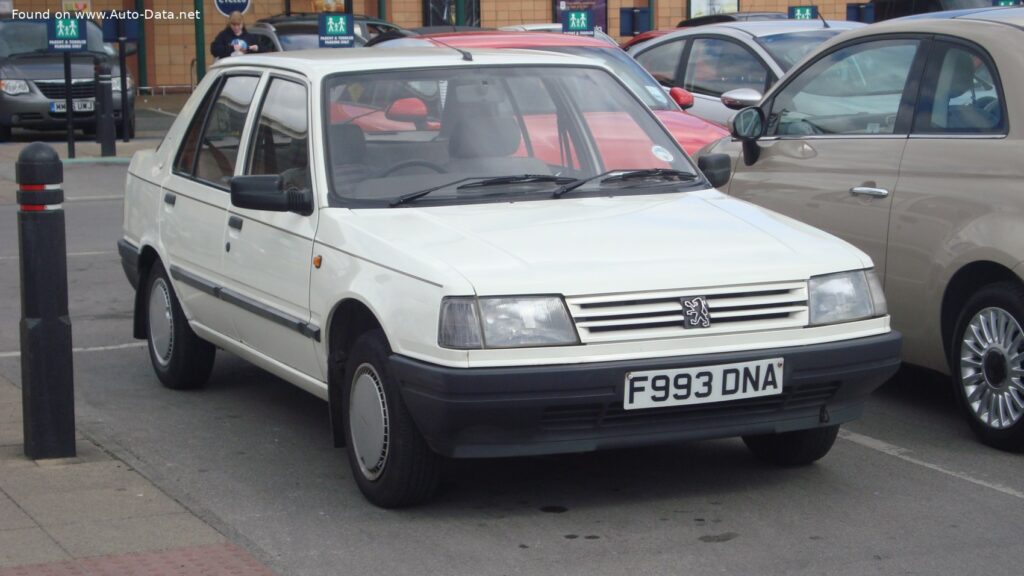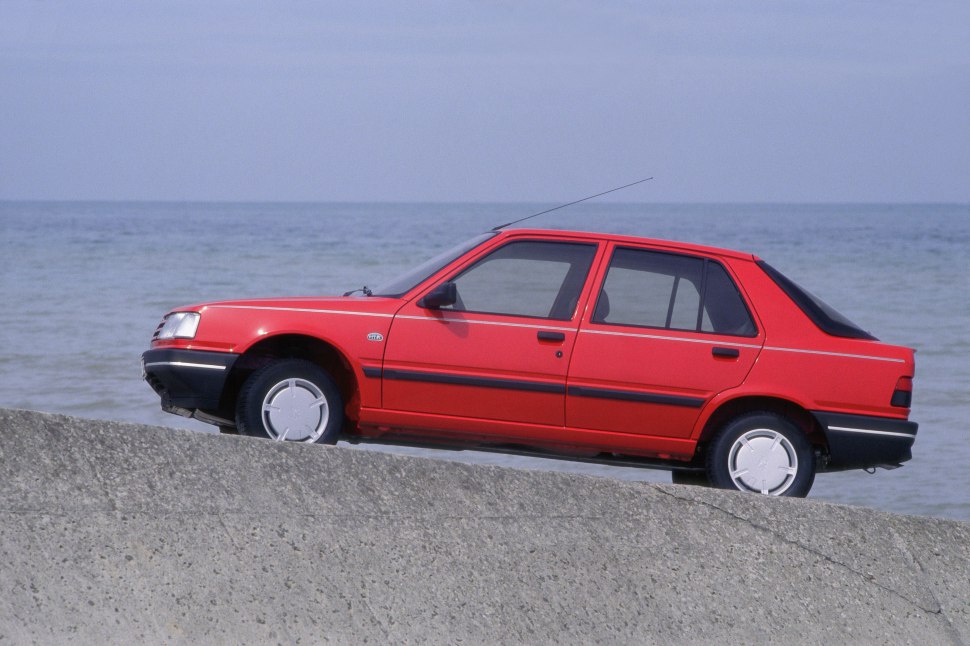
The Peugeot 309, particularly the 3C,3A facelifted generation from 1989, represents a significant chapter in the history of the French automaker’s presence in the European compact car segment. Positioned between the wildly successful 205 supermini and the larger 405 family sedan, the 309 was initially conceived as a Talbot model before Peugeot absorbed the brand and rebadged the project. This specific variant, the Peugeot 309 (3C,3A facelift 1989) 1.9 (109 Hp), was produced between 1990 and 1993, offering a blend of practical hatchback utility with a spirited powertrain for its era. While never officially sold in the United States, the 309 was a popular choice across Europe, celebrated for its robust mechanics, engaging driving dynamics, and utilitarian design, embodying Peugeot’s reputation for producing well-engineered, driver-focused vehicles.
Engine & Performance of the Peugeot 309 (3C,3A facelift 1989) 1.9 (109 Hp)
At the heart of this specific Peugeot 309 variant lies a naturally aspirated, 1.9-liter (1905 cm3 or 116.25 cu. in.) inline four-cylinder engine, designated by the code DDZ XU9M. This unit, part of Peugeot’s renowned XU engine family, was a testament to robust engineering and reliability. Unlike many contemporary engines that were beginning to adopt electronic fuel injection, this particular 1.9-liter iteration utilized a carburettor fuel injection system, a characteristic feature for many European cars of the late 1980s and early 1990s, offering simplicity and reliable operation. With a compression ratio of 9.1:1 and two valves per cylinder, the engine delivered a respectable 109 horsepower at 6000 rpm, translating to a power-per-liter output of 57.2 horsepower per liter. Torque figures were equally impressive for a car of its class, peaking at 118.01 lb.-ft. (160 Nm) at a relatively low 3000 rpm, providing accessible power delivery and a flexible driving experience.
The powertrain architecture features a front, transverse engine layout, driving the front wheels through a 5-speed manual transmission. This combination was typical for compact European hatchbacks of the period, offering an efficient and direct connection between driver and road. The relatively light kerb weight of just 2006.21 lbs (910 kg) contributed significantly to the vehicle’s lively performance. The weight-to-power ratio stood at 8.3 kg/Hp (119.8 Hp/tonne), and the weight-to-torque ratio was 5.7 kg/Nm (175.8 Nm/tonne), indicating a nimble and responsive character. Performance metrics further underscore its sporting credentials: the Peugeot 309 (3C,3A facelift 1989) 1.9 (109 Hp) could accelerate from 0 to 60 mph in an estimated 9.3 seconds, and reach a top speed of 119.3 mph (192 km/h). These figures placed it firmly in the “warm hatch” category, offering a compelling blend of everyday usability and engaging performance without the full-blown aggression of a hot hatch.
Fuel economy, while not a primary focus for performance variants, was still competitive for the era. The combined fuel consumption was rated at 33.6 US mpg (7 l/100 km), with urban driving yielding 25.3 US mpg (9.3 l/100 km) and extra-urban driving achieving a more economical 42.8 US mpg (5.5 l/100 km). The fuel tank capacity of 14.53 US gallons (55 liters) ensured a practical cruising range, making it suitable for both daily commutes and longer journeys across European landscapes. The engine required 4 liters (4.23 US qt) of engine oil and utilized 7.5 liters (7.93 US qt) of coolant, reflecting standard maintenance requirements for a vehicle of its time.
Design & Features
The Peugeot 309 (3C,3A facelift 1989) retained the practical hatchback body style that was immensely popular in Europe. Available in both 3-door and 5-door configurations, it offered seating for five occupants, emphasizing its role as a versatile family car. The facelift introduced subtle but effective styling changes, primarily to the front and rear, aligning its aesthetics more closely with the newer Peugeot models of the early 1990s, such as the 405. Its overall dimensions—a length of 159.45 inches (4050 mm), a width of 64.17 inches (1630 mm), and a height of 54.33 inches (1380 mm)—made it a compact and maneuverable vehicle well-suited for European city streets and country roads. The wheelbase measured 97.24 inches (2470 mm), contributing to its stable ride and agile handling characteristics.
Inside, the 309 prioritized functionality and ergonomic design, typical of Peugeot’s philosophy. While specific luxury features were sparse compared to modern vehicles, the cabin was designed for ease of use and durability. The trunk (boot) space offered a respectable minimum volume of 10.42 cu. ft. (295 liters), which could be expanded to a generous 21.72 cu. ft. (615 liters) with the rear seats folded, providing ample cargo capacity for groceries, luggage, or sports equipment. This flexibility was a key selling point for hatchback buyers.
The chassis and suspension setup further enhanced the 309’s reputation for excellent road holding and a comfortable ride. It featured a coil spring front suspension and a torsion beam rear suspension, a tried-and-tested combination that allowed for a good balance between comfort and dynamic handling. Peugeot engineers were renowned for tuning their suspension systems to deliver an engaging driving experience, and the 309 was no exception. Braking was handled by disc brakes at the front and drum brakes at the rear, a common arrangement for vehicles in this class. Significantly for its time, this variant of the 309 was equipped with ABS (Anti-lock Braking System) as an assisting system, a crucial safety feature that was still becoming widespread in the early 1990s, offering improved control during emergency braking maneuvers. The steering system was a hydraulic rack and pinion setup, providing direct feedback and a connected feel to the road, further contributing to the car’s driver-centric appeal. The vehicle rode on 165/70 TR13 tires, a modest size by today’s standards but appropriate for its weight and performance capabilities.
Technical Specifications
| Brand | Peugeot |
| Model | 309 |
| Generation | 309 (3C,3A facelift 1989) |
| Type (Engine) | 1.9 (109 Hp) |
| Start of production | 1990 year |
| End of production | 1993 year |
| Powertrain Architecture | Internal Combustion engine |
| Body type | Hatchback |
| Seats | 5 |
| Doors | 3-5 |
| Fuel consumption (economy) – urban | 9.3 l/100 km (25.3 US mpg, 30.4 UK mpg) |
| Fuel consumption (economy) – extra urban | 5.5 l/100 km (42.8 US mpg, 51.4 UK mpg) |
| Fuel consumption (economy) – combined | 7 l/100 km (33.6 US mpg, 40.4 UK mpg) |
| Fuel Type | Petrol (Gasoline) |
| Acceleration 0 – 100 km/h | 9.8 sec |
| Acceleration 0 – 62 mph | 9.8 sec |
| Acceleration 0 – 60 mph (Calculated) | 9.3 sec |
| Maximum speed | 192 km/h (119.3 mph) |
| Weight-to-power ratio | 8.3 kg/Hp (119.8 Hp/tonne) |
| Weight-to-torque ratio | 5.7 kg/Nm (175.8 Nm/tonne) |
| Power | 109 Hp @ 6000 rpm. |
| Power per litre | 57.2 Hp/l |
| Torque | 160 Nm @ 3000 rpm (118.01 lb.-ft. @ 3000 rpm) |
| Engine layout | Front, Transverse |
| Engine Model/Code | DDZ XU9M |
| Engine displacement | 1905 cm3 (116.25 cu. in.) |
| Number of cylinders | 4 |
| Engine configuration | Inline |
| Cylinder Bore | 83 mm (3.27 in.) |
| Piston Stroke | 88 mm (3.46 in.) |
| Compression ratio | 9.1:1 |
| Number of valves per cylinder | 2 |
| Fuel injection system | Carburettor |
| Engine aspiration | Naturally aspirated engine |
| Engine oil capacity | 4 l (4.23 US qt | 3.52 UK qt) |
| Coolant | 7.5 l (7.93 US qt | 6.6 UK qt) |
| Kerb Weight | 910 kg (2006.21 lbs) |
| Max. weight | 1350 kg (2976.24 lbs) |
| Max load | 440 kg (970.03 lbs) |
| Trunk (boot) space – minimum | 295 l (10.42 cu. ft.) |
| Trunk (boot) space – maximum | 615 l (21.72 cu. ft.) |
| Fuel tank capacity | 55 l (14.53 US gal | 12.1 UK gal) |
| Length | 4050 mm (159.45 in.) |
| Width | 1630 mm (64.17 in.) |
| Height | 1380 mm (54.33 in.) |
| Wheelbase | 2470 mm (97.24 in.) |
| Front track | 1405 mm (55.31 in.) |
| Rear (Back) track | 1380 mm (54.33 in.) |
| Drivetrain Architecture | Front wheel drive. Internal Combustion engine. |
| Drive wheel | Front wheel drive |
| Number of gears and type of gearbox | 5 gears, manual transmission |
| Front suspension | Coil spring |
| Rear suspension | Torsion |
| Front brakes | Disc |
| Rear brakes | Drum |
| Assisting systems | ABS (Anti-lock braking system) |
| Steering type | Steering rack and pinion |
| Power steering | Hydraulic Steering |
| Tires size | 165/70 TR13 |