
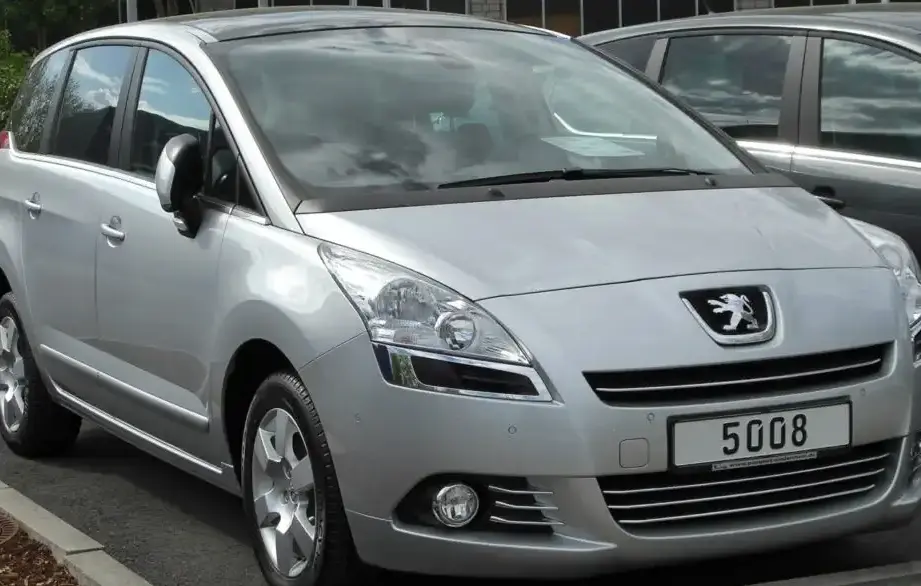
The Peugeot 5008, launched in 2009, represented Peugeot’s entry into the increasingly popular compact Multi-Purpose Vehicle (MPV) segment. The first generation, designated the 5008 I (Phase I), was produced from 2009 to 2013 and offered a practical and family-oriented alternative to traditional station wagons and smaller hatchbacks. Among the engine options available, the 2.0 HDI (163 hp) with a six-speed automatic transmission was a significant offering, positioned as a mid-range variant balancing fuel efficiency, performance, and convenience. This model aimed to appeal to families seeking a comfortable and capable vehicle for both daily commutes and longer journeys.
Technical Specifications
| Brand | Peugeot |
| Model | 5008 |
| Generation | 5008 I (Phase I, 2009) |
| Type (Engine) | 2.0 HDI (163 Hp) FAP Automatic |
| Start of production | 2009 |
| End of production | 2013 |
| Powertrain Architecture | Internal Combustion engine |
| Body type | MPV |
| Seats | 5 |
| Doors | 5 |
| Fuel consumption (urban) | 8.8 l/100 km (26.7 US mpg, 32.1 UK mpg, 11.4 km/l) |
| Fuel consumption (extra urban) | 5.7 l/100 km (41.3 US mpg, 49.6 UK mpg, 17.5 km/l) |
| Fuel consumption (combined) | 6.8 l/100 km (34.6 US mpg, 41.5 UK mpg, 14.7 km/l) |
| Fuel Type | Diesel |
| Acceleration 0 – 100 km/h | 10.4 sec |
| Acceleration 0 – 62 mph | 10.4 sec |
| Acceleration 0 – 60 mph | 9.9 sec |
| Maximum speed | 190 km/h (118.06 mph) |
| Emission standard | Euro 5 |
| Weight-to-power ratio | 9.7 kg/Hp, 102.6 Hp/tonne |
| Weight-to-torque ratio | 4.7 kg/Nm, 214 Nm/tonne |
| Power | 163 Hp @ 3750 rpm |
| Power per litre | 81.6 Hp/l |
| Torque | 340 Nm @ 2000 rpm (250.77 lb.-ft. @ 2000 rpm) |
| Engine layout | Front, Transverse |
| Engine Model/Code | RHH DW10CTED4 |
| Engine displacement | 1997 cm3 (121.86 cu. in.) |
| Number of cylinders | 4 |
| Engine configuration | Inline |
| Number of valves per cylinder | 4 |
| Fuel injection system | Diesel Commonrail |
| Engine aspiration | Turbocharger, Intercooler |
| Engine oil capacity | 5 l (5.28 US qt | 4.4 UK qt) |
| Coolant capacity | 8.6 l (9.09 US qt | 7.57 UK qt) |
| Kerb Weight | 1589 kg (3503.15 lbs.) |
| Max. weight | 2125 kg (4684.82 lbs.) |
| Max load | 536 kg (1181.68 lbs.) |
| Trunk (boot) space – minimum | 679 l (23.98 cu. ft.) |
| Trunk (boot) space – maximum | 1754 l (61.94 cu. ft.) |
| Fuel tank capacity | 60 l (15.85 US gal | 13.2 UK gal) |
| Length | 4529 mm (178.31 in.) |
| Width | 1888 mm (74.33 in.) |
| Height | 1647 mm (64.84 in.) |
| Wheelbase | 2727 mm (107.36 in.) |
| Minimum turning circle | 11.9 m (39.04 ft.) |
| Drivetrain Architecture | Front wheel drive |
| Number of gears | 6 |
| Gearbox type | Automatic transmission |
| Front suspension | Independent type McPherson |
| Rear suspension | Semi-independent, coil spring |
| Front brakes | Ventilated discs |
| Rear brakes | Disc |
| Assisting systems | ABS (Anti-lock braking system) |
| Steering type | Steering rack and pinion |
| Tires size | 215/55 R16; 215/50 R17; 215/45 R18 |
| Wheel rims size | 16; 17; 18 |
Powertrain & Engine Architecture
The heart of this 5008 variant is the DW10CTED4 engine, a 2.0-liter four-cylinder diesel engine. This engine, commonly found in various PSA Group (Peugeot-Citroën) vehicles, utilizes a common rail direct injection system, delivering fuel at extremely high pressure for optimized combustion. The RHH engine code specifically denotes a version equipped with a Diesel Particulate Filter (DPF), or FAP in Peugeot terminology, to meet stringent Euro 5 emission standards. A turbocharger with an intercooler further enhances performance by forcing more air into the cylinders. The engine produces 163 horsepower at 3750 rpm and a substantial 340 Nm (250.77 lb.-ft.) of torque at 2000 rpm. This torque output is a key characteristic of diesel engines, providing strong pulling power at lower engine speeds. The engine is transversely mounted in the front of the vehicle. The six-speed automatic transmission, while offering convenience, was a traditional torque converter type, not a dual-clutch system, and was chosen for its smoothness and reliability.
Driving Characteristics
The 2.0 HDI automatic 5008 offered a comfortable and relaxed driving experience. The automatic transmission, while not particularly sporty, provided smooth gear changes and made navigating city traffic effortless. Acceleration from 0-60 mph took around 9.9 seconds, which was adequate for everyday driving but not particularly brisk. The abundance of low-end torque meant that overtaking maneuvers were generally easy, even with a fully loaded vehicle. Compared to the manual transmission versions of the same engine, the automatic suffered a slight performance penalty and marginally lower fuel economy. Higher-output versions, such as the 2.0 HDI with 180 hp, offered noticeably quicker acceleration, but at the cost of increased fuel consumption. The gear ratios were tuned for fuel efficiency and comfort rather than outright performance.
Equipment & Trim Levels
The 2.0 HDI automatic trim typically fell into the mid-range of the 5008 lineup. Standard equipment generally included air conditioning, electric front and rear windows, a CD stereo with MP3 compatibility, and ABS brakes. Higher trim levels added features such as alloy wheels, rear parking sensors, a panoramic sunroof, and a more sophisticated infotainment system. Interior upholstery was typically cloth, with options for leather upgrades. The dashboard layout was functional and user-friendly, with a focus on practicality. Optional extras included navigation systems, Bluetooth connectivity, and a rear entertainment system.
Chassis & Braking
The 5008 utilized a McPherson strut front suspension and a semi-independent coil spring rear suspension. This setup provided a comfortable ride quality, absorbing bumps and imperfections in the road effectively. Front brakes were ventilated discs, while rear brakes were solid discs. ABS (Anti-lock Braking System) was standard, enhancing safety during emergency braking situations. The suspension was tuned for comfort and stability, prioritizing ride quality over sporty handling. Stabilizer bars were fitted to both the front and rear axles to reduce body roll during cornering.
Market Reception & Comparison
The Peugeot 5008 2.0 HDI automatic was generally well-received by critics as a practical and comfortable family vehicle. It was praised for its spacious interior, versatile seating arrangement, and fuel efficiency. However, some reviewers noted that the automatic transmission could feel somewhat sluggish at times, and the overall driving experience lacked the engagement of some competitors. Compared to other MPVs in its class, such as the Renault Scenic and Citroën C4 Picasso, the 5008 offered a distinctive styling and a slightly more premium feel. Fuel economy was competitive, averaging around 34.6 US mpg in combined driving, and reliability was generally good, although the DPF system required periodic maintenance.
Legacy
The 2.0 HDI engine, in its various iterations, proved to be a durable and reliable powerplant. The DW10CTED4 engine, while requiring regular maintenance, is known for its longevity when properly cared for. The automatic transmission, while not the most technologically advanced, is generally robust. Today, used examples of the 5008 2.0 HDI automatic are readily available and represent a relatively affordable option for families seeking a spacious and practical vehicle. However, potential buyers should be aware of the potential costs associated with DPF maintenance and ensure that the vehicle has been properly serviced throughout its life. The 5008 established Peugeot as a serious contender in the MPV market and paved the way for the second-generation model, which further refined the formula.
