
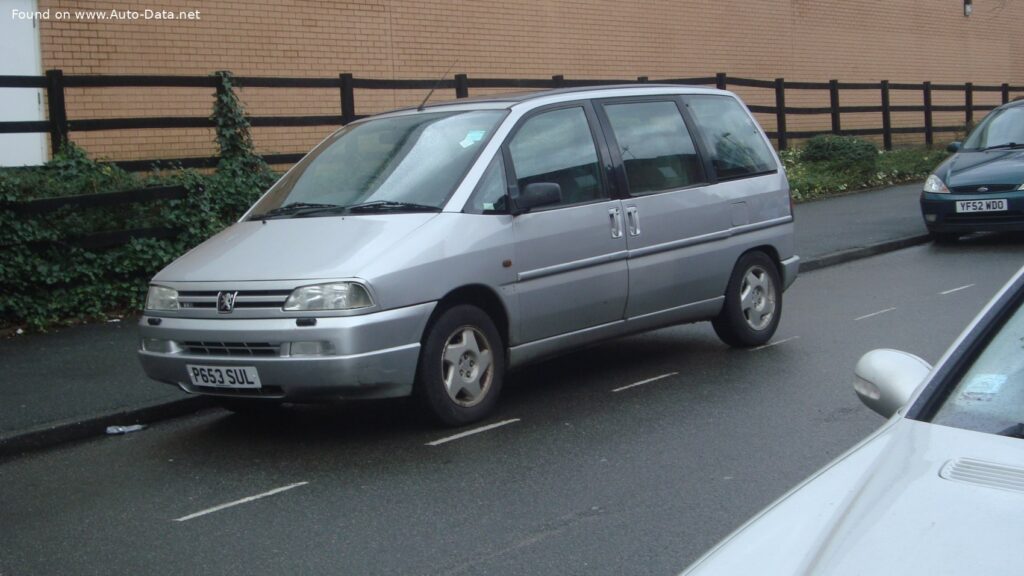
The Peugeot 806, produced between 1994 and 2002, was a large multi-purpose vehicle (MPV) designed to compete with offerings like the Renault Espace and Chrysler Voyager. The 806 (designated 221 for certain variants) represented Peugeot’s entry into the growing market for spacious, family-oriented vehicles. While not officially sold in the United States, the 806 was a significant model in Europe, known for its practicality, modular interior, and comfortable ride. This article details the 2.1 td 12V (109 Hp) version of the 806, produced between 1996 and 1999, focusing on its technical specifications and characteristics.
Peugeot 806 2.1 td 12V: An Overview
The 806 was a collaborative effort with Fiat and PSA Peugeot Citroën, resulting in the shared platform also used by the Fiat Ulysse and Citroën Evasion/Synergie. This collaboration allowed for economies of scale and shared development costs. The 2.1 td 12V model, powered by a turbocharged diesel engine, was a popular choice for buyers prioritizing fuel efficiency and torque for long-distance travel and hauling passengers. It offered a blend of practicality and affordability within the MPV segment.
Engine & Performance
The heart of the Peugeot 806 2.1 td 12V is a 2.1-liter inline-four cylinder diesel engine, designated P8C XUD11BTE. This engine produces 109 horsepower at 4300 rpm and 250 Nm (184.39 lb.-ft.) of torque at 2000 rpm. The engine utilizes a precombustion chamber injection system and is turbocharged, enhancing its power output and efficiency. While not a performance-oriented vehicle, the 806 2.1 td offers adequate power for everyday driving and highway cruising. Acceleration from 0 to 100 km/h (0-62 mph) takes 15.8 seconds, and it achieves a maximum speed of 173 km/h (107.5 mph). The engine’s power-to-weight ratio is 15.3 kg/Hp, and its torque-to-weight ratio is 6.7 kg/Nm. Fuel economy is a strong point, achieving 6.6 liters per 100 kilometers (35.6 US mpg or 42.8 UK mpg).
Design & Features
The Peugeot 806 is a five-door minivan with a spacious interior designed to accommodate up to five passengers. Its body style prioritizes practicality and versatility. A key feature of the 806 is its modular interior, with individually removable and adjustable seats. This allows for a variety of seating configurations to maximize cargo space, ranging from a minimum of 340 liters (12.01 cu. ft.) to a substantial 3300 liters (116.54 cu. ft.) with the rear seats removed. The 806’s design, while functional, is typical of the mid-1990s, with a boxy silhouette and relatively simple styling. Safety features for the era included an Anti-lock Braking System (ABS), which was becoming increasingly common on European vehicles. The vehicle utilizes a hydraulic power steering system and a five-speed manual transmission. The front suspension employs a wishbone design, while the rear utilizes coil springs. Brakes are ventilated discs at the front and drums at the rear.
Technical Specifications
| Brand | Peugeot |
| Model | 806 |
| Generation | 806 (221) |
| Type (Engine) | 2.1 td 12V (109 Hp) |
| Start of production | 1996 |
| End of production | 1999 |
| Powertrain Architecture | Internal Combustion engine |
| Body type | Minivan |
| Seats | 5 |
| Doors | 5 |
| Fuel consumption (combined) | 6.6 l/100 km |
| Fuel consumption (US mpg) | 35.6 US mpg |
| Fuel consumption (UK mpg) | 42.8 UK mpg |
| Fuel consumption (km/l) | 15.2 km/l |
| Fuel Type | Diesel |
| Acceleration 0 – 100 km/h | 15.8 sec |
| Acceleration 0 – 62 mph | 15.8 sec |
| Acceleration 0 – 60 mph | 15 sec |
| Maximum speed | 173 km/h |
| Maximum speed (mph) | 107.5 mph |
| Weight-to-power ratio | 15.3 kg/Hp |
| Weight-to-torque ratio | 6.7 kg/Nm |
| Power | 109 Hp @ 4300 rpm |
| Power per litre | 52.2 Hp/l |
| Torque | 250 Nm @ 2000 rpm |
| Torque (lb.-ft.) | 184.39 lb.-ft. @ 2000 rpm |
| Engine layout | Front, Transverse |
| Engine Model/Code | P8C XUD11BTE |
| Engine displacement | 2088 cm3 |
| Engine displacement (cu. in.) | 127.42 cu. in. |
| Number of cylinders | 4 |
| Engine configuration | Inline |
| Cylinder Bore | 85 mm |
| Cylinder Bore (in.) | 3.35 in. |
| Piston Stroke | 92 mm |
| Piston Stroke (in.) | 3.62 in. |
| Compression ratio | 21.5:1 |
| Number of valves per cylinder | 3 |
| Fuel injection system | Precombustion chamber injection |
| Engine aspiration | Turbocharger |
| Valvetrain | OHC |
| Engine oil capacity | 4.25 l |
| Engine oil capacity (US qt) | 4.49 US qt |
| Engine oil capacity (UK qt) | 3.74 UK qt |
| Coolant | 9 l |
| Coolant (US qt) | 9.51 US qt |
| Coolant (UK qt) | 7.92 UK qt |
| Kerb Weight | 1670 kg |
| Kerb Weight (lbs) | 3681.72 lbs. |
| Max. weight | 2395 kg |
| Max. weight (lbs) | 5280.07 lbs. |
| Max load | 725 kg |
| Max load (lbs) | 1598.35 lbs. |
| Trunk (boot) space – minimum | 340 l |
| Trunk (boot) space – minimum (cu. ft.) | 12.01 cu. ft. |
| Trunk (boot) space – maximum | 3300 l |
| Trunk (boot) space – maximum (cu. ft.) | 116.54 cu. ft. |
| Fuel tank capacity | 80 l |
| Fuel tank capacity (US gal) | 21.13 US gal |
| Fuel tank capacity (UK gal) | 17.6 UK gal |
| Length | 4454 mm |
| Length (in.) | 175.35 in. |
| Width | 1834 mm |
| Width (in.) | 72.2 in. |
| Height | 1714 mm |
| Height (in.) | 67.48 in. |
| Wheelbase | 2824 mm |
| Wheelbase (in.) | 111.18 in. |
| Front track | 1534 mm |
| Front track (in.) | 60.39 in. |
| Rear (Back) track | 1540 mm |
| Rear (Back) track (in.) | 60.63 in. |
| Drivetrain Architecture | Front wheel drive |
| Number of gears and type of gearbox | 5 gears, manual transmission |
| Front suspension | Wishbone |
| Rear suspension | Coil spring |
| Front brakes | Ventilated discs |
| Rear brakes | Drum |
| Assisting systems | ABS (Anti-lock braking system) |
| Steering type | Steering rack and pinion |
| Power steering | Hydraulic Steering |
| Tires size | 205/65 R15 |
