
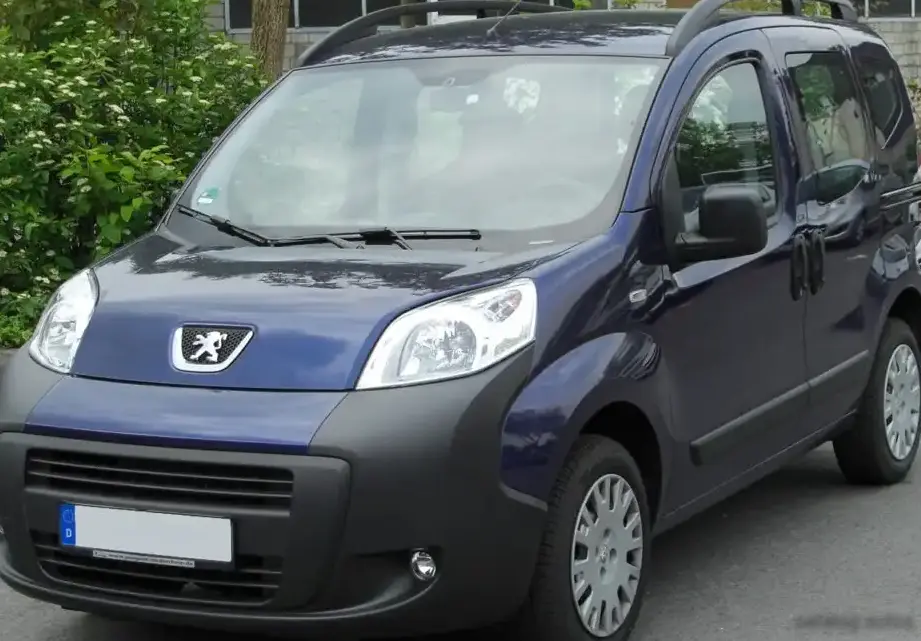
The Peugeot Bipper Tepee 1.3 HDi (75 hp) FAP is a small, five-door minivan produced by the French manufacturer Peugeot between 2010 and 2015. Part of the first generation Bipper (codenamed X8), the Tepee variant was positioned as the passenger-focused version of the vehicle, sharing its platform and mechanical components with the Fiat Fiorino and Citroën Nemo. The “Tepee” designation signified a more comfortable and family-oriented trim level compared to the commercial van versions. This particular 1.3 HDi 75 hp configuration represented an entry-level offering within the Bipper Tepee range, prioritizing fuel efficiency and affordability over outright performance.
Technical Specifications
| Brand | Peugeot |
| Model | Bipper |
| Generation | Bipper Tepee |
| Type (Engine) | 1.3 HDi (75 Hp) FAP |
| Start of production | September, 2010 |
| End of production | September, 2015 |
| Powertrain Architecture | Internal Combustion engine |
| Body type | Minivan |
| Seats | 5 |
| Doors | 5 |
| Fuel consumption (urban) | 5.7 l/100 km (41.3 US mpg, 49.6 UK mpg, 17.5 km/l) |
| Fuel consumption (extra urban) | 3.8 l/100 km (61.9 US mpg, 74.3 UK mpg, 26.3 km/l) |
| Fuel consumption (combined) | 4.5 l/100 km (52.3 US mpg, 62.8 UK mpg, 22.2 km/l) |
| Fuel Type | Diesel |
| Acceleration 0 – 100 km/h | 16.6 sec |
| Acceleration 0 – 62 mph | 16.6 sec |
| Acceleration 0 – 60 mph | 15.8 sec |
| Maximum speed | 152 km/h (94.45 mph) |
| Emission standard | Euro 5 |
| Weight-to-power ratio | 15.8 kg/Hp, 63.3 Hp/tonne |
| Weight-to-torque ratio | 6.2 kg/Nm, 160.3 Nm/tonne |
| Power | 75 Hp @ 3750 rpm |
| Power per litre | 60.1 Hp/l |
| Torque | 190 Nm @ 1750 rpm (140.14 lb.-ft. @ 1750 rpm) |
| Engine layout | Front, Transverse |
| Engine Model/Code | FHZ F13DTE5 |
| Engine displacement | 1248 cm3 (76.16 cu. in.) |
| Engine configuration | Inline |
| Cylinder Bore | 69.6 mm (2.74 in.) |
| Piston Stroke | 82 mm (3.23 in.) |
| Fuel injection system | Diesel Commonrail |
| Engine aspiration | Turbocharger, Intercooler |
| Engine oil capacity | 3.2 l (3.38 US qt | 2.82 UK qt) |
| Coolant | 6.85 l (7.24 US qt | 6.03 UK qt) |
| Kerb Weight | 1185 kg (2612.48 lbs.) |
| Max. weight | 1700 kg (3747.86 lbs.) |
| Max load | 515 kg (1135.38 lbs.) |
| Trunk (boot) space – minimum | 356 l (12.57 cu. ft.) |
| Trunk (boot) space – maximum | 884 l (31.22 cu. ft.) |
| Fuel tank capacity | 45 l (11.89 US gal | 9.9 UK gal) |
| Length | 3959 mm (155.87 in.) |
| Width | 1816 mm (71.5 in.) |
| Height | 1721 mm (67.76 in.) |
| Wheelbase | 2513 mm (98.94 in.) |
| Minimum turning circle | 11.8 m (38.71 ft.) |
| Drivetrain Architecture | The Internal combustion engine (ICE) drives the front wheels of the vehicle. |
| Drive wheel | Front wheel drive |
| Number of gears | 5 gears, manual transmission |
| Front suspension | Independent type McPherson |
| Rear suspension | Semi-independent, coil spring |
| Front brakes | Ventilated discs |
| Rear brakes | Drum |
| Assisting systems | ABS (Anti-lock braking system) |
| Steering type | Steering rack and pinion |
| Tires size | 185/65 R15 |
| Wheel rims size | 15 |
INTRODUCTION
The Peugeot Bipper Tepee, launched in 2010, was a collaborative effort between Peugeot, Fiat, and Citroën, resulting in a trio of nearly identical vans marketed under different badges. The Bipper Tepee aimed to provide a practical and affordable transportation solution for small families or individuals needing a versatile vehicle. The 1.3 HDi 75 hp variant, equipped with a five-speed manual transmission, served as the entry point to the Tepee range, offering a balance between fuel economy and usability. It was designed to appeal to buyers prioritizing low running costs and a compact footprint for urban driving.
Powertrain & Engine Architecture
The heart of the Bipper Tepee 1.3 HDi is the FHZ F13DTE5 engine, a 1.3-liter inline-four cylinder diesel engine. This engine is part of Peugeot’s HDi (High Pressure Diesel Injection) family, utilizing a common rail direct injection system to deliver fuel directly into the combustion chamber at extremely high pressure. This technology contributes to improved fuel efficiency and reduced emissions. The engine features a turbocharger with an intercooler, boosting power output to 75 horsepower at 3750 rpm and 190 Nm (140 lb-ft) of torque at 1750 rpm. The five-speed manual transmission was the only gearbox option for this variant. The engine’s relatively simple design and robust construction were intended to ensure reliability and minimize maintenance costs.
Driving Characteristics
The 1.3 HDi 75 hp Bipper Tepee, while not a performance vehicle, offered adequate power for everyday driving. Acceleration was modest, taking approximately 16.6 seconds to reach 100 km/h (62 mph). The engine’s torque peak at low rpm provided reasonable pulling power for navigating city streets and carrying a moderate load. Compared to higher-powered versions of the Bipper Tepee, such as those equipped with the 1.6 HDi engine, the 1.3 HDi felt noticeably slower, particularly when fully loaded or climbing hills. The five-speed gearbox was well-matched to the engine’s characteristics, offering a usable spread of ratios. The gear ratios were optimized for fuel efficiency rather than outright acceleration. The driving experience was generally comfortable, thanks to the Bipper Tepee’s relatively soft suspension.
Equipment & Trim Levels
The Bipper Tepee 1.3 HDi typically came with a basic but functional level of equipment. Standard features included power steering, central locking, electric front windows, and an adjustable steering column. The interior was typically finished with durable, easy-to-clean materials. The dashboard layout was simple and straightforward. Optional extras included air conditioning, a radio/CD player, and rear parking sensors. Higher trim levels offered upgrades such as alloy wheels, upgraded upholstery, and additional safety features. The Tepee trim focused on providing a more comfortable and refined interior compared to the commercial van versions, with features like improved seat fabrics and additional sound insulation.
Chassis & Braking
The Bipper Tepee utilized a front-wheel-drive layout with an independent McPherson strut suspension at the front and a semi-independent coil spring suspension at the rear. The front brakes were ventilated discs, providing adequate stopping power, while the rear brakes were drums. ABS (Anti-lock Braking System) was standard equipment. The suspension setup was tuned for comfort and ride quality, prioritizing a smooth ride over sporty handling. The relatively lightweight construction of the Bipper Tepee contributed to its nimble handling characteristics. The steering was light and easy to use, making it well-suited for urban driving.
Market Reception & Comparison
The Peugeot Bipper Tepee 1.3 HDi was generally well-received by critics for its practicality, fuel efficiency, and affordability. It was often praised as a sensible and economical choice for small families or individuals needing a versatile vehicle. Compared to other small MPVs on the market, the Bipper Tepee offered a competitive price point and a surprisingly spacious interior. However, some critics noted its lack of refinement and its modest performance. The 1.3 HDi engine, while fuel-efficient, was considered underpowered by some reviewers. Compared to the 1.6 HDi version, the 1.3 HDi offered significantly lower running costs but at the expense of performance. The Fiat Fiorino and Citroën Nemo, being mechanically identical, offered similar pros and cons.
Legacy
The Peugeot Bipper Tepee 1.3 HDi has proven to be a relatively reliable vehicle, with the 1.3 HDi engine generally regarded as durable and long-lasting. Common issues are typically related to wear and tear on components such as the clutch, brakes, and suspension. The availability of spare parts is generally good, and maintenance costs are relatively low. On the used car market, the Bipper Tepee 1.3 HDi remains a popular choice for budget-conscious buyers seeking a practical and economical vehicle. Its compact size, fuel efficiency, and versatility continue to make it a relevant option in the small MPV segment.
