
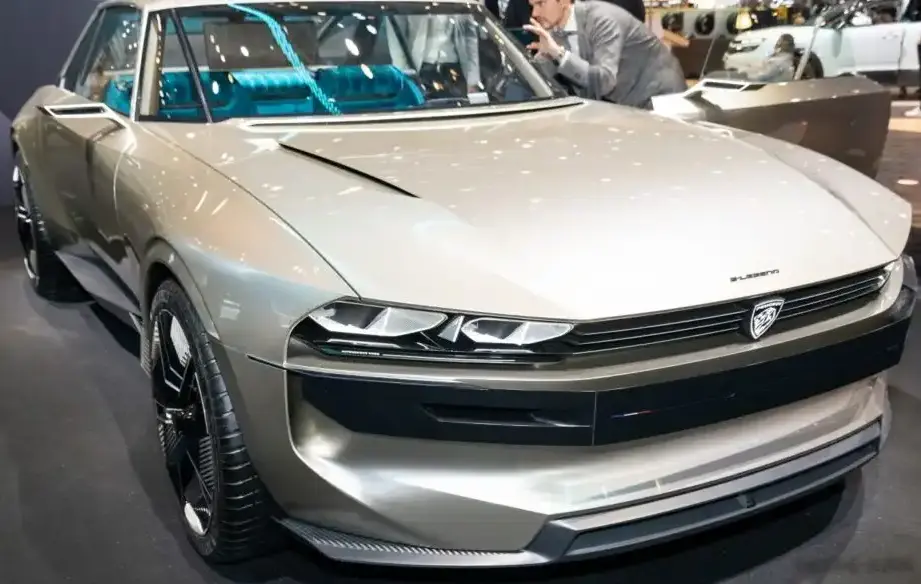
The Peugeot e-LEGEND Concept, unveiled in 2018, was a striking all-electric grand tourer concept car designed to evoke the spirit of Peugeot’s iconic 504 coupe while showcasing the brand’s vision for the future of electric vehicles. Production was limited to a single concept vehicle, serving as a technology demonstrator rather than a precursor to a production model. The e-LEGEND aimed to blend classic styling cues with cutting-edge electric powertrain technology, offering a glimpse into a potential future for Peugeot’s luxury offerings. It was positioned as a halo vehicle, demonstrating Peugeot’s commitment to electrification and autonomous driving capabilities.
Technical Specifications
| Brand | Peugeot |
| Model | e-LEGEND |
| Generation | e-LEGEND Concept |
| Type (Engine) | 100 kWh (462 Hp) AWD |
| Start of production | 2018 |
| End of production | 2018 |
| Powertrain Architecture | BEV (Electric Vehicle) |
| Body type | Coupe |
| Doors | 2 |
| Fuel Type | Electricity |
| Acceleration 0 – 60 mph (Calculated) | 3.8 sec |
| Maximum speed | 220 km/h (136.7 mph) |
| Gross battery capacity | 100 kWh |
| All-electric range | 600 km (372.82 mi) |
| Electric motor power | 462 Hp |
| Electric motor Torque | 800 Nm (590.05 lb.-ft.) |
| System power | 462 Hp |
| Length | 4650 mm (183.07 in.) |
| Width | 1930 mm (75.98 in.) |
| Height | 1370 mm (53.94 in.) |
| Wheelbase | 2690 mm (105.91 in.) |
| Drive wheel | All wheel drive (4×4) |
| Wheel rims size | 19 |
Powertrain & Engine Architecture
The e-LEGEND Concept is built around a fully electric powertrain. Its core is a 100 kWh battery pack providing a substantial range of 600 kilometers (373 miles) under the WLTP cycle. The vehicle employs a dual-motor all-wheel-drive system, delivering a combined output of 462 horsepower and a significant 800 Nm (590 lb-ft) of torque. This configuration allows for rapid acceleration, achieving 0-60 mph in approximately 3.8 seconds. The battery pack is positioned low in the chassis to optimize the car’s center of gravity, enhancing handling and stability. While specific details regarding the battery chemistry were not fully disclosed, it utilized advanced cell technology for high energy density and efficient thermal management. The powertrain operates at 800 volts, enabling faster charging times compared to conventional 400-volt systems. The e-LEGEND also featured a sophisticated energy recovery system, maximizing efficiency by capturing kinetic energy during deceleration.
Driving Characteristics
The e-LEGEND Concept, with its potent electric powertrain and all-wheel-drive system, offered a driving experience focused on effortless performance and refined comfort. The instant torque delivery characteristic of electric motors provided exhilarating acceleration, while the low center of gravity contributed to confident handling. The dual-motor setup allowed for precise torque vectoring, further enhancing agility and stability. The concept car was designed to offer multiple driving modes, ranging from a relaxed, efficiency-focused setting to a more dynamic, performance-oriented mode. The steering was tuned for precision and feedback, providing a connected feel to the driver. The absence of a traditional internal combustion engine resulted in a remarkably quiet cabin, enhancing the overall sense of luxury and refinement. The car’s weight distribution, optimized by the battery pack’s placement, contributed to balanced and predictable handling characteristics.
Equipment & Trim Levels
As a concept car, the e-LEGEND was equipped with a lavish array of features designed to showcase Peugeot’s vision for future automotive interiors. The cabin was dominated by a large, curved OLED display spanning the width of the dashboard, serving as the primary interface for infotainment, navigation, and vehicle controls. The interior materials were a blend of luxurious fabrics, reclaimed wood, and polished metal accents, creating a warm and inviting atmosphere. The seats were upholstered in supple leather and featured integrated heating and cooling functions. The e-LEGEND also incorporated advanced driver-assistance systems, including autonomous driving capabilities. A retractable steering wheel allowed for full autonomous operation when desired. The concept car featured a premium sound system and ambient lighting to further enhance the driving experience. The overall design aesthetic was a harmonious blend of classic elegance and modern technology.
Chassis & Braking
The e-LEGEND Concept utilized a lightweight chassis construction, employing a combination of steel and aluminum to optimize strength and rigidity while minimizing weight. The suspension system featured independent double wishbones at all four corners, providing a comfortable ride and precise handling. The car was equipped with large-diameter disc brakes on all wheels, ensuring ample stopping power. The braking system incorporated regenerative braking, further enhancing efficiency and reducing wear on the conventional friction brakes. The e-LEGEND’s steering system was a power-assisted rack-and-pinion setup, tuned for responsive and accurate control. The car’s 19-inch wheels were fitted with low-rolling-resistance tires to maximize efficiency. The chassis was designed to accommodate the battery pack’s weight and optimize the car’s center of gravity for improved stability and handling.
Market Reception & Comparison
The Peugeot e-LEGEND Concept received overwhelmingly positive reception from automotive critics and enthusiasts alike. It was praised for its stunning design, innovative technology, and ambitious vision for the future of electric vehicles. While not a production vehicle, it served as a powerful statement of Peugeot’s commitment to electrification and its ability to create desirable and technologically advanced automobiles. Compared to other electric vehicle concepts of the time, the e-LEGEND stood out for its blend of classic styling cues and cutting-edge technology. It differentiated itself from more utilitarian EV offerings by emphasizing luxury, performance, and emotional appeal. The concept car’s range and performance figures were competitive with those of other high-end electric vehicles, demonstrating Peugeot’s technical capabilities. The e-LEGEND’s focus on autonomous driving and advanced driver-assistance systems also positioned it as a forward-thinking vehicle.
Legacy
Although the e-LEGEND Concept never reached production, it left a lasting impact on Peugeot’s design language and technological development. Elements of its styling and interior design influenced subsequent Peugeot models, particularly those focused on electrification. The concept car’s powertrain technology and autonomous driving capabilities paved the way for Peugeot’s future electric vehicle offerings. The e-LEGEND served as a valuable platform for testing and refining new technologies, contributing to Peugeot’s expertise in the field of electric mobility. In the used car market, the single e-LEGEND concept remains a highly sought-after collector’s item, representing a pivotal moment in Peugeot’s history and a bold vision for the future of automotive design. It continues to be celebrated as a landmark achievement in automotive concept design.
