
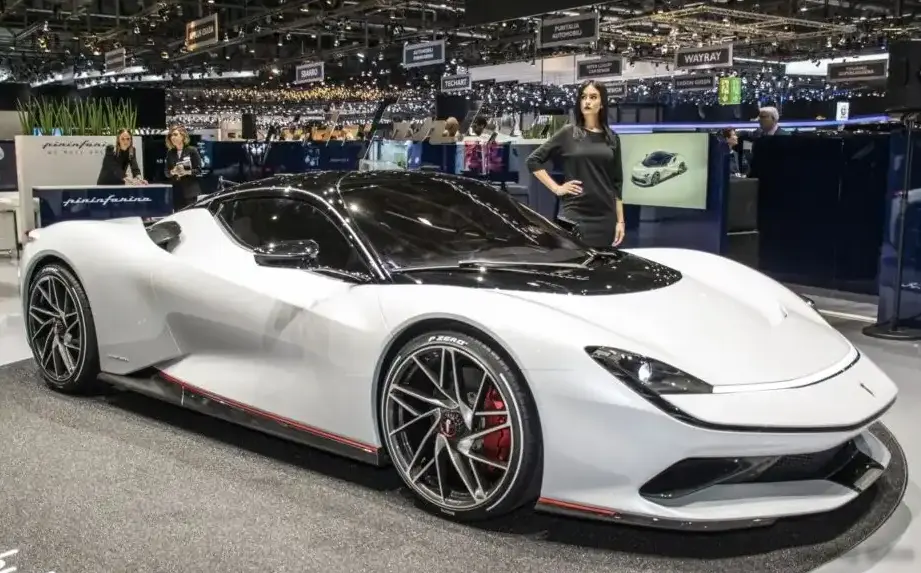
The Pininfarina Battista is an all-electric hypercar produced by the Italian automotive design firm Pininfarina S.p.A. Launched in 2019, the Battista represents Pininfarina’s first foray into series production of automobiles, moving beyond its traditional role as a design house for other manufacturers. The vehicle is built on a carbon fiber monocoque chassis and boasts a staggering 1900 horsepower delivered through a four-motor all-wheel-drive system. It is positioned as a direct competitor to other high-performance electric vehicles like the Rimac Nevera and the Lotus Evija, aiming for the ultra-luxury, high-performance segment of the automotive market.
Technical Specifications
| Brand | Pininfarina |
| Model | Battista |
| Generation | Battista |
| Type (Engine) | 120 kWh (1900 Hp) AWD |
| Start of production | 2019 |
| Powertrain Architecture | BEV (Electric Vehicle) |
| Body type | Coupe |
| Seats | 2 |
| Doors | 2 |
| Fuel Type | Electricity |
| Acceleration 0 – 60 mph (Calculated) | 1.9 sec |
| Acceleration 0 – 100 km/h | Not Officially Published |
| Acceleration 0 – 62 mph | Not Officially Published |
| Acceleration 0 – 200 km/h | Not Officially Published |
| Acceleration 0 – 300 km/h | Not Officially Published |
| Maximum speed | 350 km/h (217.48 mph) |
| Gross battery capacity | 120 kWh |
| Battery technology | Lithium-ion (Li-Ion) |
| Battery location | In the central tunnel, Behind the back wall of the passenger cabin |
| All-electric range (WLTP) | 500 km (310.69 mi) |
| System power | 1900 Hp |
| System torque | 2300 Nm (1696.39 lb.-ft.) |
| Drivetrain Architecture | Four electric motors drive each wheel individually |
| Drive wheel | All wheel drive (4×4) |
| Number of gears | 1 |
| Type of gearbox | Automatic transmission |
| Front suspension | Double wishbone |
| Rear suspension | Double wishbone |
| Front brakes | Ventilated discs, 390 mm |
| Rear brakes | Ventilated discs, 390 mm |
| Assisting systems | ABS (Anti-lock braking system) |
| Wheel rims size | Front: 20″, Rear: 20″ / 21″ |
Powertrain & Engine Architecture
The Pininfarina Battista utilizes a fully electric powertrain, eschewing the internal combustion engine entirely. At its heart lies a 120 kWh lithium-ion battery pack, strategically positioned within the vehicle’s central tunnel and behind the passenger compartment to optimize weight distribution and lower the center of gravity. This battery powers four independent electric motors – one for each wheel – providing all-wheel drive capability and torque vectoring for exceptional handling. Each motor delivers substantial power, combining for a total output of 1900 horsepower and 2300 Nm (1696.39 lb.-ft.) of torque. The battery management system is sophisticated, allowing for rapid charging and optimized battery life. The single-speed automatic transmission is inherent to the electric motor design, providing seamless and instant power delivery.
Driving Characteristics
The Battista’s driving experience is defined by its instantaneous torque and breathtaking acceleration. The 0-60 mph sprint is achieved in a claimed 1.9 seconds, placing it among the quickest production cars in the world. The all-wheel-drive system and torque vectoring capabilities provide exceptional grip and stability, even under extreme acceleration. The low center of gravity, thanks to the battery placement, contributes to remarkably flat cornering. Unlike traditional internal combustion engine hypercars, the Battista offers a near-silent driving experience, punctuated only by a synthesized soundscape designed to enhance the sense of speed and engagement. The single-speed transmission provides a linear and predictable power delivery, eliminating the need for gear changes and maximizing acceleration.
Equipment & Trim Levels
The Pininfarina Battista is positioned as a luxury hypercar, and its equipment levels reflect this. Standard features include a bespoke interior crafted from sustainable materials, a high-end audio system, advanced driver-assistance systems (ADAS), and a fully digital instrument cluster. Customers have extensive customization options, allowing them to personalize the exterior paint color, interior upholstery, and trim materials. Options include carbon fiber body panels, upgraded braking systems, and exclusive interior finishes. The interior design emphasizes minimalist elegance and driver-focused ergonomics. The Battista features a large central touchscreen display controlling most vehicle functions, along with a smaller display for the passenger.
Chassis & Braking
The Battista’s chassis is a carbon fiber monocoque, providing exceptional rigidity and minimizing weight. This lightweight construction is crucial for maximizing performance and handling. The suspension system utilizes double wishbones at both the front and rear, tuned for optimal balance between comfort and control. The braking system features ventilated discs with 390mm rotors at all four corners, providing immense stopping power. An advanced anti-lock braking system (ABS) and regenerative braking system further enhance safety and efficiency. The regenerative braking system captures energy during deceleration, returning it to the battery and extending the vehicle’s range.
Market Reception & Comparison
The Pininfarina Battista has been generally well-received by automotive critics, praised for its stunning design, blistering performance, and luxurious interior. It is often compared to other electric hypercars such as the Rimac Nevera and the Lotus Evija. While the Battista offers comparable performance to these rivals, it distinguishes itself with its Italian design flair and focus on sustainable materials. The Battista’s range of 500 km (310.69 mi) on the WLTP cycle is competitive within its segment. However, its high price tag – exceeding $2 million – limits its appeal to a very exclusive clientele.
Legacy
The Pininfarina Battista represents a significant milestone for the company, marking its transition from a design house to an automotive manufacturer. Its success will be crucial in establishing Pininfarina as a credible player in the high-performance electric vehicle market. The Battista’s advanced electric powertrain and carbon fiber construction showcase the potential of electric technology in the hypercar segment. As a limited-production vehicle, the Battista is likely to become a highly sought-after collectible in the future, representing a pivotal moment in the evolution of automotive design and technology. The long-term reliability of the powertrain remains to be fully assessed, but the use of high-quality components and a sophisticated battery management system suggests a robust and durable design.
