
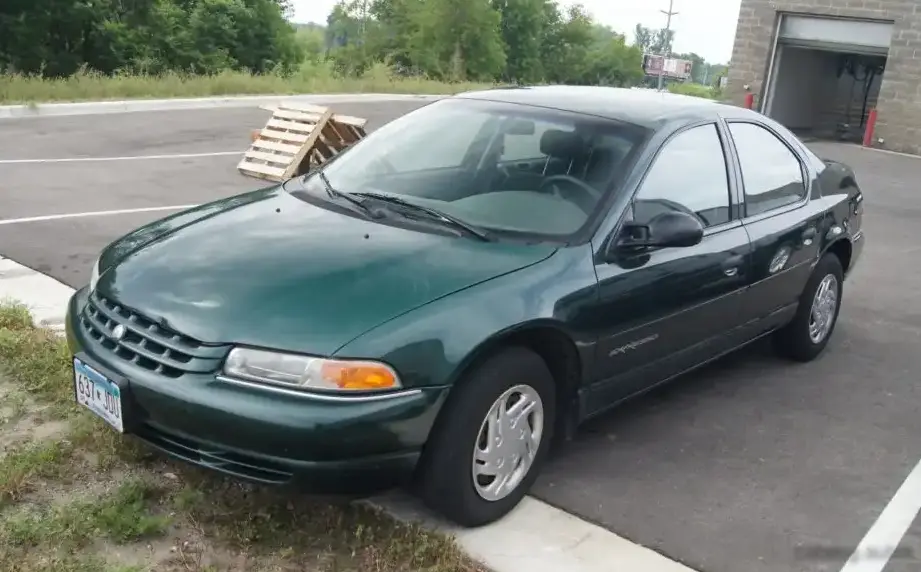
Technical Specifications
| Brand | Plymouth |
| Model | Breeze |
| Generation | Breeze |
| Type (Engine) | 2.0 16V (132 Hp) |
| Start of production | 1995 |
| End of production | 2000 |
| Powertrain Architecture | Internal Combustion engine |
| Body type | Sedan |
| Seats | 5 |
| Doors | 4 |
| Fuel consumption (urban) | 9.4 l/100 km (25 US mpg) |
| Fuel consumption (extra urban) | 6.5 l/100 km (36.2 US mpg) |
| Fuel Type | Petrol (Gasoline) |
| Maximum speed | 180 km/h (111.85 mph) |
| Weight-to-power ratio | 10.1 kg/Hp |
| Weight-to-torque ratio | 7.6 kg/Nm |
| Power | 132 Hp @ 6000 rpm |
| Power per litre | 66.1 Hp/l |
| Torque | 175 Nm @ 5000 rpm (129.07 lb.-ft. @ 5000 rpm) |
| Engine layout | Front, Transverse |
| Engine Model/Code | ECB |
| Engine displacement | 1996 cm3 (121.8 cu. in.) |
| Number of cylinders | 4 |
| Engine configuration | Inline |
| Cylinder Bore | 87.5 mm (3.44 in.) |
| Piston Stroke | 83 mm (3.27 in.) |
| Compression ratio | 9.8:1 |
| Number of valves per cylinder | 4 |
| Fuel injection system | Multi-port manifold injection |
| Engine aspiration | Naturally aspirated engine |
| Valvetrain | DOHC |
| Engine oil capacity | 4.3 l (4.54 US qt | 3.78 UK qt) |
| Coolant | 8 l (8.45 US qt | 7.04 UK qt) |
| Kerb Weight | 1330 kg (2932.15 lbs.) |
| Trunk (boot) space – minimum | 445 l (15.72 cu. ft.) |
| Fuel tank capacity | 60 l (15.85 US gal | 13.2 UK gal) |
| Length | 4739 mm (186.57 in.) |
| Width | 1803 mm (70.98 in.) |
| Height | 1374 mm (54.09 in.) |
| Wheelbase | 2743 mm (107.99 in.) |
| Front track | 1529 mm (60.2 in.) |
| Rear (Back) track | 1529 mm (60.2 in.) |
| Drivetrain Architecture | The Internal combustion engine (ICE) drives the front wheels of the vehicle. |
| Drive wheel | Front wheel drive |
| Number of gears and type of gearbox | 5 gears, manual transmission |
| Front suspension | Double wishbone |
| Rear suspension | Double wishbone |
| Front brakes | Ventilated discs |
| Rear brakes | Drum |
| Assisting systems | ABS (Anti-lock braking system) |
| Steering type | Steering rack and pinion |
| Power steering | Hydraulic Steering |
| Tires size | 195/70 R14 S |
The Plymouth Breeze 2.0 16V, produced from 1995 to 2000, was a mid-size sedan designed to offer comfortable and practical transportation for families. It occupied a key position within the Plymouth lineup, slotting between the more economically focused Plymouth Acclaim and the larger, minivan-style Plymouth Grand Voyager. Built on the Chrysler JA platform – shared with the Dodge Intrepid and Chrysler Concorde – the Breeze represented a move towards more modern, aerodynamic styling for the brand. This particular 2.0-liter, 16-valve variant, delivering 132 horsepower, served as the entry-level engine option, aiming to balance affordability with acceptable performance. It was a common sight on American roads during its production run, appealing to buyers seeking a no-frills, reliable sedan.
Powertrain & Engine Architecture
Under the hood of the Plymouth Breeze 2.0 16V resided the Chrysler ECB engine, a 2.0-liter inline-four cylinder powerplant. This engine was notable for its dual overhead camshaft (DOHC) valvetrain, operating four valves per cylinder. This configuration contributed to its relatively respectable output for its displacement. Fuel delivery was handled by a multi-port fuel injection system, carefully metering fuel into the intake ports for optimized combustion. The engine featured a compression ratio of 9.8:1, a compromise designed to allow operation on the readily available 87 octane gasoline common in the US market. The standard transmission pairing for this engine was a five-speed manual, providing a direct connection between the engine and the front wheels. The engine was mounted transversely, a common layout for front-wheel-drive vehicles, maximizing cabin space and improving packaging efficiency.
Driving Characteristics
The 132 horsepower and 129 lb-ft of torque generated by the 2.0-liter engine provided adequate, though not particularly exciting, performance in the Breeze. Acceleration from 0 to 60 mph was estimated to take around 10 to 11 seconds. The five-speed manual transmission allowed drivers to maintain the engine within its optimal power band, but the engine lacked the strong low-end torque found in larger displacement alternatives. Compared to the optional 2.4-liter four-cylinder or the more potent V6 engines offered in the Breeze, the 2.0-liter felt noticeably less responsive, especially when carrying a full load of passengers or cargo. However, the 2.0-liter engine delivered a more fuel-efficient driving experience, making it a popular choice for daily commuting and those prioritizing economy. The gear ratios were fairly standard for the time, prioritizing fuel efficiency over outright acceleration.
Equipment & Trim Levels
The 2.0-liter Breeze typically came equipped with a fairly standard set of features. Base models included air conditioning, power steering, an AM/FM radio, and cloth upholstery. Stepping up to higher trim levels, such as the LX, added amenities like power windows and door locks, upgraded audio systems, and alloy wheels. A range of optional extras were available, including a sunroof, cruise control, and enhanced interior trim packages. The interior design was functional and straightforward, prioritizing practicality and ease of use over luxurious appointments. The dashboard layout was typical of Chrysler products from that era, featuring clearly marked controls and a relatively uncluttered design. The overall feel was one of sensible, family-oriented comfort.
Chassis & Braking
The Breeze utilized an independent double wishbone suspension system at both the front and rear axles, contributing to a comfortable and controlled ride quality. The front suspension incorporated ventilated disc brakes for effective stopping power, while the rear brakes were drum-type. An anti-lock braking system (ABS) was standard equipment, enhancing safety and control during emergency braking maneuvers. Steering was handled by a rack-and-pinion system with hydraulic power assist, providing responsive and precise handling. The Breeze’s relatively lightweight construction, tipping the scales at around 2932 pounds, helped to mitigate the modest power output of the 2.0-liter engine, resulting in a reasonably agile driving experience.
Market Reception & Comparison
The Plymouth Breeze 2.0 16V was generally well-received by automotive critics as an affordable and practical family sedan. Praise was often directed towards its comfortable ride, spacious interior, and relatively good fuel economy. However, the 2.0-liter engine frequently drew criticism for its lack of power, particularly when compared to the larger engine options available within the Breeze lineup. In terms of fuel efficiency, the 2.0-liter Breeze achieved around 25 mpg in city driving and 36 mpg on the highway, making it a competitive performer in its class. Reliability was generally considered good, although some owners reported minor issues with the fuel injection system and the cooling system. When compared to rivals like the Honda Accord and Toyota Camry, the Breeze offered a lower price point but lacked the same level of refinement and established brand reputation.
Legacy
The Plymouth Breeze, and specifically the 2.0-liter variant, has become a relatively affordable and accessible classic car in the used vehicle market. The ECB engine, while not renowned for exceptional longevity, is generally reliable with consistent and proper maintenance. Parts availability remains reasonably good, as many components are shared with other Chrysler, Dodge, and Plymouth models from the same period. Today, the Breeze 2.0 16V represents a tangible example of mid-1990s American automotive design, offering a comfortable and practical driving experience at an attractive price. While it may not be a performance icon, it continues to serve as a viable option for those seeking an affordable and dependable used car, offering a glimpse into a bygone era of automotive engineering.
