
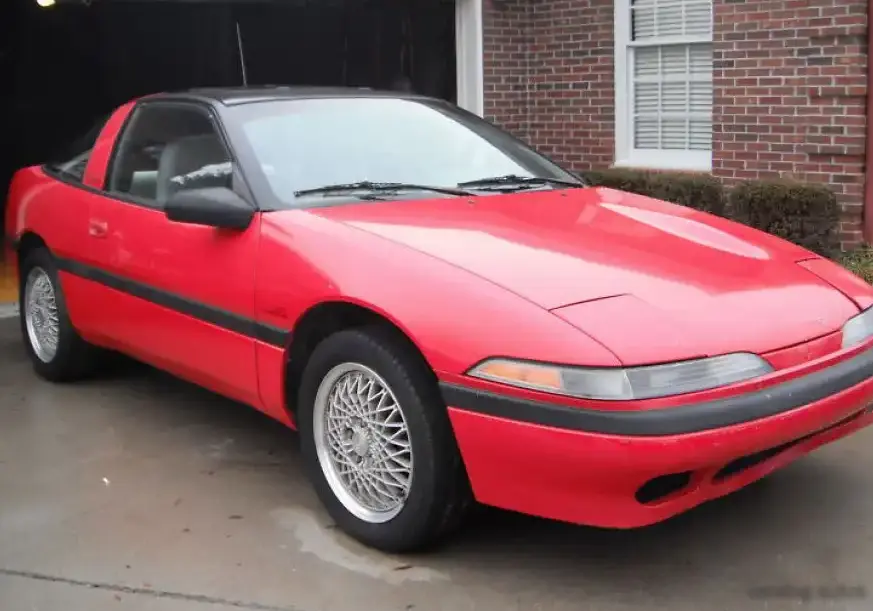
The Plymouth Laser 2.0i, produced between 1989 and 1994, was a sport compact coupe marketed by Plymouth as part of the DiamondStar Motors joint venture with Mitsubishi and Chrysler. This collaboration resulted in a platform-sharing arrangement with the Mitsubishi Eclipse and Eagle Talon, creating a trio of nearly identical vehicles sold under different brand names. The Laser 2.0i occupied a middle ground within the Laser lineup, positioned between the base model and the higher-performance Turbo variants. It aimed to provide a balance of affordability, style, and respectable performance for the burgeoning sport compact market in North America.
Technical Specifications
| Brand | Plymouth |
| Model | Laser |
| Generation | Laser |
| Type (Engine) | 2.0i (137 Hp) |
| Start of production | 1989 |
| End of production | 1994 |
| Powertrain Architecture | Internal Combustion engine |
| Body type | Coupe |
| Seats | 4 |
| Doors | 3 |
| Fuel consumption (urban) | 13 l/100 km (18.1 US mpg, 21.7 UK mpg, 7.7 km/l) |
| Fuel consumption (extra urban) | 8 l/100 km (29.4 US mpg, 35.3 UK mpg, 12.5 km/l) |
| Fuel Type | Petrol (Gasoline) |
| Acceleration 0 – 100 km/h | 8.7 sec |
| Acceleration 0 – 62 mph | 8.7 sec |
| Acceleration 0 – 60 mph | 8.3 sec |
| Maximum speed | 195 km/h (121.17 mph) |
| Weight-to-power ratio | 8.9 kg/Hp, 112.8 Hp/tonne |
| Weight-to-torque ratio | 7.2 kg/Nm, 139.1 Nm/tonne |
| Power | 137 Hp @ 6000 rpm |
| Power per litre | 68.6 Hp/l |
| Torque | 169 Nm @ 5000 rpm (124.65 lb.-ft. @ 5000 rpm) |
| Engine layout | Front, Transverse |
| Engine Model/Code | 4G63 |
| Engine displacement | 1997 cm3 (121.86 cu. in.) |
| Number of cylinders | 4 |
| Engine configuration | Inline |
| Cylinder Bore | 85 mm (3.35 in.) |
| Piston Stroke | 88 mm (3.46 in.) |
| Compression ratio | 9:1 |
| Number of valves per cylinder | 4 |
| Fuel injection system | Multi-port manifold injection |
| Engine aspiration | Naturally aspirated engine |
| Valvetrain | DOHC |
| Engine oil capacity | 4.4 l (4.65 US qt | 3.87 UK qt) |
| Coolant | 7 l (7.4 US qt | 6.16 UK qt) |
| Kerb Weight | 1215 kg (2678.62 lbs.) |
| Trunk (boot) space – minimum | 290 l (10.24 cu. ft.) |
| Trunk (boot) space – maximum | 730 l (25.78 cu. ft.) |
| Fuel tank capacity | 60 l (15.85 US gal | 13.2 UK gal) |
| Length | 4330 mm (170.47 in.) |
| Width | 1690 mm (66.54 in.) |
| Height | 1310 mm (51.57 in.) |
| Wheelbase | 2470 mm (97.24 in.) |
| Front track | 1465 mm (57.68 in.) |
| Rear (Back) track | 1450 mm (57.09 in.) |
| Drivetrain Architecture | The Internal combustion engine (ICE) drives the front wheels of the vehicle. |
| Drive wheel | Front wheel drive |
| Number of gears and type of gearbox | 5 gears, manual transmission |
| Front suspension | Coil spring |
| Rear suspension | Coil spring |
| Front brakes | Ventilated discs |
| Rear brakes | Disc |
| Assisting systems | ABS (Anti-lock braking system) |
| Steering type | Steering rack and pinion |
| Power steering | Hydraulic Steering |
| Tires size | 205/55 R16 |
| Wheel rims size | 6J x 16 |
INTRODUCTION
The Plymouth Laser 2.0i, built from 1989 to 1994, was a key component of the DiamondStar Motors partnership. This collaboration aimed to produce competitive, affordable vehicles for the North American market. The Laser, along with its Mitsubishi Eclipse and Eagle Talon siblings, was based on the 1HX0 platform, a front-wheel-drive chassis designed for sporty handling and modern styling. The 2.0i variant represented a sweet spot in the lineup, offering a balance between performance and fuel efficiency, making it a popular choice for buyers seeking a stylish and capable coupe.
Powertrain & Engine Architecture
At the heart of the Laser 2.0i lay the 4G63 2.0-liter inline-four cylinder engine. This engine, also used in various Mitsubishi models, was known for its durability and potential for modification. The 2.0i version produced 137 horsepower at 6000 rpm and 169 Nm (124.65 lb.-ft.) of torque at 5000 rpm. It featured a multi-port fuel injection system and a double overhead camshaft (DOHC) valvetrain, contributing to its relatively smooth power delivery. The engine’s 9:1 compression ratio was a compromise between performance and the ability to run on readily available 87 octane gasoline. The standard transmission was a five-speed manual, but a four-speed automatic transmission was also offered, though it impacted acceleration slightly. The engine was transversely mounted, driving the front wheels.
Driving Characteristics
The Plymouth Laser 2.0i with the five-speed manual transmission offered a reasonably engaging driving experience. Acceleration from 0 to 60 mph took approximately 8.3 seconds, while the 0-100 km/h sprint was completed in 8.7 seconds. The automatic transmission version added a noticeable fraction of a second to these times. The car’s front-wheel-drive layout provided predictable handling, although it could exhibit some understeer when pushed hard. The suspension, consisting of coil springs all around, offered a comfortable ride for everyday driving while still providing adequate control in corners. The gear ratios in the manual transmission were well-spaced, allowing the engine to stay within its powerband during spirited driving. The automatic transmission, while convenient, felt less responsive and diminished the overall sporty feel.
Equipment & Trim Levels
The Laser 2.0i typically came standard with features such as power steering, a basic audio system, cloth upholstery, and manual windows and locks. Air conditioning was a common option. Higher trim levels, often denoted by packages, could add features like upgraded sound systems, power windows and locks, cruise control, and a sunroof. Interior color schemes were generally conservative, with options typically limited to shades of gray or black. The dashboard layout was functional and driver-focused, with clearly marked gauges and easy-to-reach controls.
Chassis & Braking
The Laser 2.0i utilized a front-wheel-drive chassis with independent coil spring suspension at all four corners. The front suspension featured MacPherson struts, while the rear employed a multi-link setup. This configuration provided a good balance of ride comfort and handling. Braking duties were handled by ventilated discs at the front and solid discs at the rear. An anti-lock braking system (ABS) was available as an option, enhancing safety and control during hard braking. The car’s relatively light weight (approximately 1215 kg or 2678.62 lbs.) contributed to its nimble handling characteristics.
Market Reception & Comparison
The Plymouth Laser 2.0i was generally well-received by automotive critics as an affordable and stylish sport coupe. It was often praised for its handling and the potential of its 4G63 engine. However, some reviewers noted that the interior materials were somewhat basic and that the automatic transmission detracted from the driving experience. Compared to the Laser Turbo, the 2.0i offered less outright performance but was more fuel-efficient and less expensive to maintain. Against the Mitsubishi Eclipse and Eagle Talon, the Laser differentiated itself primarily through its Plymouth branding and slightly different styling cues. Fuel economy was respectable for the time, averaging around 18.1 US mpg in the city and 29.4 US mpg on the highway.
Legacy
The Plymouth Laser 2.0i, while discontinued in 1994 along with the Plymouth brand, has maintained a modest following among enthusiasts. The 4G63 engine is particularly well-regarded for its durability and tunability, making it a popular choice for engine swaps and modifications. While not as collectible as the Turbo models, well-maintained 2.0i Lasers can still be found on the used car market, offering an affordable entry point into the world of sport compact coupes. The car’s relatively simple mechanical design makes it reasonably easy to maintain and repair, contributing to its longevity. The Laser 2.0i represents a significant example of the DiamondStar Motors collaboration and a snapshot of the evolving sport compact car market of the early 1990s.
