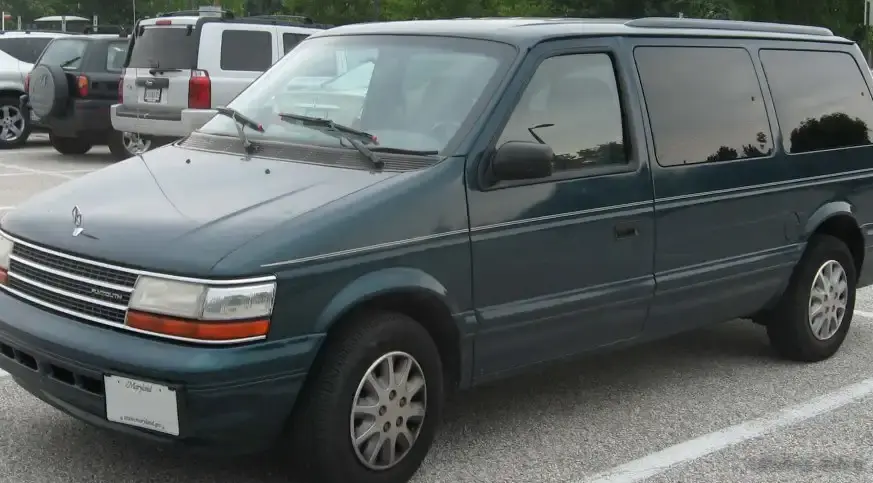
The Plymouth Voyager 3.0 i V6, produced between 1990 and 1995, represented a significant offering in the burgeoning minivan segment. Part of the first generation of Voyager minivans, it was marketed as a practical and family-oriented vehicle. This particular variant, equipped with the 3.0-liter V6 engine and a three-speed automatic transmission, occupied a mid-range position within the Voyager lineup, offering a balance between performance and affordability. It was a key competitor to the Dodge Caravan and other similar vehicles, playing a role in establishing the minivan as a dominant force in the North American automotive market.
Technical Specifications
| Brand | Plymouth |
| Model | Voyager |
| Generation | Voyager |
| Type (Engine) | 3.0 i V6 (144 Hp) |
| Start of production | 1990 year |
| End of production | 1995 year |
| Powertrain Architecture | Internal Combustion engine |
| Body type | Minivan |
| Seats | 5 |
| Doors | 4 |
| Fuel Type | Petrol (Gasoline) |
| Weight-to-power ratio | 10.4 kg/Hp, 96.1 Hp/tonne |
| Weight-to-torque ratio | 6.4 kg/Nm, 156.9 Nm/tonne |
| Power | 144 Hp @ 5000 rpm |
| Power per litre | 48.5 Hp/l |
| Torque | 235 Nm @ 2800 rpm, 173.33 lb.-ft. @ 2800 rpm |
| Engine layout | Front, Transverse |
| Engine Model/Code | 6G72 |
| Engine displacement | 2972 cm3, 181.36 cu. in. |
| Number of cylinders | 6 |
| Engine configuration | V-engine |
| Cylinder Bore | 91.1 mm, 3.59 in. |
| Piston Stroke | 76 mm, 2.99 in. |
| Compression ratio | 8.9:1 |
| Number of valves per cylinder | 2 |
| Fuel injection system | Multi-port manifold injection |
| Engine aspiration | Naturally aspirated engine |
| Valvetrain | OHC |
| Engine oil capacity | 4.3 l, 4.54 US qt | 3.78 UK qt |
| Coolant | 9.5 l, 10.04 US qt | 8.36 UK qt |
| Kerb Weight | 1498 kg, 3302.52 lbs |
| Trunk (boot) space – minimum | 670 l, 23.66 cu. ft |
| Fuel tank capacity | 75 l, 19.81 US gal | 16.5 UK gal |
| Length | 4525 mm, 178.15 in |
| Width | 1830 mm, 72.05 in |
| Height | 1631 mm, 64.21 in |
| Wheelbase | 2853 mm, 112.32 in |
| Front track | 1522 mm, 59.92 in |
| Rear (Back) track | 1578 mm, 62.13 in |
| Drivetrain Architecture | The Internal combustion engine (ICE) drives the front wheels of the vehicle. |
| Drive wheel | Front wheel drive |
| Number of gears and type of gearbox | 3 gears, automatic transmission |
| Front suspension | Coil spring |
| Rear suspension | Coil spring |
| Front brakes | Ventilated discs |
| Rear brakes | Drum |
| Assisting systems | ABS (Anti-lock braking system) |
| Steering type | Steering rack and pinion |
| Power steering | Hydraulic Steering |
| Tires size | 195/70 R14 S |
Powertrain & Engine Architecture
The heart of the Voyager 3.0 i V6 was the Mitsubishi-sourced 6G72 engine. This 2.972-liter (181.36 cubic inch) V6 featured a 60-degree V-angle and utilized a single overhead camshaft (OHC) design for each cylinder bank. The engine employed multi-port fuel injection, delivering fuel directly to each intake port for improved efficiency and power delivery. The 6G72 was known for its relatively smooth operation and decent power output for its displacement. The three-speed automatic transmission, while not particularly sophisticated by modern standards, was chosen for its ease of use and suitability for family transportation. It provided relatively smooth shifts, though it lacked the responsiveness of a manual transmission or more modern automatics.
Driving Characteristics
The 144 horsepower and 173 lb-ft of torque produced by the 3.0-liter V6 and automatic transmission combination provided adequate, but not exhilarating, performance. Acceleration was reasonable for everyday driving, but passing maneuvers required planning, especially when fully loaded with passengers and cargo. The automatic transmission’s gear ratios were geared towards fuel economy and smooth cruising rather than outright speed. Compared to the available manual transmission or the later, more powerful 3.3L V6 options, the 3.0L automatic felt noticeably slower. However, it offered a more relaxed driving experience, particularly in city traffic.
Equipment & Trim Levels
The Voyager 3.0 i V6 typically came standard with features considered essential for a family minivan in the early 1990s. These included air conditioning, a basic AM/FM radio, cloth upholstery, and power steering. Higher trim levels offered options such as upgraded sound systems, power windows and locks, and a rear window wiper. Interior upholstery was generally a durable cloth material, available in a variety of colors. The dashboard layout was functional and straightforward, prioritizing ease of use over aesthetic flair. Optional extras included alloy wheels, a sunroof, and cruise control.
Chassis & Braking
The Voyager’s chassis utilized a front-engine, front-wheel-drive layout. Suspension consisted of coil springs at all four corners, providing a comfortable ride quality. The front suspension incorporated stabilizer bars to reduce body roll during cornering. Braking duties were handled by ventilated discs at the front and drum brakes at the rear. An anti-lock braking system (ABS) was available, enhancing safety by preventing wheel lockup during hard braking. The relatively modest weight of the vehicle, around 3300 pounds, helped to compensate for the less powerful engine and drum brakes at the rear.
Market Reception & Comparison
The Plymouth Voyager 3.0 i V6 was generally well-received by critics as a practical and affordable minivan option. It was praised for its spacious interior, comfortable ride, and relatively smooth engine operation. However, some reviewers noted the lack of power compared to other minivans and the somewhat dated three-speed automatic transmission. Fuel economy was considered average for the segment. Compared to the higher-trim Voyager models with the 3.3L V6, the 3.0L automatic offered a more budget-friendly entry point into minivan ownership, appealing to families prioritizing practicality over performance.
Legacy
The Plymouth Voyager 3.0 i V6, while not a performance icon, proved to be a reliable and durable vehicle. The 6G72 engine, in particular, is known for its longevity when properly maintained. Today, these Voyagers are relatively common in the used car market, often found with high mileage but still running. While not highly sought after by collectors, they represent an affordable and practical option for those seeking a classic 1990s minivan. The powertrain, while dated, is generally considered relatively easy to repair and maintain, making it a viable option for budget-conscious buyers. The Voyager’s contribution to the popularization of the minivan segment remains significant, establishing a template for family transportation that continues to evolve today.