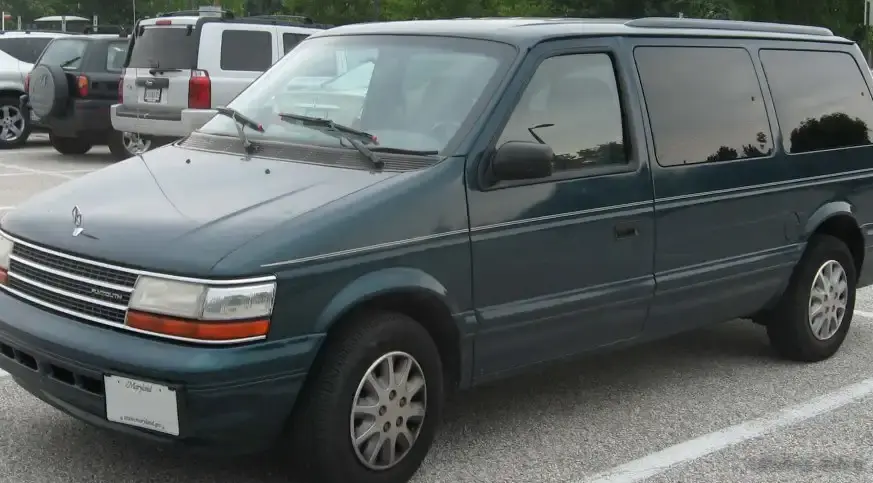
The Plymouth Voyager 3.3i, produced between 1990 and 1995, represented a significant offering in the American minivan segment. Part of the first generation of Voyager minivans (often grouped with the Dodge Caravan and Chrysler Town & Country due to their shared platform), the 3.3i trim level occupied a mid-range position within the lineup, offering a balance of power and features for families. This variant was characterized by its 3.3-liter V6 engine paired with a four-speed automatic transmission, aiming to provide comfortable and reliable transportation. The Voyager, and its Chrysler Corporation siblings, were instrumental in popularizing the minivan body style in North America, shifting family transportation away from station wagons.
Technical Specifications
| Brand | Plymouth |
| Model | Voyager |
| Generation | Voyager (First Generation) |
| Type (Engine) | 3.3 i (165 Hp) |
| Start of production | 1990 |
| End of production | 1995 |
| Powertrain Architecture | Internal Combustion engine |
| Body type | Minivan |
| Seats | 5 |
| Doors | 4 |
| Fuel consumption (combined) | 11.8 l/100 km (19.9 US mpg, 23.9 UK mpg, 8.5 km/l) |
| Fuel Type | Petrol (Gasoline) |
| Maximum speed | 200 km/h (124.27 mph) |
| Weight-to-power ratio | 9.8 kg/Hp, 102.1 Hp/tonne |
| Weight-to-torque ratio | 6.1 kg/Nm, 162.7 Nm/tonne |
| Power | 165 Hp @ 4800 rpm |
| Power per litre | 50 Hp/l |
| Torque | 263 Nm @ 3600 rpm (193.98 lb.-ft. @ 3600 rpm) |
| Engine layout | Front, Transverse |
| Engine Model/Code | EGA |
| Engine displacement | 3301 cm3 (201.44 cu. in.) |
| Number of cylinders | 6 |
| Engine configuration | V-engine |
| Cylinder Bore | 93 mm (3.66 in.) |
| Piston Stroke | 81 mm (3.19 in.) |
| Compression ratio | 8.9:1 |
| Number of valves per cylinder | 2 |
| Fuel injection system | Multi-port manifold injection |
| Engine aspiration | Naturally aspirated engine |
| Engine oil capacity | 4.3 l (4.54 US qt | 3.78 UK qt) |
| Coolant | 9.5 l (10.04 US qt | 8.36 UK qt) |
| Kerb Weight | 1616 kg (3562.67 lbs.) |
| Trunk (boot) space – minimum | 670 l (23.66 cu. ft.) |
| Fuel tank capacity | 75 l (19.81 US gal | 16.5 UK gal) |
| Length | 4525 mm (178.15 in.) |
| Width | 1830 mm (72.05 in.) |
| Height | 1632 mm (64.25 in.) |
| Wheelbase | 2853 mm (112.32 in.) |
| Front track | 1522 mm (59.92 in.) |
| Rear (Back) track | 1578 mm (62.13 in.) |
| Drivetrain Architecture | Front wheel drive |
| Number of gears and type of gearbox | 4 gears, automatic transmission |
| Front suspension | Coil spring |
| Rear suspension | Coil spring |
| Front brakes | Ventilated discs |
| Rear brakes | Drum |
| Assisting systems | ABS (Anti-lock braking system) |
| Steering type | Steering rack and pinion |
| Power steering | Hydraulic Steering |
| Tires size | 195/70 R14 |
Powertrain & Engine Architecture
The heart of the Voyager 3.3i was the EGA engine, a 3.3-liter (3301 cc) naturally aspirated V6. This engine utilized a 60-degree V-configuration, contributing to a relatively smooth power delivery. The EGA featured a cast iron block and aluminum cylinder heads, a common construction for engines of this era. Fuel delivery was managed by a multi-port fuel injection system, providing improved efficiency and responsiveness compared to earlier carbureted designs. The engine produced 165 horsepower at 4800 rpm and 263 Nm (194 lb-ft) of torque at 3600 rpm. The four-speed automatic transmission, a Chrysler-built Torqueflite A727 variant, was specifically tuned for the minivan application, prioritizing smooth shifts and drivability over outright performance. This transmission was known for its durability, but its four-speed configuration meant it wasn’t as fuel-efficient as more modern automatic transmissions.
Driving Characteristics
The 3.3i Voyager offered adequate, but not exhilarating, performance. Acceleration was sufficient for everyday driving and highway merging, but it wasn’t designed for sporty driving. The automatic transmission, while smooth, did contribute to a somewhat leisurely feel. Compared to the base 2.5-liter four-cylinder engine, the 3.3i provided a noticeable improvement in power and responsiveness, especially when fully loaded with passengers and cargo. However, it lagged behind the more powerful 3.8-liter V6 option in terms of outright acceleration. The gear ratios in the A727 transmission were optimized for cruising and towing, resulting in a comfortable ride but potentially feeling slightly undergeared at higher speeds.
Equipment & Trim Levels
The 3.3i trim level typically included features such as air conditioning, power windows and locks, an upgraded sound system, and cloth upholstery. Optional extras included a rear entertainment system (a popular choice for minivans), upgraded seating with captain’s chairs, and a sunroof. The interior design was functional and family-oriented, with ample storage compartments and a relatively spacious cabin. The dashboard layout was straightforward, with easy-to-read gauges and controls. The 3.3i generally sat in the middle of the Voyager lineup, offering more features than the base models but falling short of the luxury offered by the higher-end trims.
Chassis & Braking
The Voyager utilized a front-wheel-drive layout with an independent coil spring suspension in the front and a solid axle with coil springs in the rear. The suspension was tuned for comfort, providing a relatively smooth ride over various road surfaces. The front brakes were ventilated discs, offering good stopping power, while the rear brakes were drum brakes, a cost-saving measure common in this class of vehicle. An anti-lock braking system (ABS) was often included as standard equipment, enhancing safety. Steering was provided by a hydraulic power steering system, making maneuvering easy, especially at low speeds.
Market Reception & Comparison
The Voyager 3.3i was generally well-received by critics and consumers alike. It was praised for its spacious interior, comfortable ride, and reliable powertrain. However, some reviewers noted that the 3.3-liter engine could feel strained when fully loaded or when climbing steep hills. Fuel economy was considered average for the segment, around 19 mpg in combined driving. Compared to the 2.5-liter Voyager, the 3.3i offered a significant performance boost, making it a more appealing option for families who frequently carried passengers or towed trailers. Compared to the 3.8-liter V6, the 3.3i offered a more affordable price point, making it a more accessible option for budget-conscious buyers.
Legacy
The Plymouth Voyager 3.3i, and the first-generation Voyager as a whole, played a pivotal role in establishing the minivan as a dominant force in the American automotive market. The EGA 3.3L V6 engine, while not known for being a high-performance unit, proved to be reasonably durable and reliable when properly maintained. Today, these Voyagers are relatively affordable on the used car market, but finding well-maintained examples can be challenging. Common issues include corrosion, transmission problems, and wear and tear on suspension components. Despite its age, the Voyager 3.3i remains a popular choice for those seeking a spacious and affordable family vehicle, representing a significant chapter in the history of American automotive design and engineering.