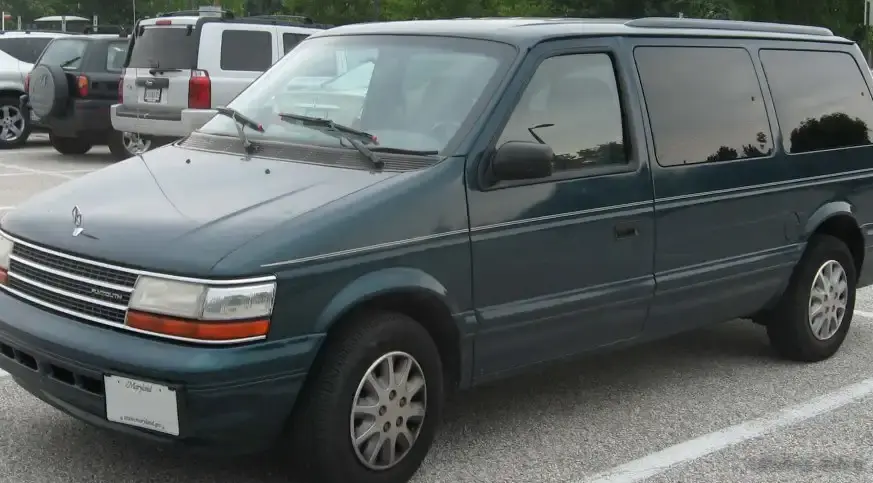
The Plymouth Voyager II 2.4 i 16V, produced between 1996 and 2000, represented a significant iteration of the Voyager minivan within the Chrysler Corporation lineup. Positioned as a mid-range offering, this variant combined a 2.4-liter inline-four engine with a three-speed automatic transmission, aiming to balance affordability with acceptable performance for family transportation. It was part of the second generation of the Voyager (often referred to as the NS platform), which saw a substantial redesign compared to its predecessor, focusing on improved interior space and updated styling. The Voyager II, along with its Dodge Caravan counterpart, were key models for Chrysler in the highly competitive North American minivan market.
Technical Specifications
| Brand | Plymouth |
| Model | Voyager |
| Generation | Voyager II |
| Type (Engine) | 2.4 i 16V (152 Hp) |
| Start of production | 1996 |
| End of production | 2000 |
| Powertrain Architecture | Internal Combustion engine |
| Body type | Minivan |
| Seats | 5 |
| Doors | 4 |
| Fuel consumption (urban) | 11.8 l/100 km (19.9 US mpg) |
| Fuel consumption (extra urban) | 9.4 l/100 km (25 US mpg) |
| Fuel Type | Petrol (Gasoline) |
| Maximum speed | 175 km/h (108.74 mph) |
| Weight-to-power ratio | 10.5 kg/Hp |
| Weight-to-torque ratio | 7.1 kg/Nm |
| Power | 152 Hp @ 5200 rpm |
| Power per litre | 62.6 Hp/l |
| Torque | 226 Nm @ 4000 rpm (166.69 lb.-ft. @ 4000 rpm) |
| Engine layout | Front, Transverse |
| Engine displacement | 2429 cm3 (148.23 cu. in.) |
| Number of cylinders | 4 |
| Engine configuration | Inline |
| Cylinder Bore | 87.5 mm (3.44 in.) |
| Piston Stroke | 101 mm (3.98 in.) |
| Compression ratio | 9.4:1 |
| Number of valves per cylinder | 4 |
| Fuel injection system | Multi-port manifold injection |
| Engine aspiration | Naturally aspirated engine |
| Valvetrain | DOHC |
| Engine oil capacity | 4.3 l (4.54 US qt | 3.78 UK qt) |
| Coolant | 9 l (9.51 US qt | 7.92 UK qt) |
| Kerb Weight | 1600 kg (3527.4 lbs.) |
| Trunk (boot) space – minimum | 450 l (15.89 cu. ft.) |
| Trunk (boot) space – maximum | 4140 l (146.2 cu. ft.) |
| Fuel tank capacity | 75 l (19.81 US gal | 16.5 UK gal) |
| Length | 4733 mm (186.34 in.) |
| Width | 1920 mm (75.59 in.) |
| Height | 1740 mm (68.5 in.) |
| Wheelbase | 2878 mm (113.31 in.) |
| Front track | 1600 mm (62.99 in.) |
| Rear (Back) track | 1626 mm (64.02 in.) |
| Drivetrain Architecture | Front wheel drive |
| Number of gears and type of gearbox | 3 gears, automatic transmission |
| Front suspension | Coil spring |
| Rear suspension | Leaf spring |
| Front brakes | Ventilated discs |
| Rear brakes | Drum |
| Assisting systems | ABS (Anti-lock braking system) |
| Steering type | Steering rack and pinion |
| Power steering | Hydraulic Steering |
| Tires size | 205/75 R14 S |
Powertrain & Engine Architecture
The heart of the Voyager II 2.4 i 16V was the 2.4-liter inline-four cylinder engine, internally designated as the EDZ engine family. This engine featured a double overhead camshaft (DOHC) valvetrain operating four valves per cylinder, contributing to its relatively high output for its displacement. The engine utilized a multi-port fuel injection system, delivering fuel directly to each intake port for improved combustion efficiency. The 9.4:1 compression ratio was a compromise between performance and the ability to run on readily available 87 octane gasoline. Paired with this engine was a Chrysler-built three-speed automatic transmission (typically the A413 or A450), chosen for its simplicity and cost-effectiveness. While not offering the refinement of more modern automatic transmissions, it provided smooth enough shifts for everyday driving. The engine was transversely mounted in the front of the vehicle, driving the front wheels.
Driving Characteristics
The 152 horsepower and 167 lb-ft of torque produced by the 2.4-liter engine provided adequate, but not exhilarating, performance in the Voyager II. Acceleration was modest, with 0-60 mph times estimated around 11-12 seconds. The three-speed automatic transmission, while reliable, had relatively wide gear ratios. This meant that the engine often felt strained during quick acceleration, and downshifts could be slow to respond. Compared to the higher-output 3.0-liter V6 or the more fuel-efficient 2.5-liter turbo diesel options available in the Voyager lineup, the 2.4-liter automatic was geared towards drivers prioritizing fuel economy and a comfortable ride over sporty performance. The automatic transmission did offer a “hold” function, allowing the driver to prevent upshifts for increased engine braking or more responsive acceleration, but it didn’t fully compensate for the transmission’s limitations.
Equipment & Trim Levels
The Voyager II 2.4 i 16V typically came standard with features considered essential for a family minivan in the late 1990s. These included air conditioning, power windows and locks, an AM/FM stereo, and cloth upholstery. Higher trim levels, such as the SE or EX, added features like alloy wheels, upgraded sound systems, cruise control, and power sliding doors. Optional extras included a rear entertainment system, leather upholstery, and a sunroof. The interior design was functional and focused on maximizing space, with a relatively simple dashboard layout and comfortable seating. The second-row seats could often be configured as captain’s chairs or a bench seat, offering flexibility for passenger and cargo needs.
Chassis & Braking
The Voyager II utilized a front-wheel-drive chassis with an independent coil spring suspension in the front and a solid axle with leaf springs in the rear. This suspension setup prioritized ride comfort over handling precision. The front brakes were ventilated discs, providing adequate stopping power, while the rear brakes were drums, a cost-saving measure common in this class of vehicle. Anti-lock braking system (ABS) was standard, enhancing safety by preventing wheel lockup during hard braking. Steering was provided by a hydraulic power rack and pinion system, offering relatively light and easy steering effort.
Market Reception & Comparison
The Voyager II 2.4 i 16V was generally well-received as an affordable and practical minivan option. Critics noted its spacious interior, comfortable ride, and reasonable fuel economy (around 19-25 mpg combined). However, the 2.4-liter engine and three-speed automatic transmission were often criticized for their lack of refinement and limited performance compared to competitors like the Honda Odyssey or Toyota Sienna. The 2.5L Turbo Diesel offered better fuel economy, while the 3.0L V6 provided significantly more power. The 2.4L automatic appealed to buyers seeking a budget-friendly minivan for everyday family use, while those prioritizing performance or towing capacity typically opted for the V6 engine.
Legacy
The Plymouth Voyager II 2.4 i 16V, while not the most powerful or technologically advanced minivan of its era, proved to be a reliable and durable vehicle. The 2.4-liter engine, when properly maintained, is known for its longevity. Today, these Voyagers can be found in the used car market at very affordable prices. Common maintenance issues include corrosion, particularly in areas exposed to road salt, and wear and tear on suspension components. The three-speed automatic transmission, while generally reliable, may exhibit signs of wear with high mileage. Despite its age, the Voyager II 2.4 i 16V remains a viable option for budget-conscious buyers seeking a spacious and practical minivan.