
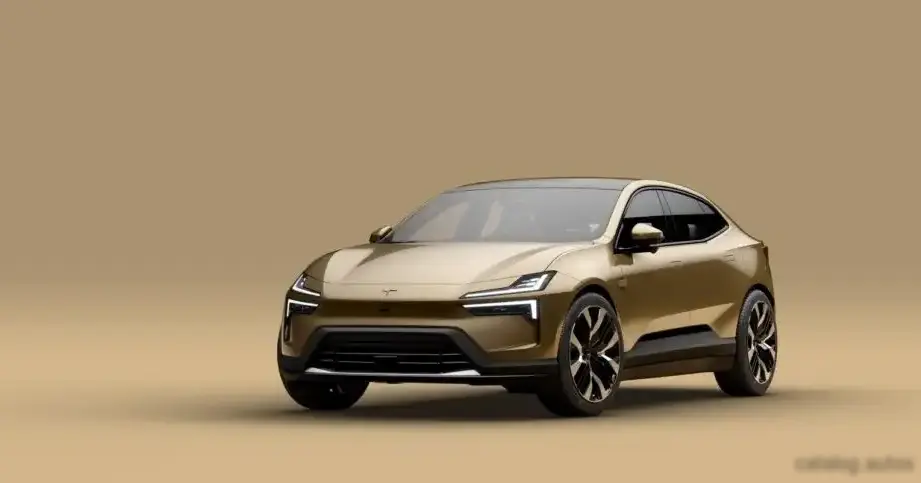
The Polestar 4, launched in April 2023, represents a significant step forward in the Swedish-Chinese manufacturer’s all-electric vehicle lineup. Positioned as a performance-oriented, fastback-style SUV, the 102 kWh (544 Hp) Long Range Dual Motor AWD variant sits at the top of the initial Polestar 4 offerings, emphasizing both range and acceleration. It’s built upon a dedicated electric vehicle architecture, aiming to compete with premium electric SUVs like the Porsche Macan and Tesla Model Y. The Polestar 4 is notable for its unique design, prioritizing a sleek roofline and a spacious, minimalist interior.
Technical Specifications
| Brand | Polestar |
| Model | 4 |
| Generation | 4 |
| Type (Engine) | 102 kWh (544 Hp) Long Range Dual Motor AWD |
| Start of production | April, 2023 |
| Powertrain Architecture | BEV (Electric Vehicle) |
| Body type | Coupe, SUV |
| Seats | 5 |
| Doors | 5 |
| Fuel Type | Electricity |
| Acceleration 0 – 100 km/h | 3.8 sec |
| Acceleration 0 – 62 mph | 3.8 sec |
| Acceleration 0 – 60 mph | 3.6 sec |
| Maximum speed | 200 km/h (124.27 mph) |
| Weight-to-power ratio | 4.3 kg/Hp, 231.4 Hp/tonne |
| Weight-to-torque ratio | 3.4 kg/Nm, 291.8 Nm/tonne |
| Gross battery capacity | 102 kWh |
| Net (usable) battery capacity | 94 kWh |
| Battery voltage | 400 V |
| Battery technology | Lithium nickel manganese cobalt oxides (Li-NMC) |
| Battery location | Below the floor |
| All-electric range (WLTP) | 560 km (347.97 mi) |
| All-electric range (EPA) | 434.5 km (269.99 mi) |
| Average Energy consumption (WLTP) | 16.7-16.8 kWh/100 km (26.88 – 27.04 kWh/100 mi) |
| Average Energy consumption (MPGe) | 125 – 125 MPGe |
| Average Energy consumption (km/kWh) | 6 – 6 km/kWh |
| Average Energy consumption (mi/kWh) | 3.7 – 3.7 mi/kWh |
| Electric motor 1 power | 272 Hp |
| Electric motor 1 Torque | 343 Nm (252.98 lb.-ft.) |
| Electric motor 1 location | Rear axle, Transverse |
| Electric motor 1 type | Synchronous |
| Electric motor 2 power | 272 Hp |
| Electric motor 2 Torque | 343 Nm (252.98 lb.-ft.) |
| Electric motor 2 location | Front axle, Transverse |
| Electric motor 2 type | Synchronous |
| System power | 544 Hp |
| System torque | 686 Nm (505.97 lb.-ft.) |
| Kerb Weight | 2351 kg (5183.07 lbs.) |
| Trunk (boot) space – minimum | 500 l (17.66 cu. ft.) |
| Trunk (boot) space – maximum | 1536 l (54.24 cu. ft.) |
| Max. roof load | 75 kg (165.35 lbs.) |
| Permitted trailer load with brakes (12%) | 2000 kg (4409.25 lbs.) |
| Permitted towbar download | 100 kg (220.46 lbs.) |
| Length | 4839 mm (190.51 in.) |
| Width including mirrors | 2139 mm (84.21 in.) |
| Height | 1544 mm (60.79 in.) |
| Wheelbase | 2999 mm (118.07 in.) |
| Ride height (ground clearance) | 166 mm (6.54 in.) |
| Drag coefficient (Cd) | 0.269 |
| Minimum turning circle | 11.6 m (38.06 ft.) |
| Drivetrain Architecture | One electric motor drives the front wheels, one electric motor drives the rear wheels. |
| Drive wheel | All wheel drive (4×4) |
| Number of gears | 1 |
| Type of gearbox | automatic transmission |
| Front suspension | Independent multi-link suspension |
| Rear suspension | Independent multi-link suspension |
| Front brakes | Ventilated discs, 364-392 mm |
| Rear brakes | Ventilated discs, 350-364 mm |
| Steering type | Steering rack and pinion |
| Power steering | Electric Steering |
| Tires size | 255/50 R20; 255/45 R21; 265/40 R22 |
| Wheel rims size | 20; 21; 22 |
Powertrain & Engine Architecture
The Polestar 4 utilizes a dual-motor, all-wheel-drive (AWD) powertrain. Each motor, one positioned on the front and one on the rear axle, delivers 272 horsepower and 343 Nm (252.98 lb-ft) of torque. These synchronous electric motors combine to produce a total system output of 544 horsepower and 686 Nm (505.97 lb-ft) of torque. The 102 kWh battery pack, utilizing Lithium-Nickel-Manganese-Cobalt (Li-NMC) chemistry, is mounted low in the vehicle’s floor to optimize the center of gravity. The 400V architecture allows for relatively fast DC fast charging, though charging times vary depending on the charger’s capabilities. The single-speed automatic transmission is inherent to electric vehicle drivetrains, providing seamless acceleration. The powertrain is designed for efficiency, with regenerative braking contributing to increased range.
Driving Characteristics
The dual-motor setup of the Polestar 4 provides instant torque and impressive acceleration. The 0-60 mph time of 3.6 seconds (calculated) is indicative of its performance capabilities. The AWD system delivers excellent traction in various conditions. Compared to potential future single-motor, rear-wheel-drive variants, this Long Range Dual Motor AWD version offers a more engaging and confident driving experience. The low center of gravity, thanks to the battery placement, contributes to stable handling. While the instant torque provides exhilarating acceleration, the Polestar 4 is also tuned for comfortable cruising, with a focus on refinement and noise isolation.
Equipment & Trim Levels
The Polestar 4 102 kWh Long Range Dual Motor AWD comes standard with a high level of equipment. Interior features include a minimalist Scandinavian-inspired design with sustainable materials. Standard features typically include a large central touchscreen display, a digital instrument cluster, premium audio system, panoramic glass roof, and advanced driver-assistance systems (ADAS) such as Pilot Assist. Optional extras include upgraded interior upholstery, performance packages with enhanced suspension tuning, and various aesthetic customization options. The Polestar 4 prioritizes a tech-forward experience, with over-the-air (OTA) software updates ensuring the vehicle remains current with the latest features and improvements.
Chassis & Braking
The Polestar 4 features an independent multi-link suspension system at both the front and rear axles, optimized for both comfort and handling. The suspension is tuned to manage the vehicle’s weight effectively and provide a balanced ride. Braking duties are handled by ventilated disc brakes on all four wheels, with front discs ranging from 364-392 mm and rear discs from 350-364 mm. The inclusion of ABS (Anti-lock Braking System) and other electronic stability control systems enhances safety. The steering system utilizes an electric power steering (EPS) setup, providing precise and responsive control.
Market Reception & Comparison
The Polestar 4 has been generally well-received by automotive critics, praised for its stylish design, strong performance, and advanced technology. Its range, while competitive, is slightly less than some rivals like the Tesla Model Y Long Range. However, the Polestar 4 distinguishes itself with its premium interior, focus on sustainability, and engaging driving dynamics. Compared to other electric SUVs in its price range, the Polestar 4 offers a unique blend of Scandinavian design and performance engineering. Fuel economy, expressed as energy consumption, is rated at 16.7-16.8 kWh/100 km (26.88 – 27.04 kWh/100 mi).
Legacy
As a relatively new model, the long-term reliability of the Polestar 4 powertrain remains to be fully established. However, Polestar’s commitment to quality and its use of proven battery technology suggest a high level of durability. The electric motors, with fewer moving parts than internal combustion engines, are expected to require minimal maintenance. The used car market for the Polestar 4 is still developing, but early indications suggest strong demand for well-maintained examples. The Polestar 4 represents a significant step in the evolution of electric vehicles, showcasing a blend of performance, sustainability, and Scandinavian design.
