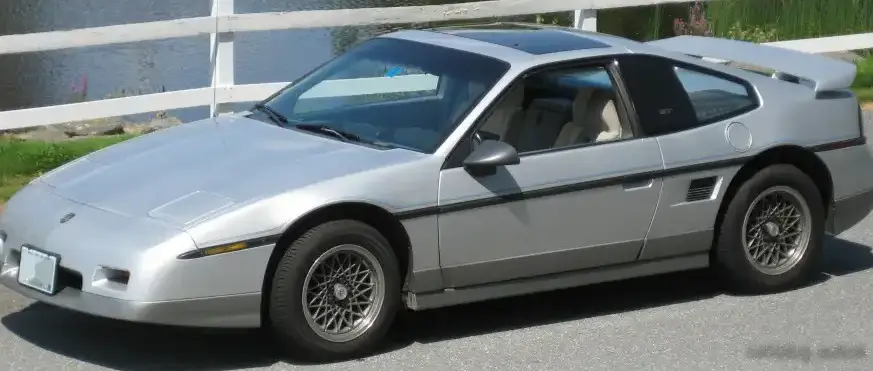
The Pontiac Fiero GT 2.8 V6, produced from 1983 to 1988, represented the performance pinnacle of the Fiero model line. Introduced as part of the first-generation Fiero (1984-1988), the GT variant aimed to deliver a sporty, affordable, and uniquely American mid-engine experience. Positioned as the top-tier trim, the 2.8 V6 GT offered a significant power upgrade over the base four-cylinder models, appealing to enthusiasts seeking a more engaging driving experience. The Fiero, as a whole, was a bold attempt by Pontiac to enter the sports car market, and the GT version was its most successful expression.
Technical Specifications
| Brand | Pontiac |
| Model | Fiero |
| Generation | Fiero |
| Type (Engine) | GT 2.8 V6 (142 Hp) |
| Start of production | August, 1983 |
| End of production | August, 1988 |
| Powertrain Architecture | Internal Combustion engine |
| Body type | Coupe |
| Seats | 2 |
| Doors | 2 |
| Fuel Type | Petrol (Gasoline) |
| Maximum speed | 180 km/h (111.85 mph) |
| Weight-to-power ratio | 8.5 kg/Hp, 117.2 Hp/tonne |
| Weight-to-torque ratio | 5.3 kg/Nm, 189.8 Nm/tonne |
| Power | 142 Hp @ 5200 rpm |
| Power per litre | 50.2 Hp/l |
| Torque | 230 Nm @ 3600 rpm (169.64 lb.-ft. @ 3600 rpm) |
| Engine layout | Middle, Transverse |
| Engine displacement | 2827 cm3 (172.51 cu. in.) |
| Number of cylinders | 6 |
| Engine configuration | V-engine |
| Cylinder Bore | 88.9 mm (3.5 in.) |
| Piston Stroke | 75.9 mm (2.99 in.) |
| Number of valves per cylinder | 2 |
| Fuel injection system | Multi-port manifold injection |
| Engine aspiration | Naturally aspirated engine |
| Valvetrain | OHV |
| Engine oil capacity | 4.3 l (4.54 US qt | 3.78 UK qt) |
| Coolant | 13 l (13.74 US qt | 11.44 UK qt) |
| Kerb Weight | 1212 kg (2672 lbs.) |
| Fuel tank capacity | 38 l (10.04 US gal | 8.36 UK gal) |
| Length | 4211 mm (165.79 in.) |
| Width | 1750 mm (68.9 in.) |
| Height | 1191 mm (46.89 in.) |
| Wheelbase | 2372 mm (93.39 in.) |
| Front track | 1483 mm (58.39 in.) |
| Rear (Back) track | 1506 mm (59.29 in.) |
| Ride height (ground clearance) | 134 mm (5.28 in.) |
| Drivetrain Architecture | The Internal combustion engine (ICE) drives the rear wheels of the vehicle. |
| Drive wheel | Rear wheel drive |
| Number of gears and type of gearbox | 4 gears, manual transmission |
| Front suspension | Independent coil spring |
| Rear suspension | McPherson |
| Front brakes | Disc |
| Rear brakes | Disc |
| Steering type | Steering rack and pinion |
| Tires size | 215/60 R14 |
| Wheel rims size | 14 |
Powertrain & Engine Architecture
The heart of the Fiero GT was the 2.8-liter (173 cubic inch) 60-degree V6 engine, designated as the L44. This engine was a descendant of the Chevrolet/GM family of V6s, known for its relatively compact size and smooth operation. The L44 featured a cast iron block and aluminum cylinder heads, utilizing a two-valve-per-cylinder overhead valve (OHV) valvetrain. Fuel delivery was handled by a multi-port fuel injection system, contributing to improved efficiency and throttle response compared to earlier carbureted engines. The engine produced 142 horsepower at 5200 rpm and 169.64 lb-ft of torque at 3600 rpm. The engine was transversely mounted behind the driver and passenger, driving the rear wheels through a four-speed manual transmission (Getrag 282) as standard. An optional three-speed automatic transmission was also available, though less common in the GT model.
Driving Characteristics
The Fiero GT 2.8 V6 offered a noticeably more spirited driving experience than the base four-cylinder models. The V6 provided ample power for everyday driving and allowed for confident acceleration. While not a high-performance sports car by contemporary standards, the mid-engine layout contributed to balanced handling and a responsive feel. The four-speed manual transmission offered precise shifts, while the optional automatic, though convenient, slightly dulled the driving experience. The rear-wheel drive configuration, combined with the relatively light weight of the Fiero, made it a fun and engaging car to drive on winding roads. However, the suspension, while adequate, was not particularly sophisticated, and the ride could be firm on rough surfaces.
Equipment & Trim Levels
The Fiero GT came standard with a number of features designed to enhance the sporty driving experience. These included a sport suspension, disc brakes on all four wheels, and a unique exterior appearance package with a rear spoiler and body-colored side skirts. The interior featured sport seats, a leather-wrapped steering wheel, and a more comprehensive gauge cluster than the base models. Optional extras included air conditioning, power windows and locks, cruise control, and a premium sound system. Interior upholstery was typically cloth, with leather available as an option. The dashboard layout was relatively simple and functional, with a focus on providing the driver with essential information.
Chassis & Braking
The Fiero utilized a space frame chassis constructed from steel, providing a rigid and lightweight platform. The suspension consisted of independent coil springs at the front and a McPherson strut setup at the rear. The GT model benefited from a slightly stiffer suspension tuning compared to the base Fiero. Braking duties were handled by disc brakes on all four wheels, providing adequate stopping power for the car’s weight and performance. The steering system was a rack-and-pinion setup, offering precise and responsive steering feel. The standard tire size was 215/60R14, mounted on 14-inch wheels.
Market Reception & Comparison
The Fiero GT was generally well-received by automotive critics, who praised its unique mid-engine layout, sporty handling, and attractive styling. However, it also faced criticism for its build quality issues and perceived lack of refinement. Compared to the base four-cylinder Fiero, the GT offered a significant performance upgrade and a more premium driving experience. Compared to other sports cars of the era, such as the Mazda RX-7 or Toyota MR2, the Fiero GT was often seen as a more affordable and accessible option, but it lacked the same level of sophistication and performance. The automatic transmission version, while offering convenience, was often criticized for diminishing the car’s sporty character.
Legacy
Despite its relatively short production run, the Pontiac Fiero GT 2.8 V6 has gained a devoted following among enthusiasts. The mid-engine layout and unique styling have made it a popular choice for restoration and modification projects. The 2.8 V6 engine, while not particularly powerful by modern standards, is generally considered to be reliable and relatively easy to maintain. However, the Fiero’s reputation for early build quality issues and potential electrical problems means that careful inspection and maintenance are essential when considering a used example. Today, well-maintained Fiero GTs are becoming increasingly collectible, representing a unique and affordable piece of American automotive history.