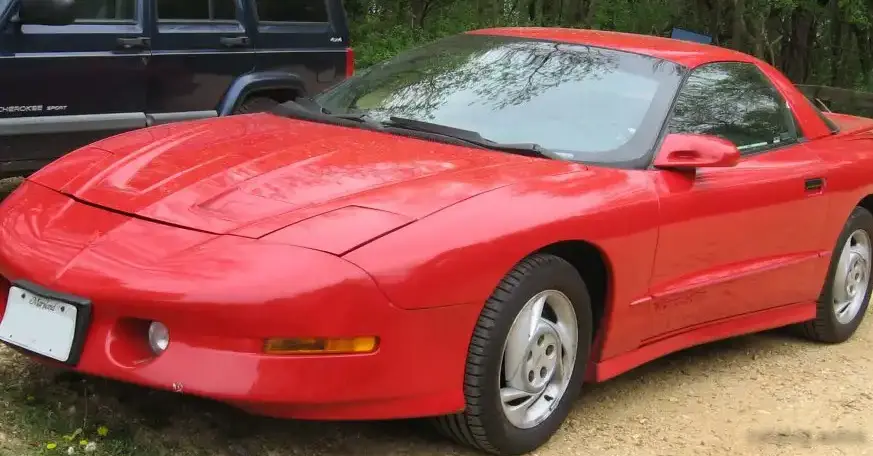
The Pontiac Firebird IV 3.4i V6, produced between November 1992 and 1995, represented a key entry point into the fourth-generation Firebird lineup (1993-2002). Positioned as a more accessible alternative to the higher-performance V8 models, the 3.4i offered a balance of reasonable power and improved fuel economy. It served as a popular choice for buyers seeking the Firebird’s distinctive styling and sporty image without the higher price tag and running costs associated with the larger engines. This variant was built on the F-body platform, shared with the Chevrolet Camaro, and aimed at the North American market, where the Firebird competed with the Ford Mustang and other personal coupes.
Technical Specifications
| Brand | Pontiac |
| Model | Firebird |
| Generation | Firebird IV |
| Type (Engine) | 3.4 i V6 (162 Hp) |
| Start of production | November, 1992 |
| End of production | 1995 |
| Powertrain Architecture | Internal Combustion engine |
| Body type | Coupe |
| Seats | 4 |
| Doors | 3 |
| Fuel consumption (economy) – combined | 10.6 l/100 km |
| Fuel consumption (economy) – combined | 22.2 US mpg |
| Fuel consumption (economy) – combined | 26.6 UK mpg |
| Fuel consumption (economy) – combined | 9.4 km/l |
| Fuel Type | Petrol (Gasoline) |
| Weight-to-power ratio | 9.1 kg/Hp |
| Weight-to-power ratio | 110.2 Hp/tonne |
| Weight-to-torque ratio | 5.4 kg/Nm |
| Weight-to-torque ratio | 184.4 Nm/tonne |
| Power | 162 Hp @ 4600 rpm |
| Power per litre | 48.3 Hp/l |
| Torque | 271 Nm @ 3600 rpm |
| Torque | 199.88 lb.-ft. @ 3600 rpm |
| Engine layout | Front, Longitudinal |
| Engine Model/Code | L32 |
| Engine displacement | 3352 cm3 |
| Engine displacement | 204.55 cu. in. |
| Number of cylinders | 6 |
| Engine configuration | V-engine |
| Cylinder Bore | 92 mm |
| Cylinder Bore | 3.62 in. |
| Piston Stroke | 84 mm |
| Piston Stroke | 3.31 in. |
| Compression ratio | 9:1 |
| Number of valves per cylinder | 2 |
| Fuel injection system | Multi-port manifold injection |
| Engine aspiration | Naturally aspirated engine |
| Valvetrain | OHC |
| Engine oil capacity | 4.7 l |
| Engine oil capacity | 4.97 US qt | 4.14 UK qt |
| Coolant | 11.8 l |
| Coolant | 12.47 US qt | 10.38 UK qt |
| Kerb Weight | 1470 kg |
| Kerb Weight | 3240.8 lbs |
| Trunk (boot) space – minimum | 365 l |
| Trunk (boot) space – minimum | 12.89 cu. ft. |
| Trunk (boot) space – maximum | 954 l |
| Trunk (boot) space – maximum | 33.69 cu. ft. |
| Fuel tank capacity | 59 l |
| Fuel tank capacity | 15.59 US gal | 12.98 UK gal |
| Length | 4968 mm |
| Length | 195.59 in. |
| Width | 1893 mm |
| Width | 74.53 in. |
| Height | 1321 mm |
| Height | 52.01 in. |
| Wheelbase | 2566 mm |
| Wheelbase | 101.02 in. |
| Front track | 1542 mm |
| Front track | 60.71 in. |
| Rear (Back) track | 1540 mm |
| Rear (Back) track | 60.63 in. |
| Drivetrain Architecture | The Internal combustion engine (ICE) drives the rear wheels of the vehicle. |
| Drive wheel | Rear wheel drive |
| Number of gears and type of gearbox | 4 gears, automatic transmission |
| Front suspension | Double wishbone |
| Rear suspension | Coil spring |
| Front brakes | Ventilated discs |
| Rear brakes | Drum |
| Assisting systems | ABS (Anti-lock braking system) |
| Steering type | Steering rack and pinion |
| Power steering | Hydraulic Steering |
| Tires size | 215/60 R16 H |
Powertrain & Engine Architecture
The heart of the Firebird IV 3.4i was the 3.4-liter (3352 cc) L32 V6 engine. This engine, part of the GM 60-degree V6 family, featured a cast iron block and aluminum cylinder heads. It utilized a multi-port fuel injection system, delivering fuel directly to each cylinder for improved efficiency and responsiveness. The engine employed an overhead camshaft (OHC) valvetrain with two valves per cylinder. The 9:1 compression ratio was a compromise between performance and the ability to run on readily available 87-octane gasoline. Paired with this engine was a 4-speed automatic transmission, a 4L60-E, which was a common and relatively reliable unit for its time. This transmission was chosen to provide smooth and convenient shifting, appealing to a broader range of drivers than a manual transmission.
Driving Characteristics
The 162 horsepower and 271 lb-ft of torque produced by the 3.4i V6 provided adequate, though not exhilarating, performance. Acceleration from 0 to 60 mph typically took around 8-9 seconds. The automatic transmission, while smooth, did contribute to some power loss compared to the available 5-speed manual. The gear ratios were tuned for everyday drivability rather than outright speed. The engine delivered its peak torque at 3600 rpm, providing reasonable pulling power for merging onto highways and passing other vehicles. Compared to the Firebird’s V8 options, the 3.4i felt noticeably less powerful, but it offered a more relaxed and fuel-efficient driving experience. The rear-wheel-drive configuration provided a sporty feel, but the relatively modest power output meant that traction was rarely an issue.
Equipment & Trim Levels
The 3.4i V6 typically came standard with features such as air conditioning, power windows and locks, and an AM/FM stereo. Interior upholstery was usually cloth, with options for leather available. The dashboard layout was typical of early 1990s GM vehicles, featuring analog gauges and a relatively simple design. Optional extras included a premium sound system, cruise control, and a sunroof. The Firebird IV offered several trim packages, and the 3.4i often served as the base for these, with upgrades available to enhance the interior and exterior appearance.
Chassis & Braking
The Firebird IV utilized a double wishbone suspension in the front and a coil spring suspension in the rear. This setup provided a comfortable ride while still offering decent handling characteristics. The front brakes were ventilated discs, providing good stopping power, while the rear brakes were drums, a cost-saving measure common in this class of vehicle. An anti-lock braking system (ABS) was available as an option, enhancing safety. The chassis was designed to be relatively lightweight, contributing to the car’s overall agility. Stabilizer bars were included to reduce body roll during cornering.
Market Reception & Comparison
The Firebird IV 3.4i V6 was generally well-received as an affordable and stylish coupe. Critics praised its comfortable ride and attractive design, but noted that its performance was not as impressive as the V8 models. Fuel economy was a strong point, averaging around 22 mpg in combined driving. Compared to the V6 Camaro, the Firebird offered a slightly more refined driving experience and a more distinctive exterior styling. The 3.4i was often seen as a good value for the money, offering a lot of features for its price point. However, some reviewers felt that the automatic transmission detracted from the car’s sporty image.
Legacy
The L32 3.4i V6 engine, while not known for being particularly groundbreaking, proved to be a relatively reliable powertrain. With proper maintenance, these engines can last for many years. Today, the Firebird IV 3.4i V6 is a relatively affordable classic car, appealing to enthusiasts looking for a stylish and nostalgic coupe. Parts availability is generally good, as many components are shared with the Chevrolet Camaro. While not as sought-after as the V8 models, the 3.4i offers a unique blend of affordability, style, and reliability, making it a worthwhile option for those seeking a piece of 1990s American automotive history.