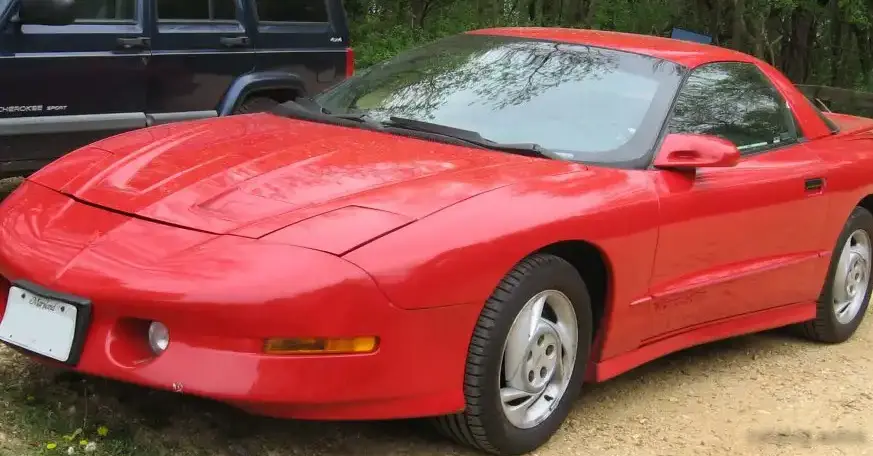
The Pontiac Firebird IV 5.7i V8 Trans Am, produced from 1995 to 2002, represented the fourth and final generation of the iconic Firebird. Positioned as the performance flagship of the Firebird lineup, the Trans Am with the 5.7-liter V8 engine offered a substantial increase in power and handling compared to the base V6 models. This generation, built on the F-body platform shared with the Chevrolet Camaro, aimed to blend aggressive styling with potent American V8 performance. The 5.7i Trans Am was a direct response to enthusiast demand for a high-performance muscle car, and it served as a final statement for the Firebird nameplate before its discontinuation.
Technical Specifications
| Brand | Pontiac |
| Model | Firebird |
| Generation | Firebird IV |
| Type | 5.7i V8 Trans Am (309 Hp) |
| Start of production | 1995 |
| End of production | 2002 |
| Powertrain Architecture | Internal Combustion engine |
| Body type | Coupe |
| Seats | 5 |
| Doors | 3 |
| Fuel consumption (urban) | 14.7 l/100 km (16 US mpg, 19.2 UK mpg) |
| Fuel consumption (extra urban) | 9 l/100 km (26.1 US mpg, 31.4 UK mpg) |
| Fuel Type | Petrol (Gasoline) |
| Maximum speed | 250 km/h (155.34 mph) |
| Weight-to-power ratio | 5.1 kg/Hp, 197.4 Hp/tonne |
| Weight-to-torque ratio | 3.4 kg/Nm, 290.1 Nm/tonne |
| Power | 309 Hp @ 5200 rpm |
| Power per litre | 54.5 Hp/l |
| Torque | 454 Nm @ 4000 rpm (334.85 lb.-ft. @ 4000 rpm) |
| Engine layout | Front, Longitudinal |
| Engine displacement | 5667 cm3 (345.82 cu. in.) |
| Number of cylinders | 8 |
| Engine configuration | V-engine |
| Cylinder Bore | 99 mm (3.9 in.) |
| Piston Stroke | 92 mm (3.62 in.) |
| Compression ratio | 10.5:1 |
| Number of valves per cylinder | 2 |
| Fuel injection system | Multi-port manifold injection |
| Engine aspiration | Naturally aspirated engine |
| Engine oil capacity | 4.7 l (4.97 US qt | 4.14 UK qt) |
| Coolant capacity | 14.5 l (15.32 US qt | 12.76 UK qt) |
| Kerb Weight | 1565 kg (3450.23 lbs.) |
| Trunk (boot) space – minimum | 365 l (12.89 cu. ft.) |
| Trunk (boot) space – maximum | 955 l (33.73 cu. ft.) |
| Fuel tank capacity | 59 l (15.59 US gal | 12.98 UK gal) |
| Length | 4920 mm (193.7 in.) |
| Width | 1890 mm (74.41 in.) |
| Height | 1320 mm (51.97 in.) |
| Wheelbase | 2570 mm (101.18 in.) |
| Front track | 1540 mm (60.63 in.) |
| Rear track | 1540 mm (60.63 in.) |
| Drivetrain Architecture | Rear wheel drive |
| Number of gears | 6 |
| Gearbox type | Manual transmission |
| Front suspension | Double wishbone |
| Rear suspension | Coil spring |
| Front brakes | Ventilated discs |
| Rear brakes | Ventilated discs |
| Assisting systems | ABS (Anti-lock braking system) |
| Steering type | Steering rack and pinion |
| Power steering | Hydraulic Steering |
| Tires size | 235/55 R16 |
Powertrain & Engine Architecture
The heart of the Firebird 5.7i Trans Am was the GM LS1 V8 engine. This 5.7-liter (346 cubic inch) engine featured an aluminum block and cylinder heads, contributing to a relatively lightweight construction for a V8. The LS1 utilized a 90-degree V-angle, a cast iron crankshaft, and connecting rods. Fuel delivery was handled by a multi-port fuel injection system, precisely metering fuel into each cylinder. The engine boasted two valves per cylinder, operated by a single overhead camshaft. The 6-speed manual transmission (T56) was standard, providing precise gear changes and maximizing the engine’s potential. This transmission was known for its robust construction and smooth operation. The engine’s design prioritized low-end torque and a broad powerband, making it responsive in a variety of driving situations.
Driving Characteristics
The 5.7i Trans Am delivered a distinctly different driving experience compared to the V6-powered Firebirds. The increased horsepower and torque resulted in significantly quicker acceleration. Zero to sixty mph times were typically in the low 5-second range, making it a competitive performer against other muscle cars of the era. The manual transmission allowed for full driver control, and the gear ratios were well-suited for both street and track use. While the suspension was tuned for performance, it still provided a reasonably comfortable ride for daily driving. The rear-wheel-drive configuration offered a balanced feel, although traction could be a challenge, especially with aggressive acceleration. Compared to the automatic transmission equipped models, the manual version offered a more engaging and connected driving experience.
Equipment & Trim Levels
The Trans Am trim level already included a number of standard features, such as sport seats, a leather-wrapped steering wheel, and a premium sound system. The 5.7i version added further enhancements, including a performance-tuned suspension, larger brakes, and unique exterior styling cues like a ram air hood. Optional extras included a T-top roof, leather upholstery, air conditioning, and a Monsoon audio system. The interior featured a driver-focused layout with analog gauges and a center console. The Trans Am’s interior, while functional, was not as luxurious as some competing grand tourers.
Chassis & Braking
The Firebird IV utilized a unibody construction for increased rigidity. The front suspension employed a double wishbone design with coil springs and stabilizer bar, while the rear suspension featured a coil-sprung solid axle. This setup provided a good balance between handling and ride comfort. The 5.7i Trans Am came equipped with ventilated disc brakes on all four wheels, providing ample stopping power. ABS (Anti-lock Braking System) was standard, enhancing safety and control during hard braking. The chassis was designed to handle the increased power of the V8 engine, and the suspension was tuned to minimize body roll and maximize grip.
Market Reception & Comparison
The Firebird 5.7i Trans Am was generally well-received by automotive critics. It was praised for its powerful engine, engaging driving dynamics, and aggressive styling. However, some critics noted the interior quality was not on par with some of its competitors, such as the Ford Mustang GT or Chevrolet Corvette. Fuel economy, at 16 mpg city and 26 mpg highway, was typical for a V8-powered muscle car of the time. Compared to the V6 Firebird, the 5.7i Trans Am commanded a significant price premium, but enthusiasts considered it a worthwhile investment for the substantial performance gains. The 5.7i Trans Am offered a more raw and visceral driving experience than the more refined Corvette.
Legacy
The Pontiac Firebird IV 5.7i V8 Trans Am represents a high point in the Firebird’s history. The LS1 engine proved to be remarkably reliable, and well-maintained examples continue to provide years of enjoyable driving. On the used car market, the 5.7i Trans Am is highly sought after by collectors and enthusiasts. Its combination of performance, styling, and relative affordability has made it a modern classic. While the Firebird nameplate is no longer in production, the 5.7i Trans Am remains a symbol of American muscle car heritage and a testament to Pontiac’s commitment to performance.