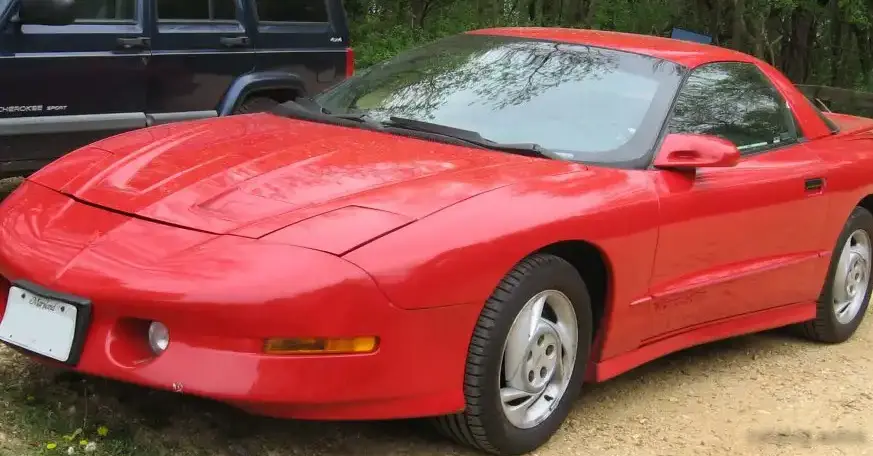
The Pontiac Firebird IV 5.7i V8, produced from 2000 to 2002, represented the final iteration of the fourth-generation Firebird (1993-2002). Positioned as the performance flagship of the Firebird lineup, it offered a substantial power upgrade over the base V6 models and even the lower-output V8 variants. Built on the F-body platform shared with the Chevrolet Camaro, the Firebird IV aimed to deliver a classic American muscle car experience with a touch of modern refinement. This particular variant, equipped with the LS1 5.7-liter V8 and a 6-speed manual transmission, was targeted towards enthusiasts seeking a potent and engaging driving experience.
Technical Specifications
| Brand | Pontiac |
| Model | Firebird |
| Generation | Firebird IV |
| Type (Engine) | 5.7i V8 (314 Hp) |
| Start of production | 2000 |
| End of production | 2002 |
| Powertrain Architecture | Internal Combustion engine |
| Body type | Coupe |
| Seats | 5 |
| Doors | 3 |
| Fuel consumption (urban) | 12.4 l/100 km (19 US mpg) |
| Fuel consumption (extra urban) | 8.4 l/100 km (28 US mpg) |
| Fuel consumption (combined) | 10.7 l/100 km (22 US mpg) |
| Fuel Type | Petrol (Gasoline) |
| Acceleration 0 – 100 km/h | 6 sec |
| Acceleration 0 – 62 mph | 6 sec |
| Acceleration 0 – 60 mph | 5.7 sec |
| Maximum speed | 250 km/h (155.34 mph) |
| Weight-to-power ratio | 5 kg/Hp |
| Weight-to-torque ratio | 3.4 kg/Nm |
| Power | 314 Hp @ 5200 rpm |
| Power per litre | 55.4 Hp/l |
| Torque | 461 Nm @ 4000 rpm (340.02 lb.-ft. @ 4000 rpm) |
| Engine layout | Front, Longitudinal |
| Engine Model/Code | LS1 |
| Engine displacement | 5665 cm3 (345.7 cu. in.) |
| Number of cylinders | 8 |
| Engine configuration | V-engine |
| Cylinder Bore | 99 mm (3.9 in.) |
| Piston Stroke | 92 mm (3.62 in.) |
| Compression ratio | 10.1:1 |
| Number of valves per cylinder | 2 |
| Fuel injection system | Multi-port manifold injection |
| Engine aspiration | Naturally aspirated |
| Engine oil capacity | 5.2 l (5.49 US qt | 4.58 UK qt) |
| Coolant capacity | 11.3 l (11.94 US qt | 9.94 UK qt) |
| Kerb Weight | 1585 kg (3494.33 lbs.) |
| Trunk (boot) space – minimum | 365 l (12.89 cu. ft.) |
| Trunk (boot) space – maximum | 955 l (33.73 cu. ft.) |
| Fuel tank capacity | 59 l (15.59 US gal | 12.98 UK gal) |
| Length | 4910 mm (193.31 in.) |
| Width | 1890 mm (74.41 in.) |
| Height | 1300 mm (51.18 in.) |
| Wheelbase | 2570 mm (101.18 in.) |
| Front track | 1540 mm (60.63 in.) |
| Rear track | 1540 mm (60.63 in.) |
| Drivetrain Architecture | Rear wheel drive |
| Number of gears | 6 gears, manual transmission |
| Front suspension | Double wishbone |
| Rear suspension | Coil spring |
| Front brakes | Ventilated discs |
| Rear brakes | Ventilated discs |
| Assisting systems | ABS (Anti-lock braking system) |
| Steering type | Steering rack and pinion |
| Power steering | Hydraulic |
| Tires size | 235/55 R16 |
Powertrain & Engine Architecture
The heart of the Firebird IV 5.7i was the LS1 small-block V8 engine. This engine, a member of General Motors’ highly successful LS series, featured an aluminum block and cylinder heads, contributing to a relatively lightweight construction. The LS1 utilized a 90-degree V-angle, overhead valve (OHV) configuration with two valves per cylinder. Fuel delivery was handled by a multi-port fuel injection system, precisely metering fuel into each intake port. The engine’s 5.7-liter (345.7 cubic inch) displacement, combined with a 10.1:1 compression ratio, allowed it to produce 314 horsepower at 5200 rpm and 340 lb-ft of torque at 4000 rpm. The standard transmission for this model was a robust 6-speed manual gearbox, providing precise control and enhancing the driving experience. The rear-wheel-drive configuration was, of course, standard for a traditional American muscle car.
Driving Characteristics
The 5.7i V8, coupled with the 6-speed manual, delivered a noticeably more engaging and powerful driving experience compared to the V6-equipped Firebirds. Acceleration was brisk, with 0-60 mph times consistently in the 5.7-second range. The LS1 engine provided a broad torque curve, making it responsive in a variety of driving situations. The 6-speed transmission allowed drivers to keep the engine in its optimal power band, maximizing acceleration and control. While not as refined as some contemporary sports cars, the Firebird IV 5.7i offered a raw, visceral feel that appealed to enthusiasts. The suspension, tuned for a balance of comfort and handling, provided adequate control in corners, though it wasn’t as sharp as some European sports coupes.
Equipment & Trim Levels
The Firebird IV 5.7i typically came well-equipped, though options allowed for further customization. Standard features included air conditioning, power windows and locks, a CD player, and sport seats. The interior featured a driver-focused cockpit with analog gauges. Optional extras included leather upholstery, a premium sound system, and a T-top roof configuration, adding a touch of open-air enjoyment. The exterior styling was characterized by its sleek, aerodynamic lines and distinctive pop-up headlights. The 5.7i often featured unique badging and styling cues to differentiate it from the lower trims.
Chassis & Braking
The Firebird IV utilized a unibody construction for rigidity. The front suspension employed a double wishbone design, while the rear suspension featured a coil spring setup. Both the front and rear brakes were ventilated discs, providing ample stopping power. An anti-lock braking system (ABS) was standard, enhancing safety. The Firebird’s chassis was designed to handle the increased power of the V8 engine, offering a reasonably balanced ride and handling characteristics. The steering was a rack-and-pinion system with hydraulic power assist, providing responsive and precise control.
Market Reception & Comparison
The Firebird IV 5.7i was generally well-received by automotive critics, who praised its powerful engine, engaging driving dynamics, and relatively affordable price. However, it faced stiff competition from the Ford Mustang GT and the Chevrolet Camaro SS, both of which offered similar performance and features. Compared to the V6 Firebirds, the 5.7i offered a significant performance upgrade, but at a higher price point. Fuel economy, while not terrible for a V8, was considerably lower than the V6 models. Reliability was generally good, though LS1 engines could be susceptible to oil consumption issues if not properly maintained.
Legacy
The Pontiac Firebird IV 5.7i represents the culmination of the Firebird’s design and engineering. The LS1 engine has proven to be remarkably durable and is still highly regarded by enthusiasts today. The Firebird IV, and particularly the 5.7i variant, has become a sought-after classic among collectors and muscle car aficionados. While Pontiac ceased production in 2010, the Firebird’s legacy lives on as a symbol of American performance and style. Well-maintained examples of the 5.7i V8 command respectable prices in the used car market, reflecting their desirability and enduring appeal.