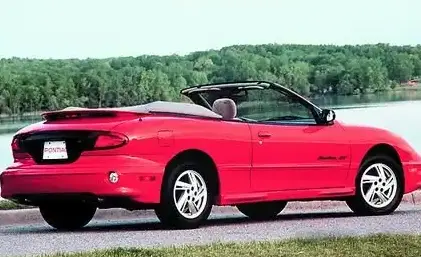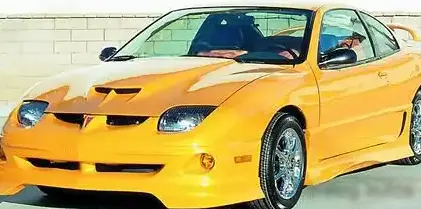
The Pontiac Sunfire Sedan 2.2i 16V Ecotec, produced from 2002 to June 2005, represented a key offering in Pontiac’s compact car lineup. Positioned as a mainstream, affordable sedan, it was part of the J-body platform family, sharing its underpinnings with other General Motors vehicles like the Chevrolet Cavalier and the Oldsmobile Alero. The 2.2i Ecotec variant, with its 141 horsepower output, served as a mid-range option, bridging the gap between the base engine and any potential performance-oriented trims. It was primarily marketed towards budget-conscious buyers seeking a practical and reliable daily driver in the North American market.
Technical Specifications
| Brand | Pontiac |
| Model | Sunfire |
| Generation | Sunfire Sedan |
| Type (Engine) | 2.2i 16V Ecotec (141 Hp) |
| Start of production | 2002 |
| End of production | June, 2005 |
| Powertrain Architecture | Internal Combustion engine |
| Body type | Sedan |
| Seats | 5 |
| Doors | 4 |
| Fuel consumption (urban) | 9.8 l/100 km (24 US mpg) |
| Fuel consumption (extra urban) | 7.1 l/100 km (33.1 US mpg) |
| Fuel consumption (combined) | 8.4 l/100 km (28 US mpg) |
| Fuel Type | Petrol (Gasoline) |
| Maximum speed | 190 km/h (118.06 mph) |
| Power | 141 Hp @ 5600 rpm |
| Torque | 203 Nm @ 4000 rpm (149.73 lb.-ft. @ 4000 rpm) |
| Engine layout | Front, Transverse |
| Engine Model/Code | L61 |
| Engine displacement | 2198 cm3 (134.13 cu. in.) |
| Number of cylinders | 4 |
| Engine configuration | Inline |
| Cylinder Bore | 86 mm (3.39 in.) |
| Piston Stroke | 94.6 mm (3.72 in.) |
| Compression ratio | 10:1 |
| Number of valves per cylinder | 4 |
| Fuel injection system | Multi-port manifold injection |
| Engine aspiration | Naturally aspirated engine |
| Valvetrain | DOHC |
| Engine oil capacity | 4.8 l (5.07 US qt | 4.22 UK qt) |
| Coolant | 8.2 l (8.66 US qt | 7.21 UK qt) |
| Trunk (boot) space (minimum) | 370 l (13.07 cu. ft.) |
| Fuel tank capacity | 54 l (14.27 US gal | 11.88 UK gal) |
| Length | 4620 mm (181.89 in.) |
| Width | 1730 mm (68.11 in.) |
| Height | 1390 mm (54.72 in.) |
| Wheelbase | 2645 mm (104.13 in.) |
| Front track | 1465 mm (57.68 in.) |
| Rear track | 1435 mm (56.5 in.) |
| Drivetrain Architecture | Front wheel drive |
| Number of gears and type of gearbox | 5 gears, manual transmission |
| Front suspension | Wishbone |
| Rear suspension | Trailing arm |
| Front brakes | Ventilated discs |
| Rear brakes | Drum |
| Assisting systems | ABS (Anti-lock braking system) |
| Steering type | Steering rack and pinion |
| Power steering | Hydraulic Steering |
| Tires size | 195/65 R15 |
Powertrain & Engine Architecture
The heart of the Sunfire 2.2i was the L61 2.2-liter inline-four cylinder engine, a member of General Motors’ Ecotec family. This engine was notable for its double overhead camshaft (DOHC) design and four valves per cylinder, contributing to improved breathing and efficiency. The L61 utilized multi-port fuel injection, delivering fuel directly into the intake ports. The engine’s 10:1 compression ratio was a balance between performance and the ability to run on regular unleaded gasoline. The 5-speed manual transmission was the standard offering, providing a relatively direct connection between the engine and the front wheels. The engine was transversely mounted, a common configuration for front-wheel-drive vehicles, optimizing space utilization.
Driving Characteristics
The 141 horsepower and 149.73 lb-ft of torque produced by the 2.2i Ecotec engine provided adequate, though not exhilarating, performance in the Sunfire Sedan. Acceleration was reasonable for everyday driving, with a 0-60 mph time estimated around 9-10 seconds. The 5-speed manual transmission allowed drivers to keep the engine in its optimal power band, providing a more engaging driving experience than an automatic would. Compared to the base engine, the 2.2i offered a noticeable improvement in responsiveness. However, it fell short of the performance offered by the optional (but rarely seen) supercharged versions of the Ecotec engine. The gear ratios were tuned for fuel efficiency and everyday usability, rather than outright speed.
Equipment & Trim Levels
The Sunfire 2.2i typically came standard with features like air conditioning, power steering, an AM/FM stereo, and basic cloth upholstery. Optional extras included power windows and locks, cruise control, and an upgraded sound system. The interior design was functional and straightforward, prioritizing practicality over luxury. Trim levels were relatively simple, with the 2.2i often serving as a step up from the base model, offering a slightly more refined interior and additional convenience features. The dashboard layout was typical of early 2000s GM vehicles, with a focus on ease of use.
Chassis & Braking
The Sunfire Sedan utilized a front-wheel-drive chassis with an independent front suspension featuring wishbone components and a trailing arm rear suspension. This setup provided a comfortable ride quality, though handling was not particularly sporty. The front brakes were ventilated discs, offering adequate stopping power, while the rear brakes were drums, a cost-saving measure common in this class of vehicle. Anti-lock braking system (ABS) was standard, enhancing safety. The steering was rack and pinion, providing reasonably precise control. Tire size was typically 195/65 R15.
Market Reception & Comparison
The Pontiac Sunfire 2.2i was generally well-received as an affordable and reliable compact sedan. Critics noted its decent fuel economy (around 28 mpg combined) and practical interior space. However, it was often criticized for its somewhat bland styling and unremarkable driving dynamics. Compared to competitors like the Honda Civic and Toyota Corolla, the Sunfire offered a lower price point but lacked the same level of refinement and brand prestige. Within the Sunfire lineup, the 2.2i offered a good balance between price and performance, making it a popular choice for buyers who wanted more power than the base engine but didn’t need the extra cost of a supercharged model.
Legacy
The Pontiac Sunfire, and specifically the 2.2i Ecotec variant, has become a relatively affordable and readily available used car. The L61 engine is known for its durability and relatively simple maintenance requirements. While not a particularly collectible vehicle, it remains a practical and economical option for those seeking a basic, reliable transportation. Common issues include oil leaks and occasional sensor failures, but overall, the powertrain is considered reasonably robust. The Sunfire’s legacy lies in its role as a mainstream, affordable compact car that provided reliable transportation for a generation of drivers.