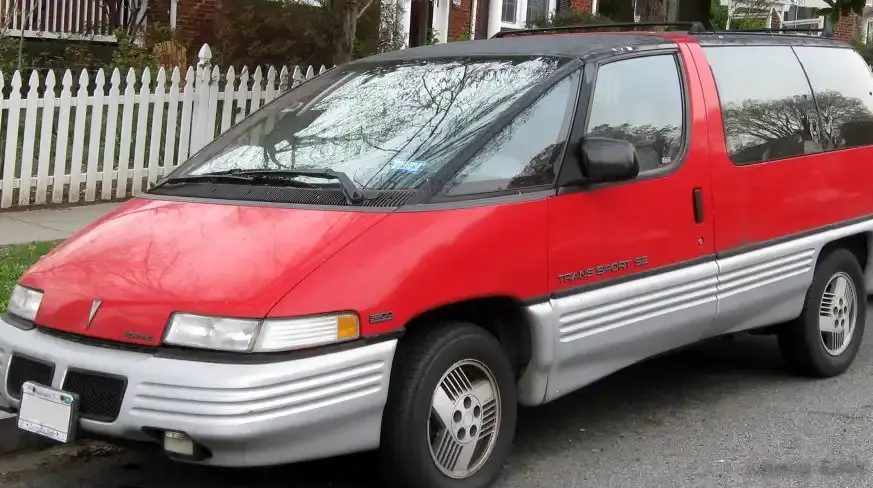
The Pontiac Trans Sport 3.1 i V6 SE, produced from 1989 to 1996, represented Pontiac’s entry into the increasingly popular minivan segment. Positioned as a more stylish and performance-oriented alternative to the more utilitarian offerings from Dodge and Chrysler, the Trans Sport aimed to attract buyers seeking a blend of practicality and a touch of sporty flair. This particular variant, equipped with the 3.1-liter V6 engine and a 3-speed automatic transmission, served as a mid-range option within the Trans Sport lineup, offering a balance between affordability and acceptable performance. It was part of the first generation of the Trans Sport, sharing its underpinnings with the Chevrolet Lumina APV and Oldsmobile Silhouette, all built on the GM U-body platform.
Technical Specifications
| Brand | Pontiac |
| Model | Trans Sport |
| Generation | Trans Sport |
| Type | 3.1 i V6 SE (122 Hp) |
| Start of production | 1989 |
| End of production | 1996 |
| Powertrain Architecture | Internal Combustion engine |
| Body type | Minivan |
| Seats | 5 |
| Doors | 4 |
| Fuel consumption (urban) | 15 l/100 km (15.7 US mpg, 18.8 UK mpg, 6.7 km/l) |
| Fuel consumption (extra urban) | 9 l/100 km (26.1 US mpg, 31.4 UK mpg, 11.1 km/l) |
| Fuel Type | Petrol (Gasoline) |
| Maximum speed | 170 km/h (105.63 mph) |
| Weight-to-power ratio | 13.1 kg/Hp (76.2 Hp/tonne) |
| Weight-to-torque ratio | 6.8 kg/Nm (148 Nm/tonne) |
| Power | 122 Hp @ 4200 rpm |
| Power per litre | 38.9 Hp/l |
| Torque | 237 Nm @ 2200 rpm (174.8 lb.-ft. @ 2200 rpm) |
| Engine layout | Front, Transverse |
| Engine displacement | 3135 cm3 (191.31 cu. in.) |
| Number of cylinders | 6 |
| Engine configuration | V-engine |
| Cylinder Bore | 88.9 mm (3.5 in.) |
| Piston Stroke | 84 mm (3.31 in.) |
| Compression ratio | 8.5:1 |
| Number of valves per cylinder | 2 |
| Fuel injection system | Single-point injection |
| Engine aspiration | Naturally aspirated engine |
| Engine oil capacity | 3.8 l (4.02 US qt, 3.34 UK qt) |
| Coolant capacity | 11.5 l (12.15 US qt, 10.12 UK qt) |
| Kerb Weight | 1601 kg (3529.6 lbs.) |
| Trunk (boot) space – maximum | 3187 l (112.55 cu. ft.) |
| Fuel tank capacity | 76 l (20.08 US gal, 16.72 UK gal) |
| Length | 4940 mm (194.49 in.) |
| Width | 1894 mm (74.57 in.) |
| Height | 1670 mm (65.75 in.) |
| Wheelbase | 2788 mm (109.76 in.) |
| Front track | 1503 mm (59.17 in.) |
| Rear track | 1559 mm (61.38 in.) |
| Drivetrain Architecture | Front wheel drive |
| Number of gears | 3 |
| Gearbox type | Automatic transmission |
| Front suspension | Wishbone |
| Rear suspension | Coil spring |
| Front brakes | Ventilated discs |
| Rear brakes | Drum |
| Assisting systems | ABS (Anti-lock braking system) |
| Steering type | Steering rack and pinion |
| Power steering | Hydraulic Steering |
| Tires size | 205/70 R15 S |
Powertrain & Engine Architecture
The heart of the Trans Sport 3.1 i V6 SE is the 3.1-liter (191 cubic inch) 60-degree V6 engine, designated as the LH0. This engine, a staple of GM’s mid-size offerings in the late 1980s and early 1990s, featured a cast iron block and aluminum cylinder heads. It utilized a single-point fuel injection system, where fuel injectors were located in the throttle body, rather than directly into the intake manifold. This system, while simpler and less expensive than multi-port fuel injection, provided adequate fuel delivery for the engine’s modest power output. The engine’s valvetrain employed two valves per cylinder, operated by a single overhead camshaft. The 3-speed automatic transmission, a GM 3T45, was chosen for its smooth operation and relative simplicity. It featured a torque converter for smooth launches and gear changes, and was geared towards providing comfortable cruising rather than sporty acceleration.
Driving Characteristics
The 122 horsepower and 175 lb-ft of torque produced by the 3.1-liter V6, when paired with the 3-speed automatic, resulted in adequate, but not exhilarating, performance. Acceleration from 0 to 60 mph was estimated to be around 11-12 seconds. The automatic transmission’s gear ratios were optimized for fuel economy and relaxed driving, meaning quick downshifts for passing maneuvers were not particularly responsive. Compared to the available manual transmission or the more powerful 3.8-liter V6 options, the 3.1L automatic felt noticeably slower. However, it provided a more user-friendly driving experience, particularly in city traffic, and was favored by buyers prioritizing convenience over performance.
Equipment & Trim Levels
The “SE” designation indicated a step up in features compared to the base Trans Sport. Standard equipment typically included features like air conditioning, power windows and locks, an upgraded sound system, and a tilt steering wheel. Interior upholstery was usually cloth, with a relatively simple dashboard layout. Optional extras included features like a sunroof, upgraded audio systems with cassette or CD players, and rear air conditioning. The Trans Sport aimed for a comfortable and functional interior, rather than a luxurious one.
Chassis & Braking
The Trans Sport utilized a front-wheel-drive layout with an independent front suspension featuring wishbone components and a coil spring rear suspension. This setup provided a reasonably comfortable ride, although handling was not particularly sharp. The front brakes were ventilated discs, offering adequate stopping power, while the rear brakes were drum brakes, a cost-saving measure common in this class of vehicle. An anti-lock braking system (ABS) was included as standard equipment, enhancing safety. The relatively lightweight construction of the vehicle, at around 3530 pounds, helped to mitigate the effects of the modest engine power.
Market Reception & Comparison
The Trans Sport 3.1 i V6 SE received mixed reviews from automotive critics. While praised for its distinctive styling and spacious interior, it was often criticized for its lackluster performance with the 3.1-liter engine and automatic transmission. Fuel economy was considered average for the class, with EPA estimates around 15 mpg city and 26 mpg highway. Compared to the 3.8-liter V6 Trans Sport, the 3.1L offered a lower purchase price but significantly less power. The 3.1L automatic was often seen as a good choice for buyers prioritizing affordability and ease of use over driving excitement.
Legacy
The 3.1-liter V6 engine, while not known for its longevity or high performance, proved to be reasonably reliable in the Trans Sport. Common issues included oil leaks and occasional sensor failures. The 3T45 automatic transmission was also generally reliable, although it could be prone to overheating if subjected to heavy use. Today, the Trans Sport 3.1 i V6 SE is a relatively affordable and readily available classic minivan. While not a collector’s item, it represents a unique and often overlooked piece of automotive history, embodying the design trends and engineering compromises of the early 1990s. Its simplicity and relatively low maintenance costs make it an appealing option for those seeking a nostalgic and practical vehicle.