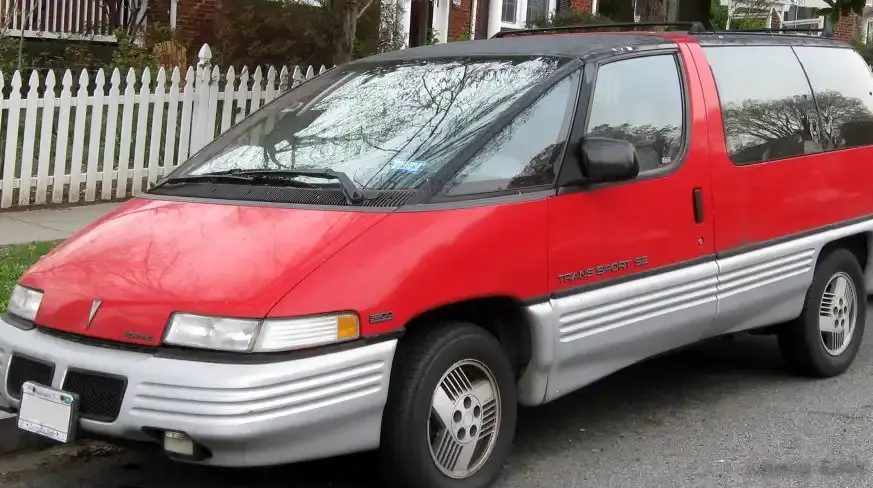
The Pontiac Trans Sport 3.8 i V6, produced from 1989 to 1996, represented Pontiac’s entry into the increasingly popular minivan segment. Positioned as a more stylish and performance-oriented alternative to the more utilitarian offerings from Dodge and Chrysler, the Trans Sport aimed to attract buyers seeking a blend of practicality and a touch of sporty flair. This particular variant, equipped with the 3.8-liter V6 engine and a four-speed automatic transmission, occupied a mid-range position within the Trans Sport lineup, offering a balance between affordability and performance. It was part of the first generation of the Trans Sport, sharing its underpinnings with the Buick Terraza and Oldsmobile Silhouette, all built on the U-body platform.
Technical Specifications
| Brand | Pontiac |
| Model | Trans Sport |
| Generation | Trans Sport |
| Type (Engine) | 3.8 i V6 (175 Hp) |
| Start of production | 1989 |
| End of production | 1996 |
| Powertrain Architecture | Internal Combustion engine |
| Body type | Minivan |
| Seats | 5 |
| Doors | 4 |
| Fuel consumption (combined) | 10.6 l/100 km (22.2 US mpg / 26.6 UK mpg / 9.4 km/l) |
| Fuel Type | Petrol (Gasoline) |
| Acceleration 0 – 100 km/h | 10.6 sec |
| Acceleration 0 – 62 mph | 10.6 sec |
| Acceleration 0 – 60 mph | 10.1 sec |
| Maximum speed | 173 km/h (107.5 mph) |
| Weight-to-power ratio | 10.2 kg/Hp (97.7 Hp/tonne) |
| Weight-to-torque ratio | 5.9 kg/Nm (170.2 Nm/tonne) |
| Power | 175 Hp @ 4800 rpm |
| Power per litre | 46.2 Hp/l |
| Torque | 305 Nm @ 3200 rpm (224.96 lb.-ft. @ 3200 rpm) |
| Engine layout | Front, Transverse |
| Engine displacement | 3791 cm3 (231.34 cu. in.) |
| Number of cylinders | 6 |
| Engine configuration | V-engine |
| Cylinder Bore | 96.5 mm (3.8 in.) |
| Piston Stroke | 86.4 mm (3.4 in.) |
| Compression ratio | 9:1 |
| Number of valves per cylinder | 2 |
| Fuel injection system | Multi-port manifold injection |
| Engine aspiration | Naturally aspirated engine |
| Engine oil capacity | 3.8 l (4.02 US qt | 3.34 UK qt) |
| Coolant capacity | 10.75 l (11.36 US qt | 9.46 UK qt) |
| Kerb Weight | 1792 kg (3950.68 lbs.) |
| Max. weight | 2325 kg (5125.75 lbs.) |
| Max load | 533 kg (1175.06 lbs.) |
| Trunk (boot) space – minimum | 521 l (18.4 cu. ft.) |
| Trunk (boot) space – maximum | 3187 l (112.55 cu. ft.) |
| Fuel tank capacity | 76 l (20.08 US gal | 16.72 UK gal) |
| Length | 4946 mm (194.72 in.) |
| Width | 1886 mm (74.25 in.) |
| Height | 1670 mm (65.75 in.) |
| Wheelbase | 2788 mm (109.76 in.) |
| Front track | 1503 mm (59.17 in.) |
| Rear (Back) track | 1559 mm (61.38 in.) |
| Drivetrain Architecture | Front wheel drive |
| Number of gears | 4 |
| Type of gearbox | Automatic transmission |
| Front suspension | Wishbone |
| Rear suspension | Coil spring |
| Front brakes | Ventilated discs |
| Rear brakes | Drum |
| Assisting systems | ABS (Anti-lock braking system) |
| Steering type | Steering rack and pinion |
| Power steering | Hydraulic Steering |
| Tires size | 205/70 R15 T |
Powertrain & Engine Architecture
The heart of the Trans Sport 3.8 i V6 was the 3800 Series II V6 engine. This engine, designated with GM engine codes like L27, was a 3.8-liter (3791 cc) naturally aspirated V6. It featured a 90-degree V-angle, two valves per cylinder, and a cast iron block with aluminum cylinder heads. The engine utilized multi-port fuel injection, contributing to improved fuel efficiency and smoother power delivery compared to earlier carbureted designs. The 3800 V6 was known for its durability and relatively simple design, making it a reliable powerplant. Paired with this engine was a four-speed automatic transmission (typically the 4T60 or 4T65), chosen for its ease of use and suitability for family transportation. This transmission was electronically controlled, offering smoother shifts than older hydraulically controlled units.
Driving Characteristics
The 175 horsepower and 225 lb-ft of torque produced by the 3.8L V6 provided adequate, though not exhilarating, performance for the Trans Sport. Acceleration from 0-60 mph took around 10.1 seconds, making it competitive with other minivans of the era. The automatic transmission, while convenient, did slightly diminish the overall performance compared to the available manual transmission. Gear ratios were tuned for fuel economy and comfortable cruising, rather than aggressive acceleration. The front-wheel-drive configuration provided predictable handling, but lacked the all-weather capability of an all-wheel-drive system. In real-world driving, the Trans Sport 3.8 i V6 felt competent for everyday tasks like commuting and hauling passengers, but struggled when fully loaded or attempting quick maneuvers.
Equipment & Trim Levels
The Trans Sport 3.8 i V6 typically came standard with features like air conditioning, power windows and locks, an AM/FM stereo, and cloth upholstery. Higher trim levels, such as the SE and LT, added features like upgraded sound systems, alloy wheels, a power driver’s seat, and a sunroof. Optional extras included leather upholstery, rear air conditioning, and a towing package. The interior design was generally functional, with a focus on maximizing space and practicality. The distinctive curved dashboard and integrated storage compartments were hallmarks of the Trans Sport’s styling.
Chassis & Braking
The Trans Sport utilized a front-wheel-drive chassis with an independent front suspension featuring wishbone components and a coil-spring rear suspension. This setup provided a reasonably comfortable ride, although it wasn’t particularly sporty. Braking duties were handled by ventilated discs at the front and drum brakes at the rear. Anti-lock braking system (ABS) was standard, enhancing safety by preventing wheel lockup during hard braking. Steering was rack-and-pinion with hydraulic power assist, providing light and easy steering feel.
Market Reception & Comparison
The Pontiac Trans Sport 3.8 i V6 received mixed reviews from automotive critics. While praised for its distinctive styling and spacious interior, it was often criticized for its somewhat lackluster performance and handling. Compared to the base engine options, the 3.8L V6 offered a noticeable improvement in acceleration and overall drivability. However, it wasn’t as refined or powerful as the V6 engines offered by some competitors. Fuel economy was average for the class, around 22 mpg combined. Reliability was generally good, with the 3800 V6 engine proving to be a durable and long-lasting powerplant.
Legacy
The Pontiac Trans Sport, and the 3.8L V6 variant specifically, holds a unique place in automotive history as a stylish and somewhat unconventional minivan. The 3800 V6 engine became renowned for its longevity and relatively low maintenance costs, making used Trans Sports a popular choice for budget-conscious buyers. Today, well-maintained examples are becoming increasingly collectible, appealing to those who appreciate the vehicle’s distinctive design and nostalgic charm. While not a performance icon, the Trans Sport 3.8 i V6 offered a compelling combination of practicality, style, and reliability for its time, and remains a recognizable and fondly remembered vehicle.