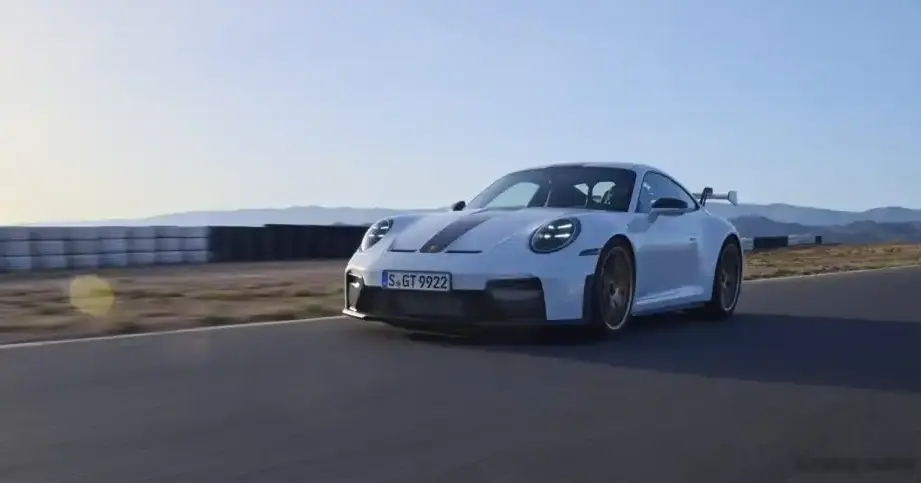
The Porsche 911 GT3 4.0 (PDK) represents the pinnacle of naturally aspirated performance within the 992 generation of the iconic 911. Introduced in October 2024 as part of the 992 facelift, this variant builds upon the already highly regarded GT3 model, offering an even more focused driving experience. It slots into the top tier of the 911 lineup, positioned above the Carrera and Carrera S models, and alongside other specialized variants like the GT Tourer. The GT3 4.0 PDK is a two-door, two-seat coupe designed for enthusiasts prioritizing track performance and driver engagement.
Technical Specifications
| Brand | Porsche |
| Model | 911 |
| Generation | 911 (992, facelift 2024) |
| Type (Engine) | GT3 4.0 (510 Hp) PDK |
| Start of production | October, 2024 |
| Powertrain Architecture | Internal Combustion engine |
| Body type | Coupe |
| Seats | 2 |
| Doors | 2 |
| Combined fuel consumption (WLTP) | 13.8 l/100 km |
| Combined fuel consumption (US mpg) | 17 US mpg |
| Combined fuel consumption (UK mpg) | 20.5 UK mpg |
| Combined fuel consumption (km/l) | 7.2 km/l |
| CO2 emissions (WLTP) | 312 g/km |
| Fuel Type | Petrol (Gasoline) |
| Acceleration 0 – 100 km/h | 3.4 sec |
| Acceleration 0 – 62 mph | 3.4 sec |
| Acceleration 0 – 60 mph | 3.2 sec |
| Acceleration 0 – 200 km/h | 10.8 sec |
| Maximum speed | 311 km/h (193.25 mph) |
| Emission standard | Euro 6e |
| Weight-to-power ratio | 2.9 kg/Hp |
| Weight-to-torque ratio | 3.3 kg/Nm |
| Power | 510 Hp |
| Power per litre | 127.6 Hp/l |
| Torque | 450 Nm (331.9 lb.-ft.) |
| Maximum engine speed | 9000 rpm |
| Engine layout | Rear, Longitudinal |
| Engine displacement | 3996 cm3 (243.85 cu. in.) |
| Number of cylinders | 6 |
| Engine configuration | Boxer |
| Cylinder Bore | 102 mm (4.02 in.) |
| Piston Stroke | 81.5 mm (3.21 in.) |
| Number of valves per cylinder | 4 |
| Fuel injection system | Direct injection |
| Engine aspiration | Naturally aspirated engine |
| Valvetrain | DOHC |
| Engine systems | Particulate filter |
| Kerb Weight | 1479 kg (3260.64 lbs.) |
| Max. weight | 1782 kg (3928.64 lbs.) |
| Max load | 303 kg (668 lbs.) |
| Trunk (boot) space – minimum | 373 l (13.17 cu. ft.) |
| Length | 4570 mm (179.92 in.) |
| Width | 1852 mm (72.91 in.) |
| Width including mirrors | 2033 mm (80.04 in.) |
| Height | 1279 mm (50.35 in.) |
| Wheelbase | 2457 mm (96.73 in.) |
| Ride height (ground clearance) | 76 mm (2.99 in.) |
| Minimum turning circle | 10.4 m (34.12 ft.) |
| Approach angle | 6.3° |
| Departure angle | 9.4° |
| Ramp-over angle | 10.6° |
| Drivetrain Architecture | Rear wheel drive |
| Number of gears and type of gearbox | 7 gears, automatic transmission PDK |
| Front suspension | Coil spring, Double wishbone, Transverse stabilizer |
| Rear suspension | Independent multi-link spring suspension with stabilizer |
| Front brakes | Ventilated discs |
| Rear brakes | Ventilated discs |
| Assisting systems | ABS (Anti-lock braking system) |
| Steering type | Steering rack and pinion |
| Power steering | Electric Steering |
| Front tires | 255/35 ZR20 |
| Rear tires | 315/30 ZR21 |
| Front wheel rims | 20 |
| Rear wheel rims | 21 |
Powertrain & Engine Architecture
At the heart of the GT3 4.0 PDK lies a 4.0-liter naturally aspirated flat-six engine, designated as the 9A2 engine family. This engine is directly derived from the 911 RSR race car, showcasing Porsche’s commitment to transferring motorsport technology to its production vehicles. It produces 510 horsepower at 8,400 rpm and 450 Nm (331.9 lb.-ft.) of torque. The engine utilizes direct fuel injection and a dry-sump lubrication system, crucial for maintaining oil supply during high-G cornering. The valvetrain employs dual overhead camshafts (DOHC) with four valves per cylinder. A particulate filter is included to meet stringent emissions regulations.
The “PDK” in the name refers to Porsche’s dual-clutch transmission. This 7-speed automatic transmission offers incredibly fast and precise gear changes, enhancing both acceleration and track performance. The PDK is specifically tuned for the GT3, with shorter gear ratios compared to other 911 models, prioritizing responsiveness and maximizing the engine’s power band. Paddle shifters mounted on the steering wheel allow for manual gear selection, providing the driver with complete control.
Driving Characteristics
The GT3 4.0 PDK delivers a visceral and engaging driving experience. The naturally aspirated engine provides a linear power delivery, building to a thrilling crescendo at its 9,000 rpm redline. The PDK transmission complements this perfectly, offering seamless shifts and allowing the driver to maintain momentum. While the manual transmission GT3 is often favored by purists, the PDK version offers a slight advantage in lap times due to its quicker shifts. The shorter gear ratios mean the engine is frequently kept within its optimal power range. The car feels incredibly balanced and agile, inspiring confidence on both the road and the track.
Equipment & Trim Levels
The GT3 4.0 PDK comes standard with a comprehensive list of performance-oriented features. These include Porsche Active Suspension Management (PASM), Porsche Torque Vectoring Plus (PTV Plus), and carbon-ceramic brakes (PCCB). The interior features sport seats with enhanced bolstering, providing excellent support during spirited driving. Alcantara upholstery is prevalent throughout the cabin, and the steering wheel is wrapped in the same material. Optional extras include a Club Sport package (which adds a roll cage and six-point harnesses), a lightweight lithium-ion battery, and various customization options through Porsche’s “Personalization Plus” program.
Chassis & Braking
The GT3 4.0 PDK features a specially tuned chassis designed for maximum performance. The suspension utilizes coil springs, double wishbones at the front, and an independent multi-link setup at the rear. A transverse stabilizer bar is fitted at both ends to reduce body roll. The braking system consists of ventilated discs all around, with the optional PCCB offering even greater stopping power and fade resistance. The car’s aerodynamic package includes a large rear wing and a front splitter, generating significant downforce at high speeds.
Market Reception & Comparison
The 911 GT3 4.0 PDK has been widely praised by automotive journalists and enthusiasts alike. Critics have lauded its exceptional performance, precise handling, and engaging driving experience. Compared to the standard GT3 with a manual transmission, the PDK version offers slightly quicker acceleration and lap times, but some argue that it sacrifices a degree of driver involvement. Compared to other high-performance sports cars, such as the Chevrolet Corvette Z06 or the McLaren 720S, the GT3 4.0 PDK offers a unique blend of track capability and everyday usability.
Legacy
The 992-generation GT3 4.0 PDK is expected to be a highly collectible Porsche in the future. Its naturally aspirated engine, combined with its advanced technology and focused driving experience, makes it a standout model in the 911 lineage. The 9A2 engine is known for its robustness and reliability, and with proper maintenance, the GT3 4.0 PDK should provide years of exhilarating performance. As a modern classic, it represents a high watermark for naturally aspirated sports car engineering.