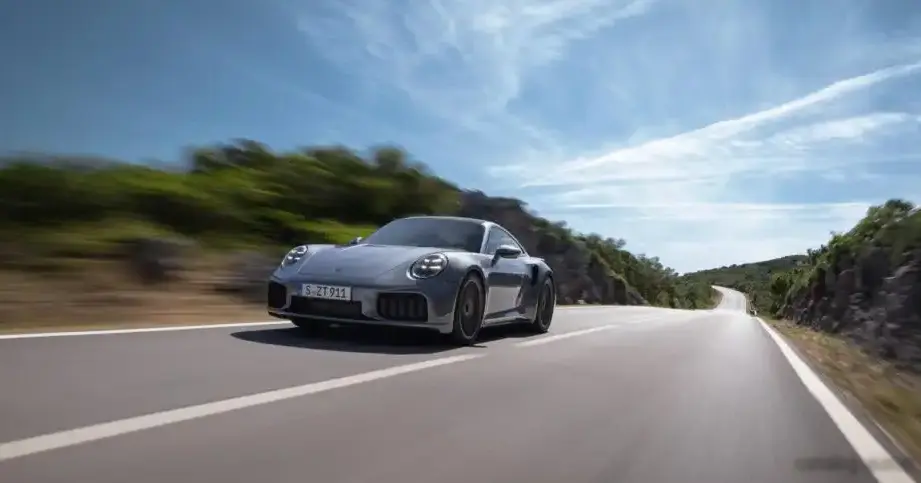
The Porsche 911 Turbo S 3.6 (711 Hp) T-Hybrid PDK, introduced for the 2025 model year as part of the 992 generation’s facelift, represents a significant evolution in the iconic 911 lineage. Building upon the already formidable 992 platform, this variant integrates a sophisticated full hybrid electric vehicle (FHEV) system with Porsche’s renowned turbocharged engine. Production commenced in September 2025, positioning it as the flagship performance model within the 911 range, above the standard Turbo models and other variants like the Carrera and Targa. The T-Hybrid designation signifies the incorporation of an electric motor to augment the traditional internal combustion engine, delivering increased power, improved efficiency, and a unique driving experience.
Technical Specifications
| Brand | Porsche |
| Model | 911 |
| Generation | 911 (992, facelift 2024) |
| Type (Engine) | Turbo S 3.6 (711 Hp) T-Hybrid PDK |
| Start of production | September, 2025 |
| Powertrain Architecture | FHEV (Full Hybrid Electric Vehicle) |
| Body type | Coupe |
| Seats | 2-4 |
| Doors | 2 |
| Fuel consumption at Low speed (WLTP) | 19.6 l/100 km (12 US mpg, 14.4 UK mpg, 5.1 km/l) |
| Fuel consumption at Medium speed (WLTP) | 11.6 l/100 km (20.3 US mpg, 24.4 UK mpg, 8.6 km/l) |
| Fuel consumption at high speed (WLTP) | 9.7 l/100 km (24.2 US mpg, 29.1 UK mpg, 10.3 km/l) |
| Fuel consumption at very high speed (WLTP) | 10.1 l/100 km (23.3 US mpg, 28 UK mpg, 9.9 km/l) |
| Combined fuel consumption (WLTP) | 11.6-11.8 l/100 km (20.3 – 19.9 US mpg, 24.4 – 23.9 UK mpg, 8.6 – 8.5 km/l) |
| CO2 emissions (WLTP) | 262-266 g/km |
| Fuel Type | Petrol (Gasoline) |
| Acceleration 0 – 100 km/h | 2.5 sec |
| Acceleration 0 – 62 mph | 2.5 sec |
| Acceleration 0 – 60 mph | 2.4 sec |
| Acceleration 0 – 200 km/h | 8.4 sec |
| Maximum speed | 322 km/h (200.08 mph) |
| Emission standard | Euro 6e |
| Weight-to-power ratio | 2.4 kg/Hp, 412.2 Hp/tonne |
| Weight-to-torque ratio | 2.2 kg/Nm, 463.8 Nm/tonne |
| Gross battery capacity | 1.9 kWh |
| Battery voltage | 400 V |
| Battery technology | Lithium-ion (Li-Ion) |
| Battery location | Under the front hood |
| Electric motor power | 82 Hp |
| Electric motor Torque | 188 Nm (138.66 lb.-ft.) |
| Electric motor location | Between the combustion engine and the transmission |
| Electric motor type | Synchronous |
| System power | 711 Hp @ 6500-7000 rpm |
| System torque | 800 Nm @ 2300-6000 rpm (590.05 lb.-ft. @ 2300-6000 rpm) |
| Power | 640 Hp |
| Power per litre | 178.2 Hp/l |
| Torque | 760 Nm (560.55 lb.-ft.) |
| Maximum engine speed | 7500 rpm |
| Engine layout | Rear, Longitudinal |
| Engine displacement | 3591 cm3 (219.14 cu. in.) |
| Number of cylinders | 6 |
| Engine configuration | Boxer |
| Cylinder Bore | 97 mm (3.82 in.) |
| Piston Stroke | 81 mm (3.19 in.) |
| Number of valves per cylinder | 4 |
| Fuel injection system | Direct injection |
| Engine aspiration | 2 x Electric Assisted Turbocharger, Intercooler |
| Valvetrain | DOHC, VarioCam |
| Engine systems | Start & Stop System, Particulate filter |
| Kerb Weight | 1725 kg (3802.97 lbs.) |
| Max. weight | 2125 kg (4684.82 lbs.) |
| Max load | 400 kg (881.85 lbs.) |
| Trunk (boot) space – minimum | 373 l (13.17 cu. ft.) |
| Fuel tank capacity | 63 l (16.64 US gal, 13.86 UK gal) |
| Max. roof load | 75 kg (165.35 lbs.) |
| Length | 4551 mm (179.17 in.) |
| Width | 1900 mm (74.8 in.) |
| Width including mirrors | 2033 mm (80.04 in.) |
| Height | 1295-1305 mm (50.98 – 51.38 in.) |
| Wheelbase | 2450 mm (96.46 in.) |
| Front overhang | 1016 mm (40 in.) |
| Rear overhang | 1085 mm (42.72 in.) |
| Ride height (ground clearance) | 93-103 mm (3.66 – 4.06 in.) |
| Minimum turning circle (turning diameter) | 10.9 m (35.76 ft.) |
| Approach angle | 7.6-8.2° |
| Departure angle | 13.3-13.9° |
| Ramp-over (brakeover) angle | 12-13° |
| Drivetrain Architecture | The Internal combustion engine (ICE) and the electric motor permanently drive the four wheels of the car with the ability to work in full electric or mixed mode. |
| Drive wheel | All wheel drive (4×4) |
| Number of gears and type of gearbox | 8 gears, automatic transmission PDK |
| Front suspension | Independent, type McPherson with coil spring and anti-roll bar |
| Rear suspension | Independent multi-link spring suspension with stabilizer |
| Front brakes | Ventilated discs, 420 mm |
| Rear brakes | Ventilated discs, 410 mm |
| Assisting systems | ABS (Anti-lock braking system), 4-wheel steering (4WS, active rear steering) |
| Steering type | Steering rack and pinion |
| Power steering | Electric Steering |
| Tires size | Front wheel tires: 255/35 ZR20, Rear wheel tires: 325/30 ZR21 |
| Wheel rims size | Front wheel rims: 9J x 20, Rear wheel rims: 11.5J x 21 |
Powertrain & Engine Architecture
At the heart of the 911 Turbo S T-Hybrid lies a 3.6-liter twin-turbocharged flat-six engine, internally designated as the ME 3.6. This engine produces 640 horsepower and 760 Nm (560.55 lb-ft) of torque. Integrated within the powertrain is a 82 horsepower electric motor positioned between the engine and the eight-speed Porsche Doppelkupplung (PDK) dual-clutch transmission. This configuration allows for electric boosting, filling in torque gaps from the turbochargers and providing instantaneous response. The 1.9 kWh lithium-ion battery, located under the front hood, provides energy storage for the electric motor. The engine utilizes direct fuel injection, variable turbine geometry (VTG) turbochargers, and Porsche’s VarioCam variable valve timing system to optimize performance and efficiency. The electric motor is a synchronous design, chosen for its high power density and efficiency.
Driving Characteristics
The integration of the electric motor significantly alters the driving experience compared to previous 911 Turbo S models. The immediate torque delivery from the electric motor eliminates turbo lag, resulting in exceptionally responsive acceleration. The 0-60 mph sprint is achieved in a blistering 2.4 seconds, and 0-100 km/h in 2.5 seconds. The PDK transmission is calibrated to work seamlessly with the hybrid system, providing quick and precise shifts. While the electric motor provides a boost in acceleration, it also contributes to improved fuel economy, particularly in urban driving conditions. The overall driving feel remains distinctly Porsche – precise, engaging, and confidence-inspiring, but with an added layer of electric immediacy.
Equipment & Trim Levels
The 911 Turbo S T-Hybrid comes standard with a comprehensive suite of features, reflecting its position as the top-tier 911 model. Interior appointments include full leather upholstery, adaptive sports seats with 18-way adjustment, a Bose Surround Sound System, and a carbon fiber interior trim package. Standard technology features include Porsche Communication Management (PCM) with a 12.3-inch touchscreen display, navigation, Apple CarPlay, and a suite of driver-assistance systems such as adaptive cruise control, lane keep assist, and park assist. Optional extras include a lift system for increased ground clearance, a panoramic sunroof, and bespoke interior customization options through Porsche Exclusive Manufaktur.
Chassis & Braking
The chassis of the 911 Turbo S T-Hybrid is based on the 992 generation’s advanced platform, featuring a multi-link suspension system with Porsche Active Suspension Management (PASM). The car benefits from Porsche’s Dynamic Chassis Control (PDCC) system, which minimizes body roll during cornering. Braking duties are handled by large, ventilated ceramic composite brakes (PCCB) as standard, providing exceptional stopping power and fade resistance. The car also features Porsche Torque Vectoring Plus (PTV Plus), which enhances agility and stability by selectively braking individual rear wheels. The steering system is a power-assisted rack-and-pinion design, offering precise and communicative feedback.
Market Reception & Comparison
The 911 Turbo S T-Hybrid has been widely praised by automotive critics for its exceptional performance, innovative hybrid technology, and refined driving experience. Compared to the previous 992 Turbo S, the T-Hybrid offers a noticeable improvement in acceleration and responsiveness, thanks to the electric motor’s instant torque. While fuel economy remains a secondary consideration for a vehicle of this caliber, the hybrid system does contribute to a modest improvement in overall efficiency. The T-Hybrid’s price point positions it at the very top of the 911 range, making it a premium offering for discerning enthusiasts.
Legacy
The 911 Turbo S T-Hybrid represents a pivotal moment in the 911’s history, marking the introduction of hybrid technology to the flagship Turbo S model. The long-term reliability of the hybrid powertrain remains to be fully assessed, but Porsche’s reputation for engineering excellence suggests a robust and durable system. On the used car market, the T-Hybrid is expected to command a premium due to its advanced technology and limited production numbers. It is likely to become a highly sought-after collector’s item, representing a significant step in the evolution of the iconic Porsche 911.