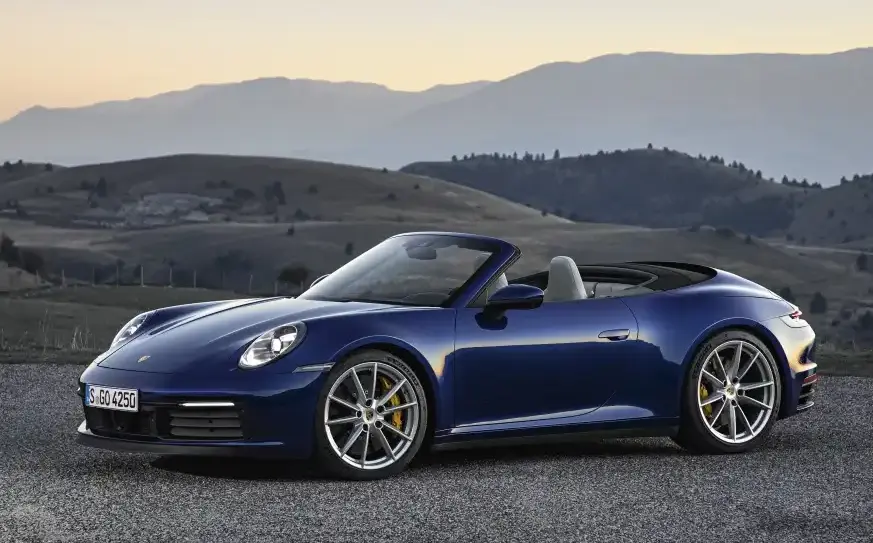
The Porsche 911 Cabriolet (992) Carrera GTS 3.0, producing 480 horsepower, represents a compelling blend of performance and open-air driving enjoyment within the iconic 911 lineage. Introduced in November 2021 and continuing through May 2024, this variant occupies a significant position in the 992 generation, offering a step up in power and refinement from the base Carrera models while remaining more accessible than the Turbo variants. It builds upon the foundation of the 992 platform, known for its advancements in technology and driving dynamics, and caters to enthusiasts seeking a thrilling yet sophisticated grand touring experience.
Technical Specifications
| Brand | Porsche |
| Model | 911 |
| Generation | 911 Cabriolet (992) |
| Type (Engine) | Carrera GTS 3.0 (480 Hp) |
| Start of production | November, 2021 |
| End of production | May, 2024 |
| Powertrain Architecture | Internal Combustion engine |
| Body type | Cabriolet |
| Seats | 4 |
| Doors | 2 |
| Combined fuel consumption (WLTP) | 10.5-10.9 l/100 km (22.4 – 21.6 US mpg, 26.9 – 25.9 UK mpg, 9.5 – 9.2 km/l) |
| CO2 emissions (WLTP) | 239-246 g/km |
| Fuel consumption (economy) – urban (NEDC) | 15.1 l/100 km (15.6 US mpg, 18.7 UK mpg, 6.6 km/l) |
| Fuel consumption (economy) – extra urban (NEDC) | 7.7 l/100 km (30.5 US mpg, 36.7 UK mpg, 13 km/l) |
| Fuel consumption (economy) – combined (NEDC) | 10.4 l/100 km (22.6 US mpg, 27.2 UK mpg, 9.6 km/l) |
| CO2 emissions (NEDC) | 238 g/km |
| Fuel Type | Petrol (Gasoline) |
| Acceleration 0 – 100 km/h | 4.3 sec |
| Acceleration 0 – 62 mph | 4.3 sec |
| Acceleration 0 – 60 mph | 4.1 sec |
| Acceleration 0 – 200 km/h | 13.4 sec |
| Maximum speed | 309 km/h (192 mph) |
| Emission standard | Euro 6d-ISC-FCM |
| Weight-to-power ratio | 3.3 kg/Hp, 303.8 Hp/tonne |
| Weight-to-torque ratio | 2.8 kg/Nm, 360.8 Nm/tonne |
| Power | 480 Hp @ 6500 rpm |
| Power per litre | 161 Hp/l |
| Torque | 570 Nm @ 2300-5000 rpm (420.41 lb.-ft. @ 2300-5000 rpm) |
| Maximum engine speed | 7500 rpm |
| Engine layout | Rear, Longitudinal |
| Engine Model/Code | DKKA |
| Engine displacement | 2981 cm3 (181.91 cu. in.) |
| Number of cylinders | 6 |
| Engine configuration | Boxer |
| Cylinder Bore | 91 mm (3.58 in.) |
| Piston Stroke | 76.4 mm (3.01 in.) |
| Number of valves per cylinder | 4 |
| Fuel injection system | Direct injection |
| Engine aspiration | BiTurbo, Intercooler |
| Valvetrain | VarioCam Plus |
| Engine oil capacity | 8 l (8.45 US qt | 7.04 UK qt) |
| Kerb Weight | 1580 kg (3483.3 lbs.) |
| Max. weight | 2010 kg (4431.29 lbs.) |
| Max load | 430 kg (947.99 lbs.) |
| Trunk (boot) space – minimum | 163 l (5.76 cu. ft.) |
| Fuel tank capacity | 64 l (16.91 US gal | 14.08 UK gal) |
| Length | 4533 mm (178.46 in.) |
| Width | 1852 mm (72.91 in.) |
| Width including mirrors | 2024 mm (79.69 in.) |
| Height | 1302 mm (51.26 in.) |
| Wheelbase | 2450 mm (96.46 in.) |
| Drag coefficient (Cd) | 0.31 |
| Minimum turning circle | 11.2 m (36.75 ft.) |
| Drivetrain Architecture | Rear wheel drive |
| Number of gears and type of gearbox | 7 gears, manual transmission |
| Front suspension | Independent type McPherson |
| Rear suspension | Independent multi-link suspension |
| Front brakes | Ventilated discs, 408 mm |
| Rear brakes | Ventilated discs, 380 mm |
| Assisting systems | ABS (Anti-lock braking system), 4-wheel steering (4WS, active rear steering) |
| Steering type | Steering rack and pinion |
| Power steering | Electric Steering |
| Tires size | Front wheel tires: 245/35 R20, Rear wheel tires: 305/30 R21 |
| Wheel rims size | Front wheel rims: 8.5J x 20, Rear wheel rims: 11.5J x 21 |
Powertrain & Engine Architecture
At the heart of the 911 Carrera GTS Cabriolet lies a 3.0-liter twin-turbocharged flat-six engine, designated as the DKKA. This engine is a significant evolution of the Porsche’s established boxer engine design, known for its low center of gravity and balanced performance. The engine utilizes direct fuel injection and Porsche’s VarioCam Plus valve timing system, optimizing both power and efficiency. The twin-turbochargers, with an intercooler, provide a broad torque curve, delivering 570 Nm (420.41 lb.-ft.) between 2300 and 5000 rpm. The engine is paired with a 7-speed manual transmission, providing precise gear changes and engaging driver control. Porsche’s PDK (Porsche Doppelkupplung) 7-speed dual-clutch transmission was also available as an option, offering lightning-fast shifts and enhanced performance.
Driving Characteristics
The 911 Carrera GTS Cabriolet delivers a dynamic and engaging driving experience. The 480 horsepower and 570 Nm of torque provide exhilarating acceleration, with a 0-60 mph time of approximately 4.1 seconds. The rear-wheel-drive configuration, combined with Porsche’s sophisticated traction control system, ensures optimal grip and stability. The manual transmission encourages driver involvement, while the optional PDK offers seamless and rapid gear changes. The GTS suspension, typically featuring Porsche Active Suspension Management (PASM), provides a balance between comfort and control, adapting to road conditions and driving style. The Cabriolet’s retractable soft top allows for open-air driving, enhancing the sensory experience without significantly compromising structural rigidity.
Equipment & Trim Levels
The Carrera GTS Cabriolet came standard with a comprehensive array of features, including a leather interior, Porsche Communication Management (PCM) infotainment system with a touchscreen display, and Porsche Active Suspension Management (PASM). Sport Seats Plus were standard, providing enhanced lateral support. Optional extras included adaptive cruise control, a premium sound system, and various interior trim options. The GTS trim also featured unique exterior styling elements, such as dark-tinted headlights, black exhaust tailpipes, and a SportDesign package, differentiating it from the base Carrera models.
Chassis & Braking
The 992 generation 911 utilizes a sophisticated chassis design, featuring an aluminum-intensive construction to reduce weight and enhance rigidity. The front suspension employs a McPherson strut design, while the rear features a multi-link setup. The GTS model typically benefits from a slightly lowered ride height and stiffer springs compared to the standard Carrera. The braking system consists of ventilated discs on all four wheels, with larger rotors on the front axle (408mm) compared to the rear (380mm). Porsche’s Ceramic Composite Brakes (PCCB) were available as an option, offering even greater stopping power and fade resistance.
Market Reception & Comparison
The 911 Carrera GTS Cabriolet was widely praised by automotive critics for its exceptional performance, refined handling, and luxurious interior. It was often lauded as the sweet spot in the 911 lineup, offering a compelling balance between performance and everyday usability. Compared to the base Carrera models, the GTS provided a noticeable increase in power and a more engaging driving experience. Compared to the higher-performance Turbo models, the GTS offered a more visceral and connected driving experience, appealing to enthusiasts who prioritize driver involvement. Fuel economy, while not a primary concern for 911 buyers, was respectable for a high-performance sports car, with combined fuel consumption ranging from 10.5 to 10.9 l/100 km.
Legacy
The 992 Carrera GTS Cabriolet is expected to maintain its value as a desirable and collectible Porsche model. The 3.0-liter twin-turbocharged engine has proven to be reliable, and the 992 generation 911 is generally considered to be a well-engineered and durable platform. As a relatively recent model, parts availability and service support are currently excellent. The combination of performance, luxury, and open-air driving enjoyment ensures that the 992 Carrera GTS Cabriolet will remain a sought-after vehicle in the used car market for years to come.