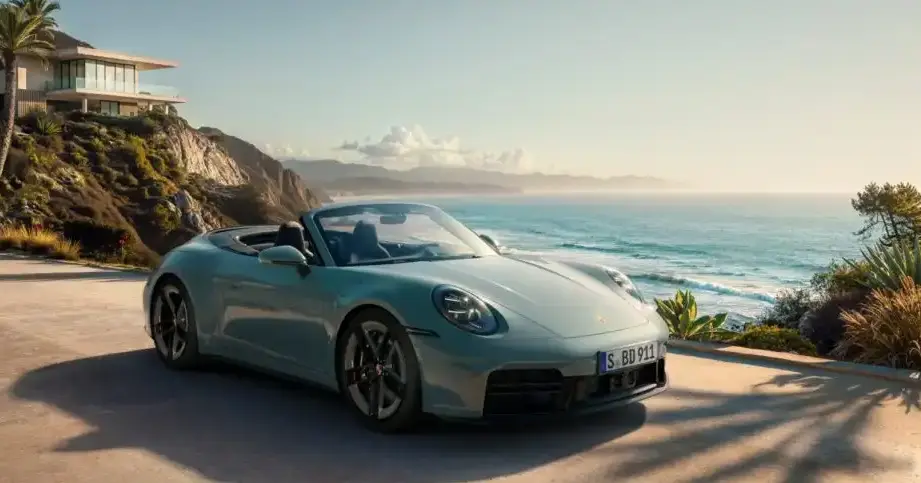
The Porsche 911 Cabriolet Carrera 4S 3.0 (480 Hp) PDK, introduced with the 992 generation facelift in July 2025, represents a compelling blend of performance, luxury, and open-air driving enjoyment. Positioned as a mid-to-high range offering within the 992 Cabriolet lineup, it builds upon the established 911 formula with updated technology and a refined driving experience. This variant caters to drivers seeking all-wheel drive capability, the convenience of Porsche’s dual-clutch PDK transmission, and a substantial power output for both spirited driving and comfortable long-distance cruising. The 992 generation, launched in 2019, continues the 911’s legacy as a sports car icon, and this facelift further enhances its appeal with subtle styling revisions and improvements to its powertrain and technology.
Technical Specifications
| Brand | Porsche |
| Model | 911 |
| Generation | 911 Cabriolet (992, facelift 2024) |
| Type (Engine) | Carrera 4S 3.0 (480 Hp) PDK |
| Start of production | July, 2025 |
| Powertrain Architecture | Internal Combustion engine |
| Body type | Cabriolet |
| Seats | 4 |
| Doors | 2 |
| Fuel consumption at Low speed (WLTP) | 18.9-19.1 l/100 km (12.4 – 12.3 US mpg, 14.9 – 14.8 UK mpg, 5.3 – 5.2 km/l) |
| Fuel consumption at Medium speed (WLTP) | 10.2-10.5 l/100 km (23.1 – 22.4 US mpg, 27.7 – 26.9 UK mpg, 9.8 – 9.5 km/l) |
| Fuel consumption at high speed (WLTP) | 8.9-9.1 l/100 km (26.4 – 25.8 US mpg, 31.7 – 31 UK mpg, 11.2 – 11 km/l) |
| Fuel consumption at very high speed (WLTP) | 9.5-9.7 l/100 km (24.8 – 24.2 US mpg, 29.7 – 29.1 UK mpg, 10.5 – 10.3 km/l) |
| Combined fuel consumption (WLTP) | 10.7-10.9 l/100 km (22 – 21.6 US mpg, 26.4 – 25.9 UK mpg, 9.3 – 9.2 km/l) |
| CO2 emissions (WLTP) | 242-247 g/km |
| Fuel Type | Petrol (Gasoline) |
| Acceleration 0 – 100 km/h | 3.5 sec |
| Acceleration 0 – 62 mph | 3.5 sec |
| Acceleration 0 – 60 mph | 3.3 sec |
| Acceleration 0 – 200 km/h | 12.5 sec |
| Maximum speed | 308 km/h (191.38 mph) |
| Weight-to-power ratio | 3.5 kg/Hp, 287.4 Hp/tonne |
| Weight-to-torque ratio | 3.2 kg/Nm, 317.4 Nm/tonne |
| Power | 480 Hp |
| Power per litre | 161 Hp/l |
| Torque | 530 Nm (390.91 lb.-ft.) |
| Maximum engine speed | 7500 rpm |
| Engine layout | Rear, Longitudinal |
| Engine displacement | 2981 cm3 (181.91 cu. in.) |
| Number of cylinders | 6 |
| Engine configuration | Boxer |
| Cylinder Bore | 91 mm (3.58 in.) |
| Piston Stroke | 76.4 mm (3.01 in.) |
| Number of valves per cylinder | 4 |
| Fuel injection system | Direct injection |
| Engine aspiration | BiTurbo, Intercooler |
| Valvetrain | DOHC |
| Engine systems | Start & Stop System, Particulate filter |
| Kerb Weight | 1670 kg (3681.72 lbs.) |
| Max. weight | 2065 kg (4552.55 lbs.) |
| Max load | 395 kg (870.83 lbs.) |
| Trunk (boot) space – minimum | 163 l (5.76 cu. ft.) |
| Length | 4542 mm (178.82 in.) |
| Width | 1852 mm (72.91 in.) |
| Width including mirrors | 2033 mm (80.04 in.) |
| Height | 1292-1302 mm (50.87 – 51.26 in.) |
| Wheelbase | 2450 mm (96.46 in.) |
| Front overhang | 1016 mm (40 in.) |
| Rear overhang | 1077 mm (42.4 in.) |
| Ride height (ground clearance) | 114-124 mm (4.49 – 4.88 in.) |
| Minimum turning circle (turning diameter) | 11.2 m (36.75 ft.) |
| Approach angle | 9.5-10.1° |
| Departure angle | 13.5-14.1° |
| Ramp-over (brakeover) angle | 11.8-12.8° |
| Drivetrain Architecture | The Internal combustion engine (ICE) drives the rear wheels permanently, and the front wheels are driven through an electrically or mechanically operated clutch if necessary. |
| Drive wheel | All wheel drive (4×4) |
| Number of gears and type of gearbox | 8 gears, automatic transmission PDK |
| Front suspension | Coil spring, Double wishbone, Transverse stabilizer |
| Rear suspension | Independent multi-link spring suspension with stabilizer |
| Front brakes | Ventilated discs, 408 mm |
| Rear brakes | Ventilated discs, 380 mm |
| Assisting systems | ABS (Anti-lock braking system) |
| Steering type | Steering rack and pinion |
| Power steering | Electric Steering |
| Tires size | Front wheel tires: 245/35 ZR20, Rear wheel tires: 305/30 ZR21; 315/30 ZR21 |
| Wheel rims size | Front wheel rims: 8.5J x 20, Rear wheel rims: 11.5J x 21 |
INTRODUCTION
The Porsche 911 Carrera 4S Cabriolet, in its 992 facelift guise, continues the tradition of offering an exhilarating open-top driving experience combined with the legendary 911 performance. Built on the 992 platform, which debuted in 2019, this iteration benefits from refinements to the engine, chassis, and interior. The “Carrera 4S” designation signifies all-wheel drive, enhancing traction and stability, while the 3.0-liter twin-turbocharged flat-six engine delivers 480 horsepower. The PDK (Porsche Doppelkupplung) transmission, a seven-speed dual-clutch unit, provides incredibly fast and smooth gear changes. This model occupies a sweet spot in the 911 range, offering a significant performance upgrade over the base Carrera Cabriolet while remaining more accessible than the higher-performance Turbo or GT variants.
Powertrain & Engine Architecture
At the heart of the 911 Carrera 4S Cabriolet lies the 3.0-liter twin-turbocharged flat-six engine, internally designated as the 9A2. This engine utilizes direct fuel injection and variable turbine geometry (VTG) turbochargers to optimize power delivery across the rev range. The VTG technology allows the turbochargers to adjust their geometry based on engine speed and load, resulting in improved responsiveness and efficiency. The engine produces 480 horsepower at 6,500 rpm and 530 Nm (390.91 lb.-ft.) of torque between 2,300 and 5,000 rpm. The PDK transmission is a crucial component of the powertrain, offering both automatic and manual shifting modes via steering wheel-mounted paddles. The PDK’s sophisticated control unit manages gear changes with remarkable speed and precision, contributing to the car’s impressive acceleration. The engine also incorporates a gasoline particulate filter (GPF) to meet increasingly stringent emissions regulations.
Driving Characteristics
The 911 Carrera 4S Cabriolet delivers a driving experience that is both engaging and refined. The all-wheel-drive system provides exceptional traction, particularly in challenging conditions, allowing the car to confidently put its power down. The PDK transmission contributes to rapid acceleration, with 0-60 mph achieved in just 3.3 seconds. The steering is precise and communicative, providing the driver with a strong sense of connection to the road. Compared to the rear-wheel-drive Carrera Cabriolet, the 4S offers increased stability and predictability, making it a more forgiving car to drive at the limit. Compared to higher-output models like the Turbo, the Carrera 4S provides a more balanced and accessible driving experience, with a focus on driver involvement rather than outright speed. The gear ratios in the PDK transmission are optimized for both acceleration and cruising efficiency.
Equipment & Trim Levels
The 911 Carrera 4S Cabriolet comes standard with a comprehensive array of features, including Porsche Active Suspension Management (PASM), which electronically adjusts the damping characteristics of the suspension. Interior appointments include leather upholstery, power-adjustable seats, and a Porsche Communication Management (PCM) infotainment system with a 10.9-inch touchscreen display. Optional extras are plentiful, allowing buyers to personalize their car to their exact specifications. These include adaptive cruise control, a Burmester high-end sound system, and various interior trim options. The Cabriolet also features a fully automatic fabric roof that can be raised or lowered in approximately 12 seconds, even while driving at moderate speeds.
Chassis & Braking
The 911 Carrera 4S Cabriolet utilizes a sophisticated chassis design that prioritizes both performance and comfort. The front suspension features a double-wishbone setup with coil springs and a transverse stabilizer bar, while the rear suspension employs an independent multi-link design with a stabilizer bar. The braking system consists of ventilated discs on all four wheels, with six-piston calipers at the front and four-piston calipers at the rear. Porsche’s Ceramic Composite Brakes (PCCB) are available as an option, offering even greater stopping power and fade resistance. The car’s electronic stability control (ESC) system helps to maintain control in challenging situations.
Market Reception & Comparison
The 911 Carrera 4S Cabriolet has been widely praised by automotive critics for its exceptional performance, handling, and refinement. It is often cited as a benchmark in the sports car segment. Compared to other trims in the 911 lineup, the 4S offers a compelling balance of performance and practicality. While the base Carrera Cabriolet is more affordable, it lacks the all-wheel-drive system and the extra power of the 4S. The Turbo models offer even greater performance, but at a significantly higher price point. Fuel economy is respectable for a high-performance sports car, with combined WLTP figures around 10.7-10.9 l/100 km.
Legacy
The 992 generation 911, and specifically the Carrera 4S Cabriolet, is expected to be a highly reliable and sought-after vehicle in the used car market. Porsche has a long-standing reputation for building durable and well-engineered cars. The 3.0-liter twin-turbocharged engine has proven to be robust, and the PDK transmission is known for its reliability. Regular maintenance, including oil changes and inspections, is crucial to ensuring the long-term health of the powertrain. The 992 generation represents a significant step forward in terms of technology and refinement, and the Carrera 4S Cabriolet is likely to remain a desirable and collectible sports car for years to come.