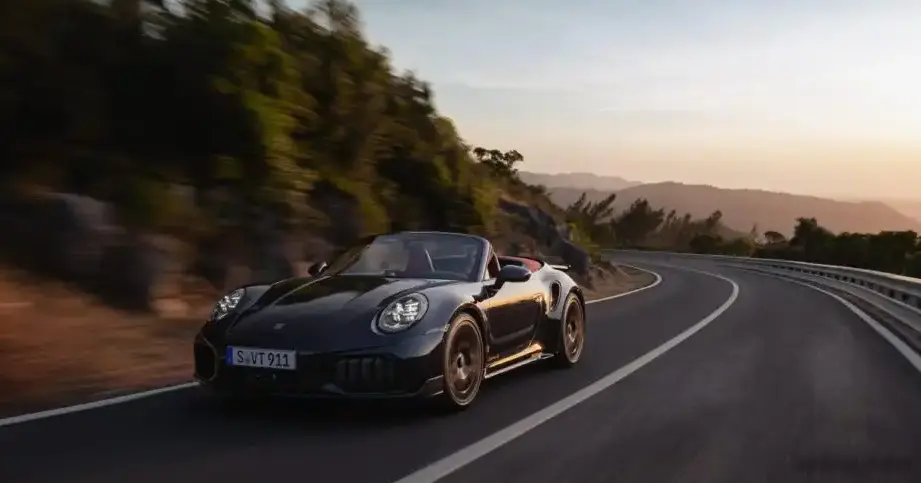
The Porsche 911 Turbo S Cabriolet (992, facelift 2024) represents the pinnacle of open-top performance within the iconic 911 lineage. Introduced for the 2025 model year, this variant builds upon the already formidable 992 generation with a groundbreaking T-Hybrid powertrain, combining a twin-turbocharged 3.6-liter flat-six engine with an electric motor. This configuration delivers a staggering 711 horsepower and 800 Nm (590 lb-ft) of torque, solidifying its position as one of the most powerful and technologically advanced convertibles available. The 992.2 generation facelift brought significant updates to the 911 range, and the Turbo S Cabriolet benefits from these enhancements, including revised styling, an upgraded interior, and optimized aerodynamics. It sits at the very top of the 911 Cabriolet range, offering unparalleled performance and luxury.
Technical Specifications
| Brand | Porsche |
| Model | 911 |
| Generation | 911 Cabriolet (992, facelift 2024) |
| Type (Engine) | Turbo S 3.6 (711 Hp) T-Hybrid PDK |
| Start of production | September, 2025 |
| Powertrain Architecture | FHEV (Full Hybrid Electric Vehicle) |
| Body type | Cabriolet |
| Seats | 4 |
| Doors | 2 |
| Fuel consumption at Low speed (WLTP) | 19.7-19.8 l/100 km (11.9 – 11.9 US mpg, 14.3 – 14.3 UK mpg, 5.1 – 5.1 km/l) |
| Fuel consumption at Medium speed (WLTP) | 11.8-12 l/100 km (19.9 – 19.6 US mpg, 23.9 – 23.5 UK mpg, 8.5 – 8.3 km/l) |
| Fuel consumption at high speed (WLTP) | 9.9-10 l/100 km (23.8 – 23.5 US mpg, 28.5 – 28.2 UK mpg, 10.1 – 10 km/l) |
| Fuel consumption at very high speed (WLTP) | 10.2-10.3 l/100 km (23.1 – 22.8 US mpg, 27.7 – 27.4 UK mpg, 9.8 – 9.7 km/l) |
| Combined fuel consumption (WLTP) | 11.7-11.8 l/100 km (20.1 – 19.9 US mpg, 24.1 – 23.9 UK mpg, 8.5 – 8.5 km/l) |
| CO2 emissions (WLTP) | 265-267 g/km |
| Fuel Type | Petrol (Gasoline) |
| Acceleration 0 – 100 km/h | 2.6 sec |
| Acceleration 0 – 62 mph | 2.6 sec |
| Acceleration 0 – 60 mph | 2.5 sec |
| Acceleration 0 – 200 km/h | 8.8 sec |
| Maximum speed | 322 km/h (200.08 mph) |
| Emission standard | Euro 6e |
| Weight-to-power ratio | 2.5 kg/Hp, 392.8 Hp/tonne |
| Weight-to-torque ratio | 2.3 kg/Nm, 442 Nm/tonne |
| Gross battery capacity | 1.9 kWh |
| Battery voltage | 400 V |
| Battery technology | Lithium-ion (Li-Ion) |
| Battery location | Under the front hood |
| Electric motor power | 82 Hp |
| Electric motor Torque | 188 Nm (138.66 lb.-ft.) |
| Electric motor location | Between the combustion engine and the transmission |
| Electric motor type | Synchronous |
| System power | 711 Hp @ 6500-7000 rpm |
| System torque | 800 Nm @ 2300-6000 rpm (590.05 lb.-ft. @ 2300-6000 rpm) |
| Power | 640 Hp |
| Power per litre | 178.2 Hp/l |
| Torque | 760 Nm (560.55 lb.-ft.) |
| Maximum engine speed | 7500 rpm |
| Engine layout | Rear, Longitudinal |
| Engine displacement | 3591 cm3 (219.14 cu. in.) |
| Number of cylinders | 6 |
| Engine configuration | Boxer |
| Cylinder Bore | 97 mm (3.82 in.) |
| Piston Stroke | 81 mm (3.19 in.) |
| Number of valves per cylinder | 4 |
| Fuel injection system | Direct injection |
| Engine aspiration | 2 x Electric Assisted Turbocharger, Intercooler |
| Valvetrain | DOHC, VarioCam |
| Engine systems | Start & Stop System, Particulate filter |
| Kerb Weight | 1810 kg (3990.37 lbs.) |
| Max. weight | 2175 kg (4795.05 lbs.) |
| Max load | 365 kg (804.69 lbs.) |
| Trunk (boot) space – minimum | 163 l (5.76 cu. ft.) |
| Fuel tank capacity | 63 l (16.64 US gal | 13.86 UK gal) |
| Length | 4551 mm (179.17 in.) |
| Width | 1900 mm (74.8 in.) |
| Width including mirrors | 2033 mm (80.04 in.) |
| Height | 1294-1304 mm (50.94 – 51.34 in.) |
| Wheelbase | 2450 mm (96.46 in.) |
| Front overhang | 1016 mm (40 in.) |
| Rear overhang | 1085 mm (42.72 in.) |
| Ride height (ground clearance) | 115-125 mm (4.53 – 4.92 in.) |
| Minimum turning circle (turning diameter) | 10.9 m (35.76 ft.) |
| Approach angle | 7.6-8.2° |
| Departure angle | 13.3-13.9° |
| Ramp-over (brakeover) angle | 12-13° |
| Drivetrain Architecture | The Internal combustion engine (ICE) and the electric motor permanently drive the four wheels of the car with the ability to work in full electric or mixed mode. |
| Drive wheel | All wheel drive (4×4) |
| Number of gears and type of gearbox | 8 gears, automatic transmission PDK |
| Front suspension | Independent, type McPherson with coil spring and anti-roll bar |
| Rear suspension | Independent multi-link spring suspension with stabilizer |
| Front brakes | Ventilated discs, 420 mm |
| Rear brakes | Ventilated discs, 410 mm |
| Assisting systems | ABS (Anti-lock braking system), 4-wheel steering (4WS, active rear steering) |
| Steering type | Steering rack and pinion |
| Power steering | Electric Steering |
| Tires size | Front wheel tires: 255/35 ZR20, Rear wheel tires: 325/30 ZR21 |
| Wheel rims size | Front wheel rims: 9J x 20, Rear wheel rims: 11.5J x 21 |
INTRODUCTION
The Porsche 911 Turbo S Cabriolet (992.2) represents the pinnacle of performance and luxury in the 911 range. Launched in late 2024 for the 2025 model year, it builds upon the already impressive 992 generation with a revolutionary T-Hybrid powertrain. This powertrain combines a 3.6-liter twin-turbocharged flat-six engine with a 48-volt electric motor integrated into the transmission, resulting in a combined output of 711 horsepower. The 992.2 facelift brought subtle but significant styling updates, an enhanced interior, and improved aerodynamics. Positioned as the flagship Cabriolet, the Turbo S offers an unparalleled driving experience, blending blistering acceleration with open-air enjoyment.
Powertrain & Engine Architecture
At the heart of the 911 Turbo S Cabriolet lies the 3.6-liter twin-turbocharged flat-six engine, designated as the ME 3.6. This engine benefits from significant upgrades in the 992.2 generation, including larger turbochargers and a revised cooling system. The addition of the electric motor, powered by a small 1.9 kWh battery, provides an electric boost, filling in torque gaps and enhancing responsiveness. The engine utilizes direct fuel injection and features Porsche’s VarioCam variable valve timing system for optimized performance and efficiency. The electric motor is seamlessly integrated between the engine and the eight-speed Porsche Doppelkupplung (PDK) dual-clutch transmission. This transmission is known for its incredibly fast and smooth shifts, contributing to the car’s exceptional acceleration. The engine code is a complex integration of ICE and electric components, reflecting the hybrid nature of the powertrain.
Driving Characteristics
The 911 Turbo S Cabriolet delivers a driving experience that is both exhilarating and refined. The T-Hybrid powertrain provides instant throttle response and relentless acceleration, with 0-60 mph achieved in a mere 2.5 seconds. The PDK transmission ensures that power is delivered seamlessly, and the all-wheel-drive system provides exceptional traction. Compared to earlier 992 Turbo S models, the T-Hybrid system noticeably improves low-end torque, making the car feel even more responsive in everyday driving situations. While the added weight of the hybrid components is present, it is largely offset by the electric boost, resulting in a net gain in performance. The Cabriolet configuration adds a slight weight penalty compared to the Coupe, but the open-top experience more than compensates for it.
Equipment & Trim Levels
The 911 Turbo S Cabriolet comes standard with a comprehensive list of features, reflecting its flagship status. Interior appointments include full leather upholstery, heated and ventilated front seats with 18-way adjustment, and carbon fiber trim. Standard technology includes a 12.3-inch touchscreen infotainment system with navigation, Apple CarPlay, and Android Auto integration. A Bose Surround Sound System is also standard. Optional extras include a bespoke Porsche Design interior package, extended leather trim, and a variety of exterior customization options. The Cabriolet features a fully automatic fabric roof that can be raised or lowered in approximately 12 seconds, even while driving at moderate speeds.
Chassis & Braking
The 911 Turbo S Cabriolet utilizes a sophisticated chassis designed to maximize performance and handling. It features Porsche Active Suspension Management (PASM), which continuously adjusts the damping characteristics to optimize ride comfort and control. Rear-axle steering is standard, enhancing agility and stability. The braking system consists of large, ventilated ceramic composite brakes (PCCB) with six-piston calipers at the front and four-piston calipers at the rear. These brakes provide exceptional stopping power and fade resistance. The car also features Porsche Stability Management (PSM) and Porsche Traction Management (PTM) to enhance safety and control.
Market Reception & Comparison
The 911 Turbo S Cabriolet (992.2) has been widely praised by automotive critics for its exceptional performance, advanced technology, and luxurious interior. The T-Hybrid powertrain has been particularly lauded for its seamless integration and significant performance gains. Compared to other high-performance convertibles, such as the Ferrari Roma Spider and the McLaren 720S Spider, the 911 Turbo S Cabriolet offers a unique blend of everyday usability and track-worthy performance. While its fuel economy is not its strong suit (around 20 mpg combined), it is relatively efficient for a car of its caliber. Reliability is expected to be high, consistent with Porsche’s reputation for engineering excellence.
Legacy
The 911 Turbo S Cabriolet (992.2) represents a significant milestone in the evolution of the 911. The introduction of the T-Hybrid powertrain signals Porsche’s commitment to electrification while preserving the iconic 911 driving experience. The 992.2 generation is expected to be highly sought after by collectors and enthusiasts alike, and the Turbo S Cabriolet, with its unique combination of performance, luxury, and open-air enjoyment, is likely to become a particularly desirable model in the years to come. The long-term reliability of the T-Hybrid system remains to be seen, but Porsche’s rigorous testing and engineering standards suggest that it will prove to be a durable and dependable powertrain.