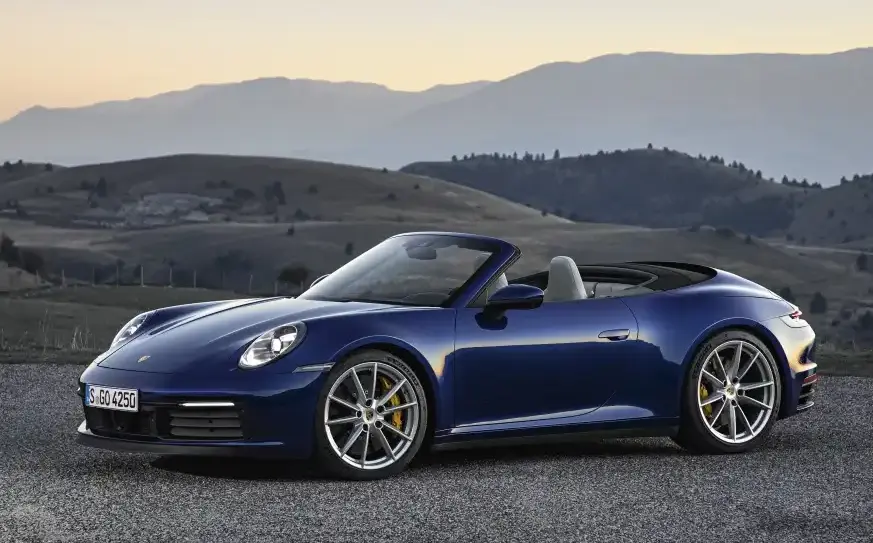
The Porsche 911 Turbo S Cabriolet (992) represents the pinnacle of open-top performance within the ninth generation of the iconic 911. Introduced in April 2020 and continuing through May 2024, this variant combines the exhilarating performance of the Turbo S engine with the added dimension of open-air driving. It sits at the very top of the 911 Cabriolet range, offering the highest levels of power and technology. The 992 generation, built on an evolved version of the Porsche Development Centre (PDC) platform, brought significant advancements in aerodynamics, technology, and interior refinement compared to its predecessor, the 991.
Technical Specifications
| Brand | Porsche |
| Model | 911 |
| Generation | 911 Cabriolet (992) |
| Type (Engine) | Turbo S 3.8 (650 Hp) PDK |
| Start of production | April, 2020 |
| End of production | May, 2024 |
| Powertrain Architecture | Internal Combustion engine |
| Body type | Cabriolet |
| Seats | 4 |
| Doors | 2 |
| Fuel consumption (economy) – urban (NEDC) | 15.9 l/100 km (14.8 US mpg, 17.8 UK mpg, 6.3 km/l) |
| Fuel consumption (economy) – extra urban (NEDC) | 8.6 l/100 km (27.4 US mpg, 32.8 UK mpg, 11.6 km/l) |
| Fuel consumption (economy) – combined (NEDC) | 11.3 l/100 km (20.8 US mpg, 25 UK mpg, 8.8 km/l) |
| CO2 emissions (NEDC) | 257 g/km |
| Fuel Type | Petrol (Gasoline) |
| Acceleration 0 – 100 km/h | 2.8 sec |
| Acceleration 0 – 62 mph | 2.8 sec |
| Acceleration 0 – 60 mph | 2.7 sec |
| Acceleration 0 – 200 km/h | 9.3 sec |
| Maximum speed | 330 km/h (205.05 mph) |
| Emission standard | Euro 6d-ISC-FCM |
| Weight-to-power ratio | 2.6 kg/Hp, 380.1 Hp/tonne |
| Weight-to-torque ratio | 2.1 kg/Nm, 467.8 Nm/tonne |
| Power | 650 Hp @ 6750 rpm |
| Power per litre | 173.6 Hp/l |
| Torque | 800 Nm @ 2500-4000 rpm (590.05 lb.-ft. @ 2500-4000 rpm) |
| Maximum engine speed | 7200 rpm |
| Engine layout | Rear, Longitudinal |
| Engine Model/Code | DKH |
| Engine displacement | 3745 cm3 (228.53 cu. in.) |
| Number of cylinders | 6 |
| Engine configuration | Boxer |
| Cylinder Bore | 102 mm (4.02 in.) |
| Piston Stroke | 76.4 mm (3.01 in.) |
| Number of valves per cylinder | 4 |
| Fuel injection system | Direct injection |
| Engine aspiration | BiTurbo, Intercooler |
| Engine oil capacity | 8.3 l (8.77 US qt | 7.3 UK qt) |
| Kerb Weight | 1710 kg (3769.9 lbs.) |
| Max. weight | 2080 kg (4585.62 lbs.) |
| Max load | 370 kg (815.71 lbs.) |
| Trunk (boot) space – minimum | 128 l (4.52 cu. ft.) |
| Fuel tank capacity | 67 l (17.7 US gal | 14.74 UK gal) |
| Length | 4535 mm (178.54 in.) |
| Width | 1900 mm (74.8 in.) |
| Width including mirrors | 2024 mm (79.69 in.) |
| Height | 1301 mm (51.22 in.) |
| Wheelbase | 2450 mm (96.46 in.) |
| Front track | 1583 mm (62.32 in.) |
| Rear (Back) track | 1600 mm (62.99 in.) |
| Drag coefficient (Cd) | 0.33 |
| Minimum turning circle | 10.9 m (35.76 ft.) |
| Drivetrain Architecture | All wheel drive (4×4) |
| Number of gears and type of gearbox | 8 gears, automatic transmission PDK |
| Front suspension | Independent, type McPherson with coil spring and anti-roll bar |
| Rear suspension | Independent multi-link spring suspension with stabilizer |
| Front brakes | Ventilated discs, 420 mm |
| Rear brakes | Ventilated discs, 390 mm |
| Front tires | 255/35 ZR20 97Y XL |
| Rear tires | 315/30 ZR21 105Y XL |
| Front wheel rims | 9J x 20 |
| Rear wheel rims | 11.5J x 21 |
Powertrain & Engine Architecture
At the heart of the 911 Turbo S Cabriolet lies a 3.8-liter twin-turbocharged flat-six engine, internally designated as the DKH. This engine produces a formidable 650 horsepower at 6750 rpm and 800 Nm (590 lb-ft) of torque available from 2500 to 4000 rpm. The engine utilizes direct fuel injection and variable turbine geometry (VTG) turbochargers to optimize performance across the rev range. The VTG technology allows the turbochargers to adjust the airflow based on engine speed and load, minimizing turbo lag and maximizing boost pressure. The engine’s boxer configuration contributes to a lower center of gravity, enhancing handling. Power is delivered through Porsche’s eight-speed Porsche Doppelkupplung (PDK) dual-clutch automatic transmission, renowned for its incredibly fast and smooth gear changes. The PDK is specifically tuned for the Turbo S, offering quicker shift times and a more aggressive driving experience.
Driving Characteristics
The 911 Turbo S Cabriolet delivers breathtaking acceleration. The combination of all-wheel drive, the PDK transmission, and the potent twin-turbo engine results in a 0-60 mph time of just 2.7 seconds and a 0-100 km/h time of 2.8 seconds. Top speed is electronically limited to 205 mph (330 km/h). Compared to lower-powered 911 Cabriolet variants, such as the base Carrera, the Turbo S offers a significantly more visceral and engaging driving experience. The power delivery is immediate and relentless, with minimal turbo lag. The PDK transmission provides seamless gear changes, allowing the driver to maintain optimal engine speed. While the base Carrera models prioritize a more balanced and accessible driving experience, the Turbo S is geared towards outright performance and track capability. The all-wheel-drive system provides exceptional traction, even in challenging conditions.
Equipment & Trim Levels
The 911 Turbo S Cabriolet comes standard with a comprehensive array of luxury and performance features. Standard interior appointments include full leather upholstery, heated and ventilated front seats with 14-way power adjustment, a Bose Surround Sound System, and a Porsche Communication Management (PCM) infotainment system with a 10.9-inch touchscreen display. Optional extras included adaptive cruise control, lane keep assist, a sport exhaust system, and various customization options for interior trim and exterior paint. The Cabriolet also features a fully automatic fabric roof that can be raised or lowered in approximately 12 seconds, even while driving at speeds up to 31 mph.
Chassis & Braking
The 911 Turbo S Cabriolet benefits from a sophisticated chassis designed to handle its immense power. It features Porsche Active Suspension Management (PASM), which electronically adjusts the damping characteristics of the shock absorbers based on road conditions and driving style. The car is equipped with Porsche Ceramic Composite Brakes (PCCB) as standard, offering exceptional stopping power and fade resistance. The braking system utilizes large, ventilated discs – 420mm at the front and 390mm at the rear. Rear-axle steering is also standard, enhancing agility and stability, particularly at higher speeds. The suspension geometry is optimized for performance, and the car features a wider track than other 911 variants.
Market Reception & Comparison
The 911 Turbo S Cabriolet was widely praised by automotive critics for its exceptional performance, handling, and luxurious features. It was consistently ranked among the fastest and most capable open-top sports cars on the market. Compared to other high-performance convertibles, such as the Ferrari F8 Spider or the McLaren 720S Spider, the 911 Turbo S offered a unique blend of everyday usability and track-focused performance. While some critics noted the relatively high price tag, most agreed that the car’s performance and features justified the cost. Fuel economy, while not a primary concern for buyers in this segment, was respectable for a car of this performance level, averaging around 20.8 US mpg in combined driving.
Legacy
The 992-generation 911 Turbo S Cabriolet has established itself as a highly desirable and collectible sports car. The DKH engine and PDK transmission have proven to be remarkably reliable, with proper maintenance. On the used car market, these models command premium prices, reflecting their performance capabilities and exclusivity. The 992 Turbo S represents a significant step forward in Porsche’s engineering prowess, and it continues to be a benchmark for open-top performance cars.