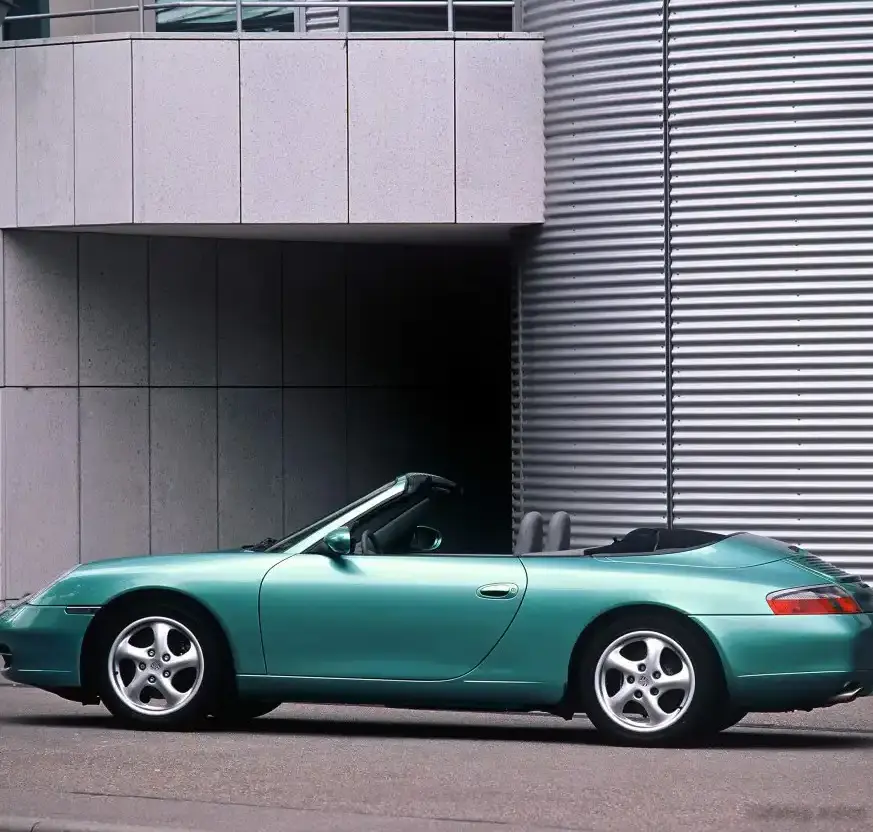
The Porsche 911 Cabriolet (996) Carrera 4 3.4, produced between 1998 and 2001, represents a pivotal moment in the evolution of the legendary 911. This variant, part of the 996 generation (produced 1997-2004), marked Porsche’s first complete redesign of the 911 since its inception in 1963. It introduced significant changes including water cooling, a new chassis, and a modernized interior, all while preserving the core characteristics that define the 911 – a rear-engined, six-cylinder boxer layout and a focus on driver engagement. The Carrera 4 3.4 occupied a mid-range position within the 996 Cabriolet lineup, offering the added security of all-wheel drive and a noticeable power increase over the base Carrera models, but falling short of the more performance-oriented Carrera 4S.
Technical Specifications
| Brand | Porsche |
| Model | 911 |
| Generation | 911 Cabriolet (996) |
| Type (Engine) | Carrera 4 3.4 (300 Hp) |
| Start of production | 1998 |
| End of production | 2001 |
| Powertrain Architecture | Internal Combustion engine |
| Body type | Cabriolet |
| Seats | 4 |
| Doors | 2 |
| Fuel consumption (urban) | 17.4 l/100 km (13.5 US mpg, 16.2 UK mpg, 5.7 km/l) |
| Fuel consumption (extra urban) | 8.8 l/100 km (26.7 US mpg, 32.1 UK mpg, 11.4 km/l) |
| Fuel consumption (combined) | 12 l/100 km (19.6 US mpg, 23.5 UK mpg, 8.3 km/l) |
| Fuel Type | Petrol (Gasoline) |
| Acceleration 0 – 100 km/h | 5.4 sec |
| Acceleration 0 – 62 mph | 5.4 sec |
| Acceleration 0 – 60 mph | 5.1 sec |
| Maximum speed | 280 km/h (173.98 mph) |
| Weight-to-power ratio | 4.8 kg/Hp, 206.9 Hp/tonne |
| Weight-to-torque ratio | 4.1 kg/Nm, 241.4 Nm/tonne |
| Power | 300 Hp @ 6800 rpm |
| Power per litre | 88.6 Hp/l |
| Torque | 350 Nm @ 4600 rpm (258.15 lb.-ft. @ 4600 rpm) |
| Engine layout | Rear, Longitudinal |
| Engine Model/Code | M96.01, M96.04 |
| Engine displacement | 3387 cm3 (206.69 cu. in.) |
| Number of cylinders | 6 |
| Engine configuration | Boxer |
| Cylinder Bore | 96 mm (3.78 in.) |
| Piston Stroke | 78 mm (3.07 in.) |
| Compression ratio | 11.3:1 |
| Number of valves per cylinder | 4 |
| Fuel injection system | Multi-port manifold injection |
| Engine aspiration | Naturally aspirated engine |
| Engine oil capacity | 8.3 l (8.77 US qt | 7.3 UK qt) |
| Coolant | 22.5 l (23.78 US qt | 19.8 UK qt) |
| Kerb Weight | 1450 kg (3196.7 lbs.) |
| Max. weight | 1850 kg (4078.55 lbs.) |
| Max load | 400 kg (881.85 lbs.) |
| Trunk (boot) space – minimum | 100 l (3.53 cu. ft.) |
| Fuel tank capacity | 64 l (16.91 US gal | 14.08 UK gal) |
| Length | 4430 mm (174.41 in.) |
| Width | 1765 mm (69.49 in.) |
| Height | 1305 mm (51.38 in.) |
| Wheelbase | 2350 mm (92.52 in.) |
| Front track | 1455 mm (57.28 in.) |
| Rear (Back) track | 1500 mm (59.06 in.) |
| Drive wheel | All wheel drive (4×4) |
| Number of gears and type of gearbox | 6 gears, manual transmission |
| Front suspension | Independent, type McPherson with coil spring and anti-roll bar |
| Rear suspension | Independent multi-link suspension |
| Front brakes | Ventilated discs |
| Rear brakes | Ventilated discs |
| Assisting systems | ABS (Anti-lock braking system) |
| Steering type | Steering rack and pinion |
| Power steering | Hydraulic Steering |
| Tires size | 205/50 R17; 255/40 R17 |
| Wheel rims size | 7J x 17; 9J x 17 |
Powertrain & Engine Architecture
The core of the 996 Carrera 4 3.4 is the M96.01 or M96.04 3.4-liter flat-six engine. This engine represented a significant departure from the air-cooled tradition of previous 911s, adopting water cooling to improve thermal management and reduce noise levels. The engine features a DOHC (Dual Overhead Camshaft) valvetrain with four valves per cylinder, contributing to its high-revving character. Fuel delivery is handled by a multi-port fuel injection system, ensuring precise fuel metering for optimal performance and efficiency. This engine generates 300 horsepower at 6800 rpm and 350 Nm (258 lb-ft) of torque at 4600 rpm. A 6-speed manual transmission was the standard offering, while a 5-speed Tiptronic S automatic transmission was available as an option. The all-wheel-drive system utilizes a viscous coupling to distribute power between the front and rear axles, enhancing traction and stability, particularly in inclement weather.
Driving Characteristics
The Carrera 4 3.4 delivered a compelling balance of performance and usability. While not as aggressively powerful as the Carrera 4S, the 3.4-liter engine provided ample power for enthusiastic driving. The all-wheel-drive system inspired confidence, especially on slippery surfaces, making it a more practical choice for all-season use. The 6-speed manual transmission offered precise shifts and allowed drivers to fully utilize the engine’s powerband. The optional Tiptronic S automatic transmission, while convenient, was often criticized for its comparatively slow response compared to the manual. The car’s handling was characteristically Porsche – precise, balanced, and rewarding. The relatively light weight (1450 kg) contributed to its agility, and the suspension provided a comfortable ride without compromising handling performance.
Equipment & Trim Levels
The Carrera 4 3.4 came standard with a solid set of features, including leather upholstery, power windows, power locks, and a basic audio system. A wide range of optional extras allowed buyers to personalize their vehicles. Popular options included a sunroof, heated seats, a navigation system, upgraded audio systems, and various interior trim packages. The 996 generation’s interior design was a significant step forward, featuring a more modern and ergonomic layout. The dashboard was dominated by a central speedometer and tachometer, flanked by smaller gauges for oil pressure, oil temperature, and coolant temperature.
Chassis & Braking
The 996 generation 911 employed a galvanized steel chassis, providing a strong and rigid foundation. The suspension system consisted of independent McPherson struts at the front and an independent multi-link setup at the rear, delivering excellent handling and ride comfort. Braking was provided by ventilated disc brakes on all four wheels, offering ample stopping power. An Anti-lock Braking System (ABS) was standard, enhancing safety and control. The Carrera 4 3.4 featured a slightly wider track than the rear-wheel-drive Carrera models, contributing to its enhanced stability.
Market Reception & Comparison
The 996 Carrera 4 3.4 was generally well-received by automotive critics. It was praised for its performance, handling, and all-weather capabilities. Some critics, however, noted that the engine lacked the distinct character of earlier air-cooled 911s. Compared to the base Carrera, the Carrera 4 3.4 offered superior traction and stability, making it a more confident performer in challenging conditions. In comparison to the Carrera 4S, it provided a more accessible entry point into the 911 range, albeit with slightly less power and performance. Fuel economy was reasonable for a sports car of its class, averaging around 19.6 US mpg in combined driving.
Legacy
The 996 Carrera 4 3.4 has become a sought-after model among Porsche enthusiasts. Initially undervalued, prices have been steadily increasing as collectors recognize its historical significance. The M96 engine, while generally reliable, is known to be susceptible to intermediate shaft (IMS) bearing failure, a potential issue that prospective buyers should be aware of and address if necessary. Despite this potential concern, the 996 Carrera 4 3.4 remains a rewarding and engaging sports car that offers a unique combination of performance, practicality, and iconic Porsche styling. Its place as the first water-cooled 911 secures its position in automotive history.