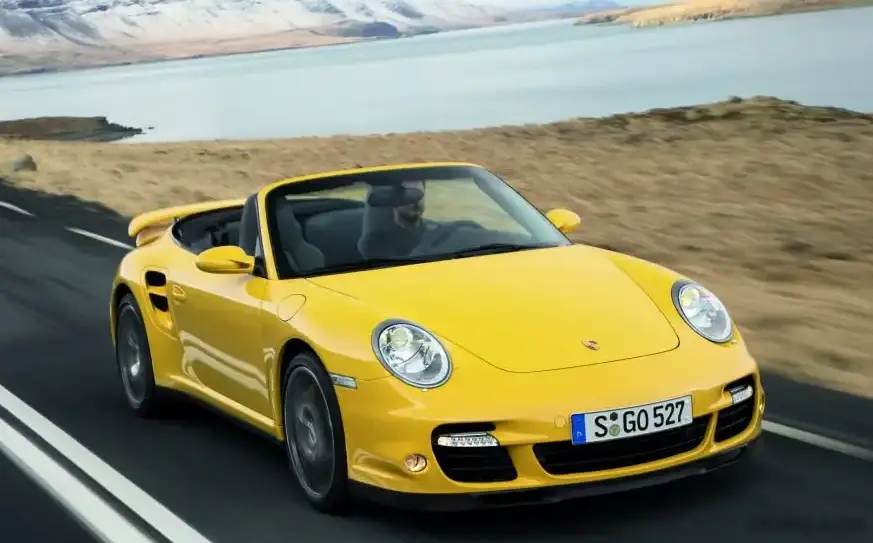
The Porsche 911 Cabriolet (997) Carrera 4 3.6, produced from 2005 to 2008, represents a significant iteration of Porsche’s iconic sports car. Falling within the 997 generation (2004-2012), this variant combined the open-air thrill of a cabriolet with Porsche’s renowned all-wheel-drive system. Positioned as a high-performance offering within the 997 range, the Carrera 4 3.6 catered to drivers seeking a blend of everyday usability and exhilarating performance. It served as a step up from the base Carrera models, offering enhanced grip and stability, while remaining below the more focused and powerful Carrera S and Turbo variants.
Technical Specifications
| Brand | Porsche |
| Model | 911 |
| Generation | 911 Cabriolet (997) |
| Type (Engine) | Carrera 4 3.6 (325 Hp) |
| Start of production | 2005 |
| End of production | 2008 |
| Powertrain Architecture | Internal Combustion engine |
| Body type | Cabriolet |
| Seats | 4 |
| Doors | 2 |
| Fuel consumption (urban) | 16.6 l/100 km (14.2 US mpg, 17 UK mpg, 6 km/l) |
| Fuel consumption (extra urban) | 8.4 l/100 km (28 US mpg, 33.6 UK mpg, 11.9 km/l) |
| Fuel consumption (combined) | 11.3 l/100 km (20.8 US mpg, 25 UK mpg, 8.8 km/l) |
| CO2 emissions | 272 g/km |
| Fuel Type | Petrol (Gasoline) |
| Acceleration 0 – 100 km/h | 5.3 sec |
| Acceleration 0 – 62 mph | 5.3 sec |
| Acceleration 0 – 60 mph | 5 sec |
| Maximum speed | 280 km/h (173.98 mph) |
| Weight-to-power ratio | 4.7 kg/Hp, 211.7 Hp/tonne |
| Weight-to-torque ratio | 4.1 kg/Nm, 241 Nm/tonne |
| Power | 325 Hp @ 6800 rpm |
| Power per litre | 90.4 Hp/l |
| Torque | 370 Nm @ 4250 rpm (272.9 lb.-ft. @ 4250 rpm) |
| Engine layout | Rear, Longitudinal |
| Engine Model/Code | M96.05 |
| Engine displacement | 3596 cm3 (219.44 cu. in.) |
| Number of cylinders | 6 |
| Engine configuration | Boxer |
| Compression ratio | 11.3:1 |
| Fuel injection system | Multi-port manifold injection |
| Engine aspiration | Naturally aspirated engine |
| Engine oil capacity | 8.3 l (8.77 US qt | 7.3 UK qt) |
| Coolant | 31 l (32.76 US qt | 27.28 UK qt) |
| Kerb Weight | 1535 kg (3384.1 lbs) |
| Max. weight | 1920 kg (4232.88 lbs) |
| Max load | 385 kg (848.78 lbs) |
| Trunk (boot) space – maximum | 105 l (3.71 cu. ft.) |
| Fuel tank capacity | 67 l (17.7 US gal | 14.74 UK gal) |
| Length | 4427 mm (174.29 in) |
| Width | 1852 mm (72.91 in) |
| Height | 1310 mm (51.57 in) |
| Wheelbase | 2350 mm (92.52 in) |
| Drag coefficient (Cd) | 0.30 |
| Minimum turning circle | 10.9 m (35.76 ft) |
| Drive wheel | All wheel drive (4×4) |
| Number of gears | 6 gears, manual transmission |
| Front suspension | Independent type McPherson |
| Rear suspension | Independent multi-link suspension |
| Front brakes | Ventilated discs |
| Rear brakes | Ventilated discs |
| Assisting systems | ABS (Anti-lock braking system) |
| Steering type | Steering rack and pinion |
| Power steering | Hydraulic Steering |
| Tires size | 235/40 ZR18; 295/35 ZR18 |
| Wheel rims size | 8J x 18; 11J x 18 |
Powertrain & Engine Architecture
At the heart of the 997 Carrera 4 3.6 lies the M96.05 engine, a 3.6-liter naturally aspirated flat-six (boxer) engine. This engine, a hallmark of Porsche engineering, featured a dry-sump lubrication system, crucial for maintaining oil supply during the high G-forces experienced in spirited driving. The M96.05 utilized multi-port fuel injection, delivering fuel directly into the intake ports, optimizing combustion efficiency. The engine’s valvetrain employed four valves per cylinder, enhancing breathing and contributing to its high-revving nature. The 325 horsepower and 370 Nm (272.9 lb-ft) of torque were delivered to all four wheels via a standard six-speed manual transmission. Porsche’s all-wheel-drive system, typically favoring a rear-biased distribution, provided enhanced traction and stability, particularly in adverse weather conditions. An optional Tiptronic S automatic transmission was also available, offering drivers the convenience of automated gear changes.
Driving Characteristics
The 997 Carrera 4 3.6 with a manual transmission offered a distinctly engaging driving experience. The engine’s power delivery was linear and predictable, building smoothly to its 6800 rpm redline. While not as brutally quick as the Carrera S, the 3.6-liter engine provided ample power for both daily driving and spirited weekend excursions. The all-wheel-drive system instilled confidence, allowing drivers to exploit more of the available power, especially on less-than-ideal road surfaces. The six-speed manual gearbox was precise and offered a satisfying mechanical feel. Compared to the automatic version, the manual provided a more connected and involving driving experience, allowing for greater control over the engine’s powerband. The automatic, while convenient, slightly dulled the overall driving experience, with slightly slower shift times and a less direct connection to the engine.
Equipment & Trim Levels
The Carrera 4 3.6 came standard with a well-appointed interior featuring leather upholstery, power-adjustable seats, and an automatic climate control system. The dashboard layout was typical Porsche, prioritizing functionality and driver focus. Optional extras were plentiful, including navigation systems, upgraded sound systems (Bose or PCM), sport seats, and various interior trim packages. The Cabriolet models featured a fully automatic retractable soft top, allowing for open-air driving at the touch of a button. Exterior options included a range of wheel designs, paint colors, and aerodynamic enhancements.
Chassis & Braking
The 997 Carrera 4 3.6 utilized an independent suspension system at all four corners, featuring McPherson struts at the front and a multi-link setup at the rear. This configuration provided a comfortable ride while maintaining excellent handling characteristics. Braking duties were handled by ventilated disc brakes on all four wheels, providing ample stopping power. Porsche’s ABS (Anti-lock Braking System) was standard, enhancing safety and stability during hard braking. The Carrera 4 featured a slightly wider track than the rear-wheel-drive Carrera, contributing to its increased stability.
Market Reception & Comparison
The 997 Carrera 4 3.6 was generally well-received by automotive critics. It was praised for its balanced handling, comfortable ride, and refined engine. Compared to the base Carrera, the all-wheel-drive system was seen as a significant advantage, particularly in regions with inclement weather. However, some critics noted that the Carrera 4 lacked the raw excitement of the Carrera S. Fuel economy was reasonable for a high-performance sports car, averaging around 20.8 US mpg in combined driving. Reliability was generally good, although the M96 engine has been known to exhibit issues with intermediate shaft bearing failure in some cases, requiring preventative maintenance.
Legacy
The 997 Carrera 4 3.6 remains a desirable Porsche model in the used car market. Its combination of performance, practicality, and all-weather capability makes it a compelling choice for enthusiasts. While the M96 engine requires diligent maintenance, particularly regarding the intermediate shaft bearing, it is a robust and rewarding powerplant. The 997 generation as a whole is considered by many to be a sweet spot in the 911 lineage, offering a blend of classic Porsche feel and modern technology. Values have been steadily increasing in recent years, reflecting the growing demand for well-maintained examples of this iconic sports car.