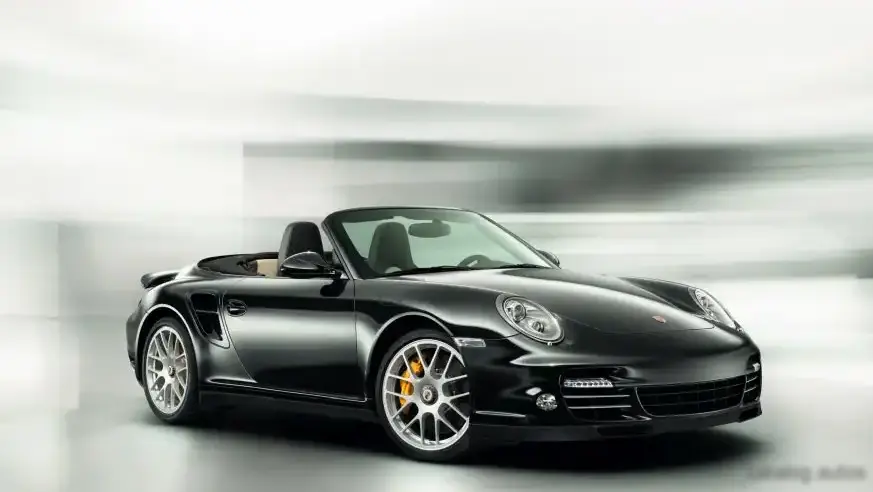
The Porsche 911 Cabriolet Carrera 4 3.6, produced from 2008 to 2011, represents a significant iteration of the iconic 911 lineage. This variant falls within the 997 generation, specifically the facelifted model introduced in 2008, often referred to as the 997.2. Positioned as a high-performance, all-wheel-drive convertible, the Carrera 4 3.6 offered a blend of open-air driving enjoyment and the renowned Porsche driving experience. It sat towards the upper end of the 997 Cabriolet range, offering more power and capability than the base Carrera models but remaining below the more focused Carrera S and Turbo variants. This model year brought refinements to the engine, interior, and exterior styling, enhancing both performance and luxury.
Technical Specifications
| Brand | Porsche |
| Model | 911 |
| Generation | 911 Cabriolet (997, facelift 2008) |
| Type (Engine) | Carrera 4 3.6 (345 Hp) |
| Start of production | 2008 |
| End of production | 2011 |
| Powertrain Architecture | Internal Combustion engine |
| Body type | Cabriolet |
| Seats | 4 |
| Doors | 2 |
| Fuel consumption (economy) – urban | 16.2 l/100 km (14.5 US mpg, 17.4 UK mpg, 6.2 km/l) |
| Fuel consumption (economy) – extra urban | 7.8 l/100 km (30.2 US mpg, 36.2 UK mpg, 12.8 km/l) |
| Fuel consumption (economy) – combined | 10.8 l/100 km (21.8 US mpg, 26.2 UK mpg, 9.3 km/l) |
| CO2 emissions | 254 g/km |
| Fuel Type | Petrol (Gasoline) |
| Acceleration 0 – 100 km/h | 5.2 sec |
| Acceleration 0 – 62 mph | 5.2 sec |
| Acceleration 0 – 60 mph | 4.9 sec |
| Maximum speed | 284 km/h (176.47 mph) |
| Emission standard | Euro 5 |
| Weight-to-power ratio | 4.5 kg/Hp, 221.9 Hp/tonne |
| Weight-to-torque ratio | 4 kg/Nm, 250.8 Nm/tonne |
| Power | 345 Hp @ 6500 rpm |
| Power per litre | 95.5 Hp/l |
| Torque | 390 Nm @ 4400 rpm (287.65 lb.-ft. @ 4400 rpm) |
| Engine layout | Rear, Longitudinal |
| Engine Model/Code | MA1.02 |
| Engine displacement | 3614 cm3 (220.54 cu. in.) |
| Number of cylinders | 6 |
| Engine configuration | Boxer |
| Compression ratio | 12.5:1 |
| Fuel injection system | Direct injection |
| Engine oil capacity | 7.5 l (7.93 US qt | 6.6 UK qt) |
| Coolant | 28.9 l (30.54 US qt | 25.43 UK qt) |
| Kerb Weight | 1555 kg (3428.19 lbs.) |
| Max. weight | 1930 kg (4254.92 lbs.) |
| Max load | 375 kg (826.73 lbs.) |
| Trunk (boot) space – minimum | 105 l (3.71 cu. ft.) |
| Fuel tank capacity | 67 l (17.7 US gal | 14.74 UK gal) |
| Length | 4435 mm (174.61 in.) |
| Width | 1852 mm (72.91 in.) |
| Height | 1310 mm (51.57 in.) |
| Wheelbase | 2350 mm (92.52 in.) |
| Drag coefficient (Cd) | 0.30 |
| Minimum turning circle | 10.9 m (35.76 ft.) |
| Drive wheel | All wheel drive (4×4) |
| Number of gears | 6 |
| Gearbox type | Manual transmission |
| Front suspension | Independent type McPherson |
| Rear suspension | Independent multi-link suspension |
| Front brakes | Ventilated discs, 330 mm |
| Rear brakes | Ventilated discs, 330 mm |
| Assisting systems | ABS (Anti-lock braking system) |
| Steering type | Steering rack and pinion |
| Power steering | Hydraulic Steering |
| Tires size | 235/40 ZR18; 295/35 ZR18 |
| Wheel rims size | 8J x 18; 11J x 18 |
Powertrain & Engine Architecture
At the heart of the 911 Carrera 4 3.6 lies the MA1.02 engine, a 3.6-liter naturally aspirated flat-six (boxer) engine. This engine benefited from Porsche’s Direct Fuel Injection (DFI) technology, introduced with the 997.2 generation. DFI allowed for more precise fuel metering, resulting in increased power output and improved fuel efficiency compared to the previous 997.1 models. The engine produces 345 horsepower at 6,500 rpm and 390 Nm (287.65 lb-ft) of torque at 4,400 rpm. The flat-six configuration contributes to a low center of gravity, enhancing handling and stability. The engine’s intake and exhaust systems were optimized for improved breathing, further contributing to its performance. The standard transmission for this model was a 6-speed manual, though a 5-speed Tiptronic S automatic transmission was also available as an option. The automatic transmission featured manual shift capability, allowing drivers to select gears for more control.
Driving Characteristics
The Carrera 4 3.6, even with the manual transmission, delivers a refined and engaging driving experience. The all-wheel-drive system provides excellent traction, particularly in adverse weather conditions, making it a more usable sports car year-round. The power delivery is linear and predictable, with a strong mid-range providing ample acceleration for everyday driving and spirited performance on winding roads. Compared to the base Carrera, the all-wheel-drive system adds weight, slightly impacting agility, but the added stability is a worthwhile trade-off for many drivers. The automatic transmission, while offering convenience, does slightly diminish the direct connection to the engine felt with the manual. However, it provides smooth and quick shifts, making it a viable option for those prioritizing ease of use.
Equipment & Trim Levels
The Carrera 4 3.6 came standard with a comprehensive list of features, including leather upholstery, automatic climate control, a Bose sound system, and bi-xenon headlights. Optional extras were plentiful, allowing buyers to personalize their vehicles. Popular options included sport seats, a navigation system, a sunroof, and Porsche Dynamic Chassis Control (PDCC), which actively counteracts body roll for even flatter cornering. Interior trim options included various leather colors and finishes, as well as carbon fiber accents. The Cabriolet featured a fully automatic retractable soft top, which could be operated at speeds up to 50 km/h (31 mph).
Chassis & Braking
The 997.2 Carrera 4 3.6 utilizes a fully independent suspension system, with McPherson struts at the front and a multi-link setup at the rear. This configuration provides a comfortable ride while maintaining excellent handling characteristics. The Carrera 4 features larger brakes compared to the base Carrera, with ventilated discs at all four corners. ABS (Anti-lock Braking System) is standard, providing enhanced stopping power and control. The steering is a hydraulic rack-and-pinion system, offering precise and responsive feedback. The all-wheel-drive system utilizes a viscous coupling to distribute power between the front and rear axles, ensuring optimal traction in all conditions.
Market Reception & Comparison
The 911 Carrera 4 3.6 was well-received by automotive critics, who praised its performance, handling, and refinement. It was often lauded as a versatile sports car that could be enjoyed both on the track and on the street. Compared to the Carrera S, the 3.6 offered a slightly more accessible price point while still delivering a thrilling driving experience. The 1.8L models were often seen as a more practical choice for daily driving, offering a better balance of performance and fuel economy. However, the Carrera 4 3.6’s all-wheel-drive system and more powerful engine made it a more capable and engaging machine.
Legacy
The 997.2 Carrera 4 3.6 has proven to be a reliable and durable sports car. The MA1.02 engine is generally considered to be robust, with proper maintenance. The DFI system, while offering performance benefits, can be susceptible to carbon buildup over time, requiring periodic cleaning. Today, these cars are sought after by enthusiasts as a well-rounded and enjoyable 911 variant. The combination of performance, all-wheel-drive capability, and open-air driving enjoyment makes it a desirable classic that continues to provide a rewarding driving experience.