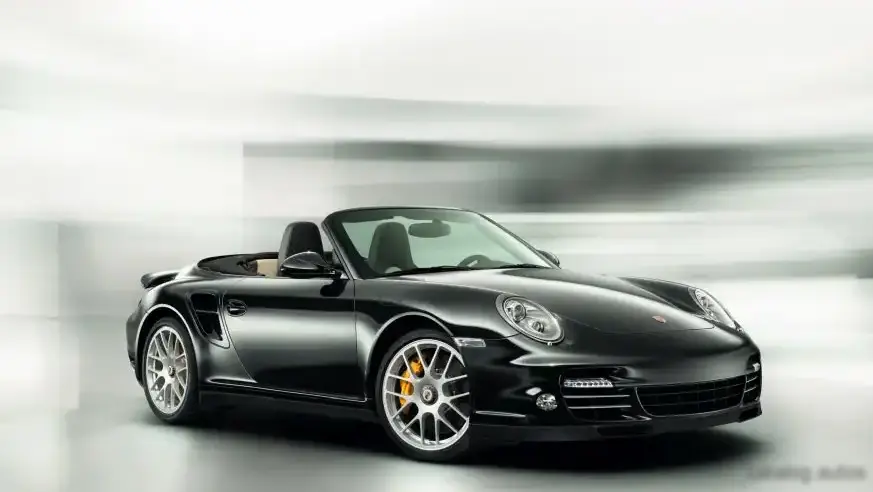
The Porsche 911 Turbo Cabriolet, specifically the 997 generation facelift model produced from 2009 to 2011, represents a pinnacle of open-top performance engineering. This variant, powered by a 3.8-liter twin-turbocharged flat-six engine producing 500 horsepower, combined exhilarating speed with the unique experience of convertible motoring. Positioned as the flagship performance variant within the 997 Cabriolet range, it offered a substantial upgrade over the standard Carrera models and even the Carrera S, appealing to drivers seeking uncompromising power and exclusivity. It was a relatively short production run, bridging the gap between the 997.1 and 997.2 generations, and solidified the 911’s reputation as a world-class sports car.
Technical Specifications
| Brand | Porsche |
| Model | 911 |
| Generation | 911 Cabriolet (997, facelift 2008) |
| Type (Engine) | Turbo 3.8 (500 Hp) |
| Start of production | 2009 |
| End of production | 2011 |
| Powertrain Architecture | Internal Combustion engine |
| Body type | Cabriolet |
| Seats | 4 |
| Doors | 2 |
| Fuel consumption (economy) – urban | 16.7 l/100 km (14.1 US mpg, 16.9 UK mpg, 6 km/l) |
| Fuel consumption (economy) – extra urban | 8.4 l/100 km (28 US mpg, 33.6 UK mpg, 11.9 km/l) |
| Fuel consumption (economy) – combined | 11.7 l/100 km (20.1 US mpg, 24.1 UK mpg, 8.5 km/l) |
| CO2 emissions | 275 g/km |
| Fuel Type | Petrol (Gasoline) |
| Acceleration 0 – 100 km/h | 3.8 sec |
| Acceleration 0 – 62 mph | 3.8 sec |
| Acceleration 0 – 60 mph | 3.6 sec |
| Maximum speed | 312 km/h (193.87 mph) |
| Emission standard | Euro 5 |
| Weight-to-power ratio | 3.3 kg/Hp, 304 Hp/tonne |
| Weight-to-torque ratio | 2.5 kg/Nm, 395.1 Nm/tonne |
| Power | 500 Hp @ 6000-6500 rpm |
| Power per litre | 131.6 Hp/l |
| Torque | 650 Nm @ 1950-5000 rpm (479.42 lb.-ft. @ 1950-5000 rpm) |
| Engine layout | Rear, Longitudinal |
| Engine Model/Code | MA1.70 |
| Engine displacement | 3800 cm3 (231.89 cu. in.) |
| Number of cylinders | 6 |
| Engine configuration | Boxer |
| Compression ratio | 9.8:1 |
| Fuel injection system | Direct injection |
| Engine aspiration | Turbocharger, Intercooler |
| Engine oil capacity | 8 l (8.45 US qt | 7.04 UK qt) |
| Coolant | 29 l (30.64 US qt | 25.52 UK qt) |
| Kerb Weight | 1645 kg (3626.6 lbs) |
| Max. weight | 1995 kg (4398.22 lbs) |
| Max load | 350 kg (771.62 lbs) |
| Trunk (boot) space – maximum | 105 l (3.71 cu. ft.) |
| Fuel tank capacity | 67 l (17.7 US gal | 14.74 UK gal) |
| Length | 4450 mm (175.2 in) |
| Width | 1852 mm (72.91 in) |
| Width including mirrors | 1952 mm (76.85 in) |
| Height | 1300 mm (51.18 in) |
| Wheelbase | 2350 mm (92.52 in) |
| Drag coefficient (Cd) | 0.32 |
| Minimum turning circle | 10.9 m (35.76 ft) |
| Drive wheel | All wheel drive (4×4) |
| Number of gears and type of gearbox | 6 gears, manual transmission |
| Front suspension | Independent type McPherson |
| Rear suspension | Independent multi-link suspension |
| Front brakes | Ventilated discs |
| Rear brakes | Ventilated discs |
| Assisting systems | ABS (Anti-lock braking system) |
| Steering type | Steering rack and pinion |
| Power steering | Hydraulic Steering |
| Tires size | 235/35 ZR19; 305/30 ZR19 |
| Wheel rims size | 8.5J x 19; 11J x 19 |
Powertrain & Engine Architecture
At the heart of the 997 Turbo Cabriolet lies the MA1.70 engine, a 3.8-liter twin-turbocharged flat-six. This engine builds upon the foundation of the earlier 996 Turbo’s powerplant, but with significant enhancements. Key features include direct fuel injection (DFI), variable turbine geometry (VTG) turbochargers, and an intercooler system designed to maximize cooling efficiency. The DFI system allows for precise fuel delivery, improving both power and fuel economy. The VTG turbochargers adjust the angle of the turbine vanes to optimize boost pressure across the engine’s rev range, minimizing turbo lag and providing a broad torque curve. The engine’s flat-six configuration, also known as a boxer engine, contributes to a low center of gravity, enhancing handling stability. The 6-speed manual transmission was standard, offering precise gear changes and a direct connection to the engine. Porsche also offered a PDK (Porsche Doppelkupplung) dual-clutch transmission as an option, providing even faster and smoother shifts.
Driving Characteristics
The 997 Turbo Cabriolet delivers a driving experience that is both exhilarating and surprisingly refined. The 500 horsepower and 650 Nm (479 lb-ft) of torque provide immense acceleration, with 0-60 mph times consistently in the 3.6-3.8 second range. The all-wheel-drive system ensures excellent traction, even in challenging conditions. The manual transmission, while requiring more driver involvement than the PDK, offers a rewarding and engaging experience. The suspension, tuned for performance, provides a firm but controlled ride. While not as track-focused as the 911 GT models, the Turbo Cabriolet is more than capable of delivering thrilling performance on both the road and the track. Compared to the naturally aspirated Carrera models, the Turbo offers a significantly higher level of performance and a more responsive driving experience. The Turbo also differs from the 911 Carrera S, offering a substantial power increase and the added benefit of all-wheel drive.
Equipment & Trim Levels
The 997 Turbo Cabriolet came standard with a comprehensive list of features, reflecting its position as the flagship model. Standard equipment included leather upholstery, heated front seats, a Bose audio system, a navigation system, and bi-xenon headlights. Optional extras were plentiful, allowing buyers to personalize their vehicles to their exact specifications. Popular options included sport seats, a carbon fiber interior trim package, and a lift system to raise the front of the car for navigating speed bumps. The Cabriolet also featured a fully automatic retractable soft top, allowing for open-air motoring at the touch of a button.
Chassis & Braking
The 997 Turbo Cabriolet utilizes a robust chassis designed to handle the immense power of the engine. The suspension features independent McPherson struts at the front and a multi-link setup at the rear. Porsche’s Active Suspension Management (PASM) system, available as an option, allows drivers to adjust the damping characteristics to suit their driving preferences. The braking system consists of ventilated discs at all four corners, providing exceptional stopping power. Porsche Ceramic Composite Brakes (PCCB) were available as an option, offering even greater braking performance and reduced weight.
Market Reception & Comparison
The 997 Turbo Cabriolet was widely praised by automotive critics for its exceptional performance, handling, and refinement. It was consistently ranked among the best sports cars in the world. While fuel economy was not a primary concern for buyers of this vehicle, the 997 Turbo Cabriolet offered reasonable fuel consumption for its performance level. Reliability was generally good, although maintenance costs could be high due to the complexity of the engine and drivetrain. Compared to other high-performance convertibles of the time, such as the Ferrari California and the Mercedes-Benz SL63 AMG, the 997 Turbo Cabriolet offered a unique combination of performance, practicality, and driving engagement.
Legacy
The 997 Turbo Cabriolet remains a highly sought-after vehicle in the used car market today. Its combination of performance, exclusivity, and Porsche’s renowned build quality has ensured its enduring appeal. The MA1.70 engine, while complex, has proven to be relatively reliable when properly maintained. However, potential buyers should be aware of the potential for costly repairs, particularly related to the turbochargers and fuel injection system. The 997 Turbo Cabriolet represents a sweet spot in the 911 lineage, offering a thrilling driving experience and a timeless design.