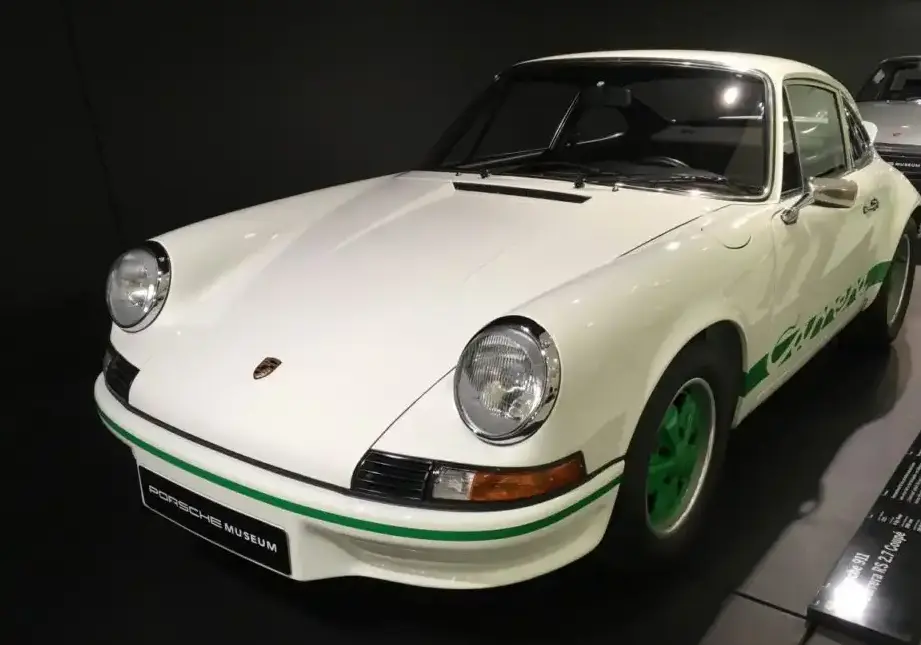
The Porsche 911 Carrera RS 2.7, produced from 1972 to 1973, represents a pivotal moment in the evolution of the iconic 911. Falling within the “F” series of the original 911 (1964-1973), the Carrera RS 2.7 was Porsche’s answer to increasingly stringent homologation regulations for Group 4 sports car racing. It wasn’t simply a racing homologation special, however; it quickly became celebrated for its exceptional handling, performance, and the purity of its driving experience. The “RS” designation stands for “Rennsport,” signifying a focus on racing. This 210 horsepower variant was the first 911 to break the 200 hp barrier and set a new standard for sports car performance. It was a relatively limited production run, making it a highly sought-after collector’s item today.
Technical Specifications
| Brand | Porsche |
| Model | 911 |
| Generation | 911 Coupe (F) |
| Type (Engine) | Carrera RS 2.7 (210 Hp) |
| Start of production | 1972 |
| End of production | 1973 |
| Powertrain Architecture | Internal Combustion engine |
| Body type | Coupe |
| Seats | 4 |
| Doors | 2 |
| Fuel consumption (economy) – combined | 10.8 l/100 km |
| Fuel consumption (economy) – combined | 21.8 US mpg |
| Fuel consumption (economy) – combined | 26.2 UK mpg |
| Fuel consumption (economy) – combined | 9.3 km/l |
| Fuel Type | Petrol (Gasoline) |
| Acceleration 0 – 100 km/h | 6.3 sec |
| Acceleration 0 – 62 mph | 6.3 sec |
| Acceleration 0 – 60 mph | 6 sec |
| Maximum speed | 240 km/h |
| Maximum speed | 149.13 mph |
| Weight-to-power ratio | 5.1 kg/Hp |
| Weight-to-power ratio | 195.3 Hp/tonne |
| Weight-to-torque ratio | 4.2 kg/Nm |
| Weight-to-torque ratio | 237.2 Nm/tonne |
| Power | 210 Hp @ 6300 rpm |
| Power per litre | 78.2 Hp/l |
| Torque | 255 Nm @ 5100 rpm |
| Torque | 188.08 lb.-ft. @ 5100 rpm |
| Maximum engine speed | 7300 rpm |
| Engine layout | Rear, Longitudinal |
| Engine Model/Code | 911.83 |
| Engine displacement | 2687 cm3 |
| Engine displacement | 163.97 cu. in. |
| Number of cylinders | 6 |
| Engine configuration | Boxer |
| Cylinder Bore | 90 mm |
| Cylinder Bore | 3.54 in. |
| Piston Stroke | 70.4 mm |
| Piston Stroke | 2.77 in. |
| Compression ratio | 8.5:1 |
| Fuel injection system | Multi-port manifold injection |
| Engine aspiration | Naturally aspirated engine |
| Engine oil capacity | 10 l |
| Engine oil capacity | 10.57 US qt |
| Engine oil capacity | 8.8 UK qt |
| Kerb Weight | 1075 kg |
| Kerb Weight | 2369.97 lbs |
| Max. weight | 1400 kg |
| Max. weight | 3086.47 lbs |
| Max load | 325 kg |
| Max load | 716.5 lbs |
| Trunk (boot) space – maximum | 200 l |
| Trunk (boot) space – maximum | 7.06 cu. ft. |
| Permitted trailer load with brakes (12%) | 840 kg |
| Permitted trailer load with brakes (12%) | 1851.88 lbs |
| Permitted trailer load without brakes | 600 kg |
| Permitted trailer load without brakes | 1322.77 lbs |
| Length | 4147 mm |
| Length | 163.27 in. |
| Width | 1652 mm |
| Width | 65.04 in. |
| Height | 1320 mm |
| Height | 51.97 in. |
| Wheelbase | 2271 mm |
| Wheelbase | 89.41 in. |
| Front track | 1372 mm |
| Front track | 54.02 in. |
| Rear (Back) track | 1394 mm |
| Rear (Back) track | 54.88 in. |
| Ride height (ground clearance) | 150 mm |
| Ride height (ground clearance) | 5.91 in. |
| Minimum turning circle (turning diameter) | 10.7 m |
| Minimum turning circle (turning diameter) | 35.1 ft. |
| Drivetrain Architecture | The Internal combustion engine (ICE) drives the rear wheels of the vehicle. |
| Drive wheel | Rear wheel drive |
| Number of gears and type of gearbox | 5 gears, manual transmission |
| Front suspension | Spring Strut, Wishbone |
| Rear suspension | Trailing arm |
| Front brakes | Ventilated discs, 282 mm |
| Rear brakes | Ventilated discs, 290 mm |
| Steering type | Steering rack and pinion |
| Tires size | Front wheel tires: 185/70 R15Rear wheel tires: 215/60 R15 |
| Wheel rims size | Front wheel rims: 6J x 15Rear wheel rims: 7J x 15 |
Powertrain & Engine Architecture
The heart of the Carrera RS 2.7 is the Type 911/83 engine, a 2.7-liter air-cooled flat-six. This engine was a significant departure from the earlier 2.4-liter engines, featuring a larger bore and stroke. The increased displacement, combined with a higher compression ratio of 8.5:1 and revised cylinder heads, allowed for the substantial power increase. Bosch mechanical fuel injection (MFI) was employed, a sophisticated system for the time that provided precise fuel delivery. The engine utilized a dry-sump lubrication system, crucial for maintaining oil supply during the high G-forces experienced in racing. The five-speed manual transmission, a robust unit, was the only transmission option available. The engine’s character is defined by its responsive throttle, strong mid-range torque, and willingness to rev to its 7300 rpm redline.
Driving Characteristics
The Carrera RS 2.7 offered a driving experience that was remarkably balanced and engaging. Its relatively lightweight construction (approximately 2370 lbs) combined with the 210 horsepower engine resulted in brisk acceleration – 0 to 60 mph in around 6 seconds and a top speed of 149 mph. The suspension, featuring stiffer springs and dampers compared to standard 911s, provided excellent body control and minimized roll. The steering was precise and communicative, offering a direct connection to the road. While not overtly powerful by modern standards, the RS 2.7’s strength lay in its agility and predictability. It demanded a skilled driver to extract its full potential, but rewarded them with a pure and visceral driving experience.
Equipment & Trim Levels
The Carrera RS 2.7 was offered in a relatively spartan trim, reflecting its racing-oriented purpose. The interior was functional and focused on the driver. Standard features included high-backed bucket seats, a three-spoke steering wheel, and a basic instrument cluster. Options were limited but included a limited-slip differential, which was highly desirable for track use. The exterior was characterized by its flared wheel arches, necessitated by the wider tires, and a distinctive “ducktail” rear spoiler, which improved aerodynamic stability. The car was available in a range of colors, but many were finished in vibrant shades like Signal Orange, a color now synonymous with the RS 2.7.
Chassis & Braking
The chassis of the Carrera RS 2.7 was based on the standard 911 platform but featured several key modifications. The suspension was significantly upgraded with stiffer springs, Koni shock absorbers, and a thicker rear stabilizer bar. The brakes consisted of ventilated discs all around, providing ample stopping power. The wider tires – 185/70 R15 at the front and 215/60 R15 at the rear – significantly increased grip. The combination of these chassis and braking enhancements resulted in a car that was exceptionally stable and capable, both on the road and on the track.
Market Reception & Comparison
The Carrera RS 2.7 was immediately lauded by automotive journalists and enthusiasts alike. It was praised for its performance, handling, and overall driving experience. Compared to the standard 911, the RS 2.7 offered a significant step up in performance and refinement. It also represented a considerable price premium. Compared to other sports cars of the era, such as the Ferrari Dino 246 GT, the RS 2.7 offered a more practical and accessible package, while still delivering a thrilling driving experience. Its fuel economy, while not exceptional, was reasonable for a high-performance sports car of the time.
Legacy
The Porsche 911 Carrera RS 2.7 is widely regarded as one of the greatest sports cars of all time. It established the RS lineage within the 911 model range, a tradition that continues today with high-performance, track-focused variants. The engine, while relatively simple by modern standards, proved to be remarkably durable and reliable. Today, the Carrera RS 2.7 is a highly sought-after collector’s item, with prices continuing to rise. Its influence can be seen in countless sports cars that followed, and it remains a benchmark for driving purity and engagement.