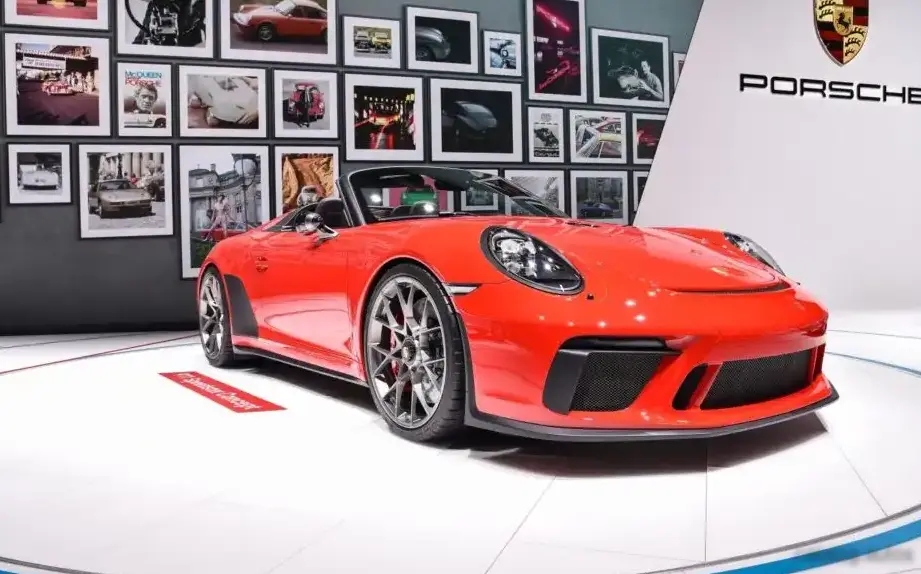
The Porsche 911 Speedster (991 II) 4.0, produced from July 2019 to October 2020, represents the final iteration of the 991 generation 911. This limited-production, two-seat roadster was designed as a modern interpretation of Porsche’s classic Speedster models, blending open-top driving exhilaration with the high performance expected of the 911 lineage. Positioned as the most exclusive and powerful variant of the 991.2 generation, it served as a send-off to the platform before the introduction of the 992. The 4.0-liter engine and manual transmission configuration were key differentiators, appealing to purists and collectors.
Technical Specifications
| Brand | Porsche |
| Model | 911 |
| Generation | 911 Speedster (991 II) |
| Type (Engine) | 4.0 (510 Hp) |
| Start of production | July, 2019 |
| End of production | October, 2020 |
| Powertrain Architecture | Internal Combustion engine |
| Body type | Roadster |
| Seats | 2 |
| Doors | 2 |
| Fuel consumption (economy) – urban | 20.6 l/100 km (11.4 US mpg, 13.7 UK mpg, 4.9 km/l) |
| Fuel consumption (economy) – extra urban | 9.9 l/100 km (23.8 US mpg, 28.5 UK mpg, 10.1 km/l) |
| Fuel consumption (economy) – combined | 13.8 l/100 km (17 US mpg, 20.5 UK mpg, 7.2 km/l) |
| CO2 emissions | 317 g/km |
| Fuel Type | Petrol (Gasoline) |
| Acceleration 0 – 100 km/h | 4 sec |
| Acceleration 0 – 62 mph | 4 sec |
| Acceleration 0 – 60 mph | 3.8 sec |
| Maximum speed | 310 km/h (192.63 mph) |
| Emission standard | Euro 6d-Temp |
| Weight-to-power ratio | 2.9 kg/Hp, 348.1 Hp/tonne |
| Weight-to-torque ratio | 3.1 kg/Nm, 320.8 Nm/tonne |
| Power | 510 Hp @ 8400 rpm |
| Power per litre | 127.6 Hp/l |
| Torque | 470 Nm @ 6250 rpm (346.65 lb.-ft. @ 6250 rpm) |
| Engine layout | Rear, Longitudinal |
| Engine Model/Code | DRM |
| Engine displacement | 3996 cm3 (243.85 cu. in.) |
| Number of cylinders | 6 |
| Engine configuration | Boxer |
| Cylinder Bore | 102 mm (4.02 in.) |
| Piston Stroke | 81.5 mm (3.21 in.) |
| Number of valves per cylinder | 4 |
| Fuel injection system | Direct injection |
| Engine aspiration | Naturally aspirated engine |
| Kerb Weight | 1465 kg (3229.77 lbs.) |
| Max. weight | 1793 kg (3952.89 lbs.) |
| Max load | 328 kg (723.12 lbs.) |
| Trunk (boot) space – maximum | 125 l (4.41 cu. ft.) |
| Fuel tank capacity | 64 l (16.91 US gal | 14.08 UK gal) |
| Length | 4562 mm (179.61 in.) |
| Width | 1852 mm (72.91 in.) |
| Width including mirrors | 1978 mm (77.87 in.) |
| Height | 1250 mm (49.21 in.) |
| Wheelbase | 2457 mm (96.73 in.) |
| Front track | 1551 mm (61.06 in.) |
| Rear (Back) track | 1555 mm (61.22 in.) |
| Drag coefficient (Cd) | 0.35 |
| Drive wheel | Rear wheel drive |
| Number of gears and type of gearbox | 6 gears, manual transmission |
INTRODUCTION
The 991.2 Speedster is a modern homage to Porsche’s storied past, specifically recalling the 356 Speedster of the 1950s and 60s. Built on the 991.2 generation 911 platform, it distinguishes itself with a lower, raked windshield, a magnesium roof structure, and a double-bubble rear deck reminiscent of classic racing models. Production was intentionally limited to 1,948 units – a nod to Porsche’s founding year – making it a highly sought-after collector’s item. The 4.0-liter engine variant represents the pinnacle of the 991.2 Speedster offerings, delivering exceptional performance and a visceral driving experience.
Powertrain & Engine Architecture
At the heart of the 991.2 Speedster 4.0 lies the 4.0-liter naturally aspirated flat-six engine, internally designated as the DRM. This engine is derived from the 911 GT3 RS and 911 R, but specifically tuned for the Speedster. It features direct fuel injection, a high compression ratio, and a dry-sump lubrication system for optimal performance under demanding conditions. The engine produces 510 horsepower at 8,400 rpm and 346 lb-ft of torque at 6,250 rpm. The engine’s valvetrain utilizes Porsche’s VarioCam Plus system, which adjusts both intake valve timing and lift to optimize power and efficiency across the rev range. Crucially, the Speedster 4.0 exclusively came with a six-speed manual transmission, reinforcing its focus on driver engagement. This transmission features a shorter throw and a more direct feel compared to the standard 911 gearbox.
Driving Characteristics
The 991.2 Speedster 4.0 delivers a driving experience that is both exhilarating and engaging. The naturally aspirated engine provides a linear power delivery and a captivating exhaust note, encouraging drivers to explore the full rev range. The manual transmission demands active participation, fostering a strong connection between driver and machine. Compared to other 991.2 variants, the Speedster 4.0 feels significantly more responsive and agile, thanks to its lighter weight and focused chassis setup. While not as overtly track-focused as the GT3 RS, it offers a remarkable level of performance and precision on both the road and the track. The gear ratios are optimized for acceleration, allowing for rapid progress in any gear. The lack of turbocharging contributes to a more immediate throttle response, enhancing the overall driving experience.
Equipment & Trim Levels
The Speedster 4.0 was exceptionally well-equipped, though Porsche offered extensive personalization options through its “Porsche Exclusive Manufaktur” program. Standard features included full leather interior, carbon fiber trim, a sport exhaust system, and Porsche Dynamic Chassis Control (PDCC). The interior design was minimalist yet luxurious, with a focus on driver-centric ergonomics. The seats were specifically designed for the Speedster, providing excellent support and comfort. Optional extras included a lift system to raise the front axle for navigating speed bumps, a bespoke paint finish, and various carbon fiber components. The interior could be customized with a wide range of leather colors and stitching patterns.
Chassis & Braking
The chassis of the 991.2 Speedster 4.0 is based on the 911 Carrera 4S, but with significant modifications to enhance performance and handling. It features a lowered ride height, stiffer springs, and upgraded dampers. The rear suspension geometry was optimized to improve stability and traction. The braking system consists of ventilated discs on all four wheels, with six-piston calipers at the front and four-piston calipers at the rear. Porsche Ceramic Composite Brakes (PCCB) were available as an option, offering even greater stopping power and fade resistance. The steering system is a power-assisted rack-and-pinion setup, providing precise and responsive steering feel. The standard tire size is 245/35 ZR20 at the front and 305/30 ZR20 at the rear.
Market Reception & Comparison
The 991.2 Speedster 4.0 was universally praised by automotive critics for its exceptional performance, engaging driving experience, and stunning design. It was lauded as a fitting farewell to the 991 generation 911. Compared to other 991.2 variants, such as the Carrera S or GTS, the Speedster 4.0 offered a significantly more focused and visceral driving experience. While the Carrera S and GTS provided a more comfortable and refined ride, the Speedster prioritized performance and driver engagement. Compared to the 911 GT3 RS, the Speedster offered a more accessible and usable experience, making it a more practical choice for everyday driving. Fuel economy, while not a primary concern for Speedster buyers, was reasonable for a high-performance sports car, averaging around 17 mpg combined.
Legacy
The 991.2 Speedster 4.0 is already considered a modern classic and a highly collectible Porsche. Its limited production run and exceptional performance have ensured its long-term desirability. The 4.0-liter engine is regarded as one of Porsche’s finest achievements, and the manual transmission configuration appeals to purists. The powertrain has proven to be remarkably reliable, with few reported issues. On the used car market, prices for the 991.2 Speedster 4.0 have steadily increased, reflecting its rarity and desirability. It represents a significant milestone in Porsche’s history, embodying the brand’s commitment to performance, innovation, and driving pleasure.