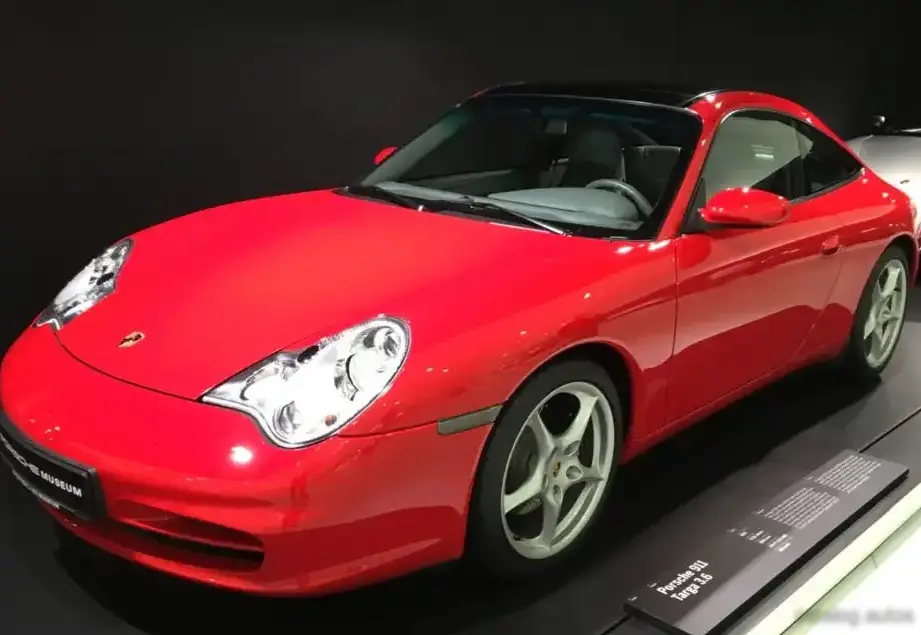
The Porsche 911 Targa (996) with the 3.6-liter engine producing 320 horsepower and paired with the Tiptronic S automatic transmission represents a significant iteration of Porsche’s iconic sports car. Produced from 2002 to 2005, this variant occupied a middle ground within the 996.2 facelift range, offering a blend of performance and convenience. It aimed to provide a more accessible entry point into the 911 experience compared to the track-focused Carrera models or the more expensive Turbo variants, while still delivering the open-air driving experience synonymous with the Targa nameplate. This generation marked a departure from air-cooled engines and a move towards more modern technology, though it remains a subject of debate among Porsche enthusiasts regarding its water-cooled engine and initial build quality concerns.
Technical Specifications
| Brand | Porsche |
| Model | 911 |
| Generation | 911 Targa (996, facelift 2001) |
| Type (Engine) | 3.6 (320 Hp) Tiptronic S |
| Start of production | 2002 |
| End of production | 2005 |
| Powertrain Architecture | Internal Combustion engine |
| Body type | Targa |
| Seats | 4 |
| Doors | 2 |
| Fuel consumption (economy) – urban | 16.9 l/100 km (13.9 US mpg, 16.7 UK mpg, 5.9 km/l) |
| Fuel consumption (economy) – extra urban | 8.1 l/100 km (29 US mpg, 34.9 UK mpg, 12.3 km/l) |
| Fuel consumption (economy) – combined | 11.3 l/100 km (20.8 US mpg, 25 UK mpg, 8.8 km/l) |
| CO2 emissions | 274 g/km |
| Fuel Type | Petrol (Gasoline) |
| Acceleration 0 – 100 km/h | 5.7 sec |
| Acceleration 0 – 62 mph | 5.7 sec |
| Acceleration 0 – 60 mph | 5.4 sec |
| Maximum speed | 280 km/h (173.98 mph) |
| Weight-to-power ratio | 4.7 kg/Hp, 214 Hp/tonne |
| Weight-to-torque ratio | 4 kg/Nm, 247.5 Nm/tonne |
| Power | 320 Hp @ 6800 rpm |
| Power per litre | 89 Hp/l |
| Torque | 370 Nm @ 4250 rpm (272.9 lb.-ft. @ 4250 rpm) |
| Engine layout | Rear, Longitudinal |
| Engine Model/Code | M96.05 |
| Engine displacement | 3596 cm3 (219.44 cu. in.) |
| Number of cylinders | 6 |
| Engine configuration | Boxer |
| Compression ratio | 11.3:1 |
| Number of valves per cylinder | 4 |
| Fuel injection system | Multi-port manifold injection |
| Engine aspiration | Naturally aspirated engine |
| Engine oil capacity | 8.8 l (9.3 US qt, 7.74 UK qt) |
| Coolant | 31 l (32.76 US qt, 27.28 UK qt) |
| Kerb Weight | 1495 kg (3295.91 lbs) |
| Max. weight | 1900 kg (4188.78 lbs) |
| Max load | 405 kg (892.87 lbs) |
| Trunk (boot) space – maximum | 130 l (4.59 cu. ft.) |
| Fuel tank capacity | 64 l (16.91 US gal, 14.08 UK gal) |
| Length | 4430 mm (174.41 in) |
| Width | 1770 mm (69.69 in) |
| Height | 1305 mm (51.38 in) |
| Wheelbase | 2350 mm (92.52 in) |
| Drivetrain Architecture | The Internal combustion engine (ICE) drives the rear wheels of the vehicle. |
| Drive wheel | Rear wheel drive |
| Number of gears and type of gearbox | 5 gears, automatic transmission Tiptronic S |
| Front suspension | Independent type McPherson |
| Rear suspension | Independent multi-link suspension |
| Front brakes | Ventilated discs |
| Rear brakes | Ventilated discs |
| Assisting systems | ABS (Anti-lock braking system) |
| Steering type | Steering rack and pinion |
| Power steering | Hydraulic Steering |
| Tires size | 205/50 R17; 255/40 R17 |
| Wheel rims size | 7J x 17; 9J x 17 |
Powertrain & Engine Architecture
At the heart of the 996.2 Targa lies the M96.05 3.6-liter flat-six engine. This engine, a significant upgrade over the earlier 996 models, featured improved cylinder heads, revised intake and exhaust systems, and a strengthened intermediate shaft to address concerns about IMS bearing failure – a common issue in earlier 996s. The engine utilizes a multi-port fuel injection system, delivering fuel directly into the intake ports. The valvetrain employs four valves per cylinder, contributing to the engine’s high-revving nature and power output. The Tiptronic S transmission is a five-speed automatic with manual shift capability. It offered smoother shifts and quicker response times compared to the standard Tiptronic, but still didn’t quite match the engagement of a traditional manual gearbox. The transmission features adaptive shift programming, adjusting shift points based on driving style.
Driving Characteristics
The 320 hp and 272 lb-ft of torque delivered by the M96.05 engine, coupled with the Tiptronic S transmission, provided a respectable, though not overwhelming, driving experience. Acceleration from 0-60 mph took around 5.4 seconds, making it quicker than the base Carrera but slower than the Carrera S or Turbo models. The Tiptronic S transmission, while convenient, did introduce some power loss compared to the six-speed manual. Gear ratios were optimized for a balance of acceleration and cruising efficiency. The engine felt responsive, with peak torque available at 4250 rpm, providing ample power for everyday driving and spirited weekend excursions. However, drivers seeking a more visceral and engaging experience often preferred the manual transmission for its direct connection to the engine.
Equipment & Trim Levels
The 911 Targa 3.6 Tiptronic S came standard with a relatively well-equipped interior. Standard features included leather upholstery, power-adjustable seats, automatic climate control, a Bose sound system, and a retractable glass roof panel – the defining feature of the Targa. Optional extras were plentiful, allowing buyers to customize their vehicles. Popular options included sport seats, navigation system, heated seats, and various interior trim packages. The Targa model generally sat in the mid-range of the 996 lineup, offering a more luxurious and comfortable experience than the base Carrera but lacking the outright performance of the S or Turbo models.
Chassis & Braking
The 996 Targa utilized a fully independent suspension system, with McPherson struts at the front and a multi-link setup at the rear. This provided a comfortable ride while maintaining excellent handling characteristics. The braking system consisted of ventilated discs on all four wheels, providing ample stopping power. ABS (Anti-lock Braking System) was standard. The Targa’s chassis was tuned to balance performance and comfort, making it a capable and enjoyable car to drive on both the road and the track. Stabilizer bars were used front and rear to reduce body roll during cornering.
Market Reception & Comparison
The 911 Targa 3.6 Tiptronic S received mixed reviews from automotive critics. While praised for its comfortable ride, stylish design, and open-air driving experience, it was often criticized for the Tiptronic S transmission’s lack of engagement and the engine’s relatively modest power output compared to other 996 variants. Fuel economy was also a concern, with combined fuel consumption averaging around 20.8 US mpg. Compared to the manual Carrera, the Tiptronic S version offered less driver involvement but greater convenience. Compared to the Carrera S, it lacked the extra power and performance. However, it offered a more affordable entry point into the 911 world.
Legacy
The 996 Targa 3.6 Tiptronic S has become a relatively affordable entry point into Porsche ownership in the used car market. While the early 996 models were plagued by IMS bearing issues, the 996.2 facelift models, including the Targa, benefited from improvements to address this problem. However, potential buyers should still have the IMS bearing inspected by a qualified mechanic. Overall, the 996 Targa 3.6 Tiptronic S remains a stylish and capable sports car that offers a unique blend of performance, comfort, and open-air driving enjoyment. Its relative affordability and iconic design have ensured its continued popularity among Porsche enthusiasts.